Extracting knowledge from web is an important
NLP problem. Since any information worthwhile is mostly of
the SPO (Subject, Predicate and Object) form, we will be aiming
to extract such tuples from the huge web data available today.
We also aim to build a query module that can search for the
most relevant tuple and return it. The framework involves three
main modules: A relation extractor, Learning Module and a Query Module.
Dependency graph obtained from the Stanford
parser is used to extract the tuples. An SVM is trained to learn
to distinguish trustworthy tuples from the non-trustworthy to
reduce the computational complexity involved in using a parser
on each and every sentence. The classifier also helps in removal
of noise which crept in due to the parser. Similar tuples are
grouped together for obtaining a frequency count. During the
query process, all the tuples with certain amount of overlap with
the query are returned and ranked according to their relevance
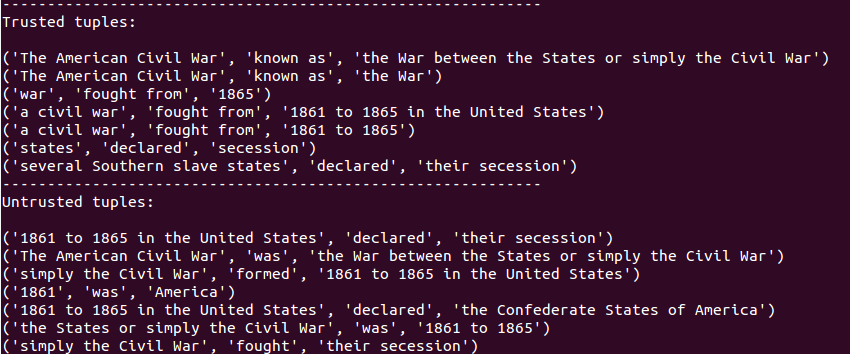
to the query. Some tuples extracted by the "relation exractor" module for input sentence "The American Civil War, also known as the War between the States or simply the Civil War, was a civil war fought from 1861 to 1865 in the United States after several Southern slave states declared their secession and formed the Confederate States of America":Abstract:
Some of the trsutworthy tuples identified by the classifier after training on the AIMed corpus with 1955 sentences from MEDLINE ab- stracts annotated with gene/protein names and protein-protein interactions:
('Injections', 'transmit', 'infections')
('green tea', 'had', 'significant chemopreventive effects')
('zinc deficiency', 'affects', 'cognitive development')
('Exposure to paclitaxel for 8 h or less', 'produced', 'biphasic survival curves')
('a low fat diet', 'reduces', 'DDT bioaccumulation')
('Raman', 'comprised', 'a near infrared laser')
('asthmatic patients', 'contained', 'high levels of IgE antibody')
('poxvirus', 'causes', 'tumors')
('The gastrointestinal tract of numerous animal species', 'contains', 'melatonin')
('osteoblasts', 'secrete', 'the primary endocrine source')
('A58', 'disrupts', 'reverse transcription')
('PPAR alpha agonists', 'repress', 'human fibrinogen gene expression')
('Human coronary artery', 'expressed', 'MCP-1 mRNA')
('dihydropyrimidine dehydrogenase', 'affect', 'tumor sensitivity and resistance')
('the use of dexamethasone', 'reduce', 'delivery of chemotherapeutic agents')
('The beta-lactamase characterized from strain SLO74', 'named', 'OCH-1')
Some of the top results for the query WHAT energize kinases. Notice that the system returned tuples with 'stimulate' in the relation field because it's a synonym of 'energize':

Some of the top results for the query WHAT cause WHAT. Notice that the system returned tuples with 'induce', 'makes' and 'have' in the relation field because they are all synonyms of 'cause':

Documentation:
PROPOSAL PRESENTATION POSTER FINAL REPORT CODES