The literary mind
Mark Turner
Turner, Mark;
The literary mind
Oxford University Press, 1996, 187 pages
ISBN 0195104110, 9780195104110
topics: | language | origin | cognitive | storytelling
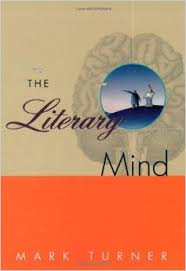
an interesting thesis - that stories - other people's lives - are interesting and informative because we can project them onto our lives, and thereby find guidance in some of our own quests. Parables [e.g. Chicken soup for the soul] are stories explicitly designed for this. The steps in this projection involve evaluation, planning, image schemas (structures where one action causes another, etc.), metonymy (things in stories stand for issues confrontiong us). now turner goes on to argue, such stories precede language, are precultural in some primitive sense of being able to understand (and maybe describe?) events, particularly spatial events that involve our bodies. stories thus constitute the foundation from which language - and grammar - arose.
provocative - but is it convincingly argued? there is some evidence presented, but i did not find it that convincing. After the first two chapters, the argument degenerates into a long list of metaphors of the Johnson and Lakoff variety - how our body patterns actions and manipulations and how such spatial aspects are projected onto abstractions (such as the mind as a container) to create metaphors and stories.
The chapter on how concepts are blended - e.g. the yacht _Great America II in 1993, is trying to race the clipper Northern Light_, which made the passage in 76 days, 8 hours, in 1853. This is a "blend" - where the spaces are not source and target, yet they are combined. All this is of some interest, but the main argument is more like a series of parables, they are plausible, but not a solid argument, perhaps.
i presume one should be impressed that mark turner reads homer in the original. but i found it disappointingly old européenne that even in long verse quotations, he should cite it in ancient greek.
Excerpts
from preface:

Story is a basic principle of mind. Most of our experience, our knowledge,
and our thinking is organized as stories. The mental scope of story is
magnified by projection — one story helps us make sense of another. The
projection of one story onto another is parable, a basic cognitive
principle that shows up everywhere...

We interpret every level of our experience by means of parable. In this book,
I investigate the mechanisms of parable. I explore technical details of the
brain sciences and the mind sciences that cast light on our use of parable as
we think, invent, plan, decide, reason, imagine, and persuade. I analyze the
activity of parable, inquire into its origin, speculate about its biological
and developmental bases, and demonstrate its range. In the final chapter, I
explore the possibility that language is not the source of parable but
instead its complex product.

Parable is the root of the human mind — of thinking, knowing, acting,
creating, and plausibly even of speaking. But the common view, firmly in
place for two and a half millennia, sees the everyday mind as unliterary
and the literary mind as optional.  This book is an attempt to show how
wrong the common view is and to replace it with a view of the mind that is
more scientific, more accurate, more inclusive, and more interesting, a
view that no longer misrepresents everyday thought and action as divorced
from the literary mind.
ch 1 : Bedtime with Shahrazad
But there is something odd here. The vizier does not say, "Look, daughter,
this is your current situation: You are comfortable, so comfortable that
you have the leisure to get interested in other people's problems. But if
you keep this up, you will end in pain." Instead, he says, "Once upon a
time there was a comfortable donkey who got interested in the problems of
the ox. The donkey, who thought he was the sharpest thing ever, gave some
clever advice to the dullard ox. It worked amazingly well, at least for the
ox, but it had unfortunate consequences for the donkey. Before you know it,
the ox was lolling about in the hay of contentment while the donkey was
sweating and groaning at the ox's labor."

The vizier presents one story that projects to another story whose
principal character is Shahrazad. We, and Shahrazad, are to understand the
possible future story of Shahrazad by projecting onto it the story of the
ox and the donkey.  The punch line is that Shahrazad is the donkey. This
projection of one story onto another may seem exotic and literary, and it
is — but it is also, like story, a fundamental instrument of the
mind. Rational capacities depend upon it. It is a literary capacity
indispensable to human cognition generally. This is the second way in which
the human mind is essentially literary.
Image schemas
How do we recognize objects, events, and stories? Part of the answer has to
do with "image schemas." Mark Johnson and Leonard Talmy—followed more
recently by Claudia Brugman, Eve Sweetser, George Lakoff, Ronald Langacker,
me, and many others—have analyzed linguistic evidence for the existence of
image schemas. Image schemas are skeletal patterns that recur in our sensory
and motor experience. Motion along a path, bounded interior, balance, and
symmetry are typical image schemas.

Consider the image schema container. Like all image schemas, it is minimal.
It has three parts: an interior, an exterior, and a boundary that separates
them. We experience many things as containers: a bottle, a bag, a cup, a car,
a mountain valley, rooms, houses, cupboards, boxes, chests, and drawers. Two
of our most important containers are our heads and our bodies.
Blended spaces and Logical proof
Structure that is developed in a blended space can change our view of the
input spaces, as in the following riddle, which Arthur Koestler attributed to
psychologist Carl Dunker:

	A Buddhist monk begins at dawn to walk up a mountain. He stops and
	starts and varies his pace as he pleases, and reaches the mountaintop
	at sunset. There he meditates overnight. At dawn, he begins to walk
	back down, again moving as he pleases. He reaches the foot of the
	mountain at sunset. Prove that there is a place on the path that he
	occupies at the same hour of the day on the two separate journeys.

The reader might pause here to try to solve the riddle before reading
further.  It can be solved ingeniously by imagining the Buddhist monk walking
up as his double walks down on the same day. In that blended space, it is
clear that there is a place on the path that the two Buddhist monks occupy at
the same hour of the day: The place is where he meets himself.

This inference, that there must be a place that the two travelers inhabit at
the same time of day, is projected from the blend back to the input spaces to
create a point of connection between the input spaces of the two journeys,
although no encounter occurs in either of them.

Interestingly, people who count this blend as supplying a proof often cannot
supply an alternative proof that does not make use of the blend. p.72
Send your jottings to Book Excerptise
to contribute some excerpts from your favourite book to
book
excerptise. send us a plain text file with
page-numbered extracts from your favourite book. You can preface your
extracts with a short review.
email to (bookexcerptise [at] gmail [dot] com).
bookexcerptise is maintained by a small group of editors. comments are always welcome at bookexcerptise [at] gmail. This article last updated on : 2014 Apr 19