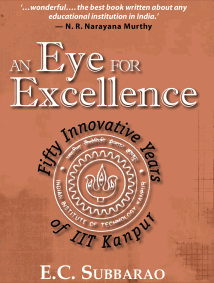
An Eye for Excellence: Fifty innovative years of IIT Kanpur
E.C. Subbarao
Subbarao, E.C.;
An Eye for Excellence: Fifty innovative years of IIT Kanpur
Harper Collins 2008 Rs. 595
ISBN 9788172237691
topics: | iit | india | history | education
Review
ECS Subbarao, who taught Metallurgy at IITK from 1963 to 1981, presents an useful compendium of facts and anecdotes about IIT Kanpur, which everyone associated with the institute, past or present, may like to read. However, the style may be too reverential, and the writing flits from topic to topic, failing to construct a meaningful narrative, let alone rouse any passion. The almost hagiographical narrative follows the origins (ch.1-4) and lists the many achievemeents of noted alumnus as well as faculty (ch. 5-6).
The most effective chapters may be the ones dealing with the pioneering contributions of IITK, particularly the history of computer science education (ch.7). The chapter on the faculty is illuminated by long excerpts from early pioneers - D. Balasubramanian, Amitabha Ghosh, Usha Kumar, and many others, often touching on the strong traditions of music on campus... Later, it touches upon a bleak period in the 70s (ch.8) before striking the highs again (ch.9-10).
On the whole the verdict is a strong endorsement for everything that is IITK; indeed, there is almost no significant critique of any of the policy decisions nor any significant suggestions for the future. At one point, Subbarao quotes ex-IITK professor P.C. Kapur: "sometimes it is necessary to take a contrarian view in order to impart a semblance of balance and realism." However, he fails to follow this advice himself.
     In the '60s, A number of faculty from several US universities came
     under to the institute under the Kanpur Indo-American Programme.
     Harry Huskey of UC Berkeley helped foment interest in computers, and
     organized an international workshop on computation in 1964.  Here is
     Clay Perry of UCSD, on an elephant excursion.
	  (image from stanford: http://infolab.stanford.edu/pub/gio/personal/1965India/Khajaraho/index.html)
     The chapter on computer education may be the most effective part of
     the book.
Flaws in the vision?
The contrarian view from P.C. Kapur provokes more thought about IIT Kanpur
than much else in the book, coming as it does during a discussion of the
70s, when labour problems and a troublesome power-struggle between
the director and the BOG chairman caused a partial "eclipse":

   In the final analysis, there was a fundamental flaw in the vision
   underlying IITK, namely, an ivory tower, resplendent in its splendid
   isolation, which was to shine like a beacon of scholarly pursuit and
   knowledge.  In reality, it turned out to be an alien entity implanted in
   the middle of what was, even by Indian standards, a particularly backward
   and reactionary context with which it was organically linked in numerous
   ways. p.289 (for rest of PC Kapur's comment, see below)

Given the devastating nature of this critique, perhaps it deserved a comment
from the author - but it is simply mentioned in passing.

The PC Kapur quotation set me thinking - is IITK indeed an alien entity,
implanted onto a recalcitrant countryside?  I can reconcile with this view
for the early years, when villagers would crowd around to see the newly
installed elevators whisking people up the floors, and dacoits would raid
faculty residences, even shooting one professor in the eye (I happened to
stay for some years in the house where this is reputed to have happened).
In that atmosphere, IITK may have indeed have seemed like an alien entity.

If IIT was an alien entity, perhaps the 70s, when a large group of workers
brought the institute to a halt, with the active co-operation of some
well-respected faculty and students, perhaps that was not so much an
"eclipse", as a self-correction?  After all, elite institutions from
Berkeley to Cambridge have been known for their stance on any number of
social issues, and IIT Kanpur could perhaps be proud of such moments.
"Being alien": Is it all negative?
On the other hand, being alien was perhaps part of the objective of IIT
Kanpur.  One could even argue that if today, it feels less alien, that may
be partly because of modernizations that reflect the visions that underlie
the founding of IIT Kanpur.

But are the problems for IIT over?  Nowhere in the book do you feel that the
IIT system today might be facing problems.  Yet there is increasing disquiet
within the system, and the challenges are many.  There is increasing
interference by the government (for the first time, an MHRD bureaucrat is
sitting on the IITK Board of Governors, and the board is where
the rot started at AIIMS).  Academically, too many students are
completely apathetic and postgraduate programmes are mediocre, while
politically mandated student intake policies play havoc with the system.

The last chapter (Road ahead) attempts to present a vision for the future.
Unfortunately, this is merely a rehashing of the well-known problems with
the JEE and the PhD program.  Also, it fails to address fundamental issues
where IIT can actually make a difference - e.g. how in the UG program, the
set of disciplines have become increasingly irrelevant for the vast majority
of students.  Unlike academic institutions abroad, no department in India
can ever close because of lack of demand, and successive batches of
students find themselves imprisoned in futile courses of study, ramping up
frustration levels among the student body.

For a more critical, and in part humorous view, see Shashi Gulhati's
The IITs : Slumping or Soaring, which includes a peek into a
directorial interview at the Minister's office, where he comments on the
extent to which IIT directors have become subservient to MHRD
bureaucrats.   Rohit Manchanda's Monastery, sanctuary, laboratory
history of IIT Bombay is a far more pleasant read, highlighting the human
side with anecdotes, a far cry from the barren official history served here.

Nonetheless, it is clear that Prof. Subbarao has done his homework well, and
An Eye for Excellence remains an useful compendium of important facets in
the history of IIT Kanpur. But calling it an "Imperative addition to any
avid techie's shelf" (Hindu) is surely going too far.

Much of the following excerpts were typed in as I read this book in a
three-hour sitting at the IITK stall at Pan-IIT in January...
Excerpts / Summary
Ch.1: Genesis: Founding, Collaborations
The idea of a need for technical education - Sir Ardeshir Dalal, ex-ICS and
director at TISCO - vision of world class engineers / research facilities.
Setting up of TIFR under Homi Bhaba, CSIR under SS Bhatnagar, and sending
batches of Indian scholars on govt scholarships to US and European
universities.
  [About Ardeshir: "there is an indefinable atmosphere of preciseness about
  him. Even his cheroot seems trained to scatter its ashes in the ashtray.
	- Tata archives

First engg colleges in India:
      1794: Guindy
      1847: Roorkee
      1854: Poona
      1856: Shibpur

[However, the curriculum and objectives of many of these varied depending
on the needs of the E.I. Co or the British government.  For example,
initially, Roorkee trained only "overseers", and even then
Indians were not admitted for the first two decades (till 1865) but then
in 1869 all engg hiring for India was shifted to the Cooper's Hill College
in England, which adopted its syllabi from Roorkee.  It was not until 1909
that engineering education resumed at Roorkee. see Mital, History of Roorkee,
2008]
IIT Kanpur: recommended for "Hydraulic engineering"
In the Sarkar committee interim report (there was never a final one) Kanpur
was recommended for "hydraulic engineering" apparently because of the
"irrigation potential" in the area.  [Notably, the site was chosen next to
the Lower Ganges canal, which is perhaps the least exploited natural
resource on campus.]

The idea of collaborating with leading foreign universities was that of
Dr. Humayun Kabir.  The handshaking countries/ bodies:
	Kgp '50 UNESCO, US UK Germany  [BC Roy offered an old jail to house
			it, inaugr 18 Aug 1951]
	Bom '58 USSR (UNESCO)
	Mad '59 Germany
	Kan '59 USA [under USAID: JFK letter to Nehru 1961]
	Del '63 UK  [after act of parliament; converted from Coll of Engg under DU]
Is expansion of IITs desirable?
existing IITs should be strengthened first.
  [a sudden comparison to Takshila, where "10,500 students from all over the world studied
  more than 60 subjects estd 700 BC, and Nalanda, built 4th c. BC", p.6]

CBS 60 minutes on IITs, 2003:
Leslie Stahl, co-host: IIT is "the most important university you never heard
   of".  Put Harvard, MIT and Princeton together, and you begin to get an idea
   of the status of these schools in India.  p.9

In initial years, CMs of states often headed the board of governors - e.g. BC
Roy of WB at IITkgp, S. Sampurnanand and CB Gupta of UP at IITK, etc.

Fig 1.3 peacock at faculty (type 6) house - v. poor image - can't see peacock
	head!  also - no photographer credits for almost all the images.
Ch2: Kelkar: A visionary (1909-1990)
     diploma Elec Engg 33 IISc; phd Liverpool 37;
     planning officer for IITB 56; dy dir 58
     diro IITK 59-74
p.19-21:
Kelkar himself says he was "a mere creature of time, chosen perchance to
     become an agent of change."

the book is full of paeans to Kelkar:
      Subtlety and sensitivity with which he made others feel... that they
      were in the driver's seat. e.g. at IITJEE, the faculty member even if an
      assistant prof, would take decisions themselves (at other IITs they often
      consulted the director.) [? this is an elected post at kgp - and a
      prestigious one - i wonder if it has a history of conflict behind it...]
	He also gave the support staff a sense of involvement and pride in their
      work.

     PC Kapur: But it was his value system - simplicity, patience, commitment
     to excellence, humane and caring nature - that made him a legend in his
     own lifetime.

Prof. S. Ranganathan: "When we came [to IITK] on that bleak day in Dec 59..
     there was little room for optimism.  Yet [Kelkar] chose to light the
     candle rather than curse the darkness and today it is a source of
     great satisfaction to all of us" [senate condolence mtg 90]
Ch.3: Realizing a vision
The faculty recruitment process, based on prior interactions with the
candidate, and subsequent validation by a selection committee, appears to
have been devised by Kelkar and GK Chandirmani, secy, Min. of Education; but
the same process is now in place at all IITs.  However, instituting these
changes in the prevailing bureaucratic atmosphere was no mean task, and
Kelkar refers to it in a convocation speech a decade after leaving IITK:

	No institution in this country set up by or aided by the government can
	avoid working under the shadow of bureaucracy ...  at the time of
	discussion [the bureaucrat] assumes unwittingly the role of the
	interpreter who can give the 'authorized version' of how best the
	Institute can achieve the objectives set for it by the government. One
	has to concede that this is a terrible dilemma which any institution
	could face... IIT Kanpur was very fortunate. We found in Mr. G K
	Chandiramani a very sympathetic official who almost bent backwards to
	set aside for a while the bureaucratic approach.
		- http://www.iitk.ac.in/infocell/iitk/history/extracts.html

The curriculum and particularly the relative, letter-based grading, novel
for India at the time, clearly bore the stamp of KIAP influence.  Also, the
insistence on strict deadlines for turning in the grades, and showing
end-semester copies to the students - all these were a break from university
practice.


IITK Seal designed in 1965 - VG Stokes' role in suggesting it
Sampurnanand - CM of UP and chairman BOG - suggested "trinetra" -
     third eye of shiva - to repr knowledge.  Prof Kastagir, of an arts
     college in LKO - sugg embedding it in a trishul.  Stokes personally
     drew up and hand lettered a 15" seal using a font as in Roman
     engravings.  24-toothed gear - technology working round the clock.
     [this chapter is silent on the US profs - perhaps their role in the
     curriculum etc shd have been discussed w some anecdotes?]
Ch.4 American connection
     I am delighted that 9 major ctrs of learning have been willing to pool
     their resources in coopern with USAID: JFK to Nehru 1961
     would lead to the Kanpur Indo-American Programme (KIAP)

1961: Kelkar and Chandiramani (jt edu advsr GoI), together w Norman Dahl
of MIT - toured 9 consortium univs to discuss modes of interaction.

EC Subbarao was then at Westinghouse labs (directed by C Zener (of Zener
     diode fame).  Had not heard of IITK or Kelkar, but was impressed; later
     Kelkar wrote long letter urging ECS to join, and he did following his
     wife's wishes.

KIAP: Nov 1961 meeting at Nehru's office.
      120 fac mems visited over ten years (1966 review): p.58
Recommendations of 1966 Review committee
This committee was headed by Richard Teare of CMU, made a number of
suggestions:
  Faculty
     no tenure system: since confirmation at end of 1 year - hence close
     scrutiny needed at hiring point itself.
  Students:
	batch selection: was too early - rules for branch change shd be
	relaxed
  Curriculumm: leaned towards theory - real applications of engg deserved
  	more attn
  R&D: more interdiscipl research and equipment sharing

Interestingly, even fifty years down, these very points remain some of the
unaddressed weaknesses in the IIT structure.

Indo-pak war 1971 soured Indo-US relations - last KIAP prof JG Fox of CMU
left 72.  His summary p.59:
   UG students: world class, compared favourably w best students anywhere.
   PG : not top class
   faculty: young faculty were more democratic and willing to argue w senior
	 profs which was new for india.  many were US trained. IITK managed to
	 attract good faculty.
   support staff: quality was poor and not adequate

Norman Dahl - first honorary doctorate of IITK.  1967
Morarji Desai - 2nd (1967)
PK Kelkar - 3d, 1981
	  [incidentally, the 4th was APJ Abdul Kalam, 2000]
ch.5: Alumnus. "They traverse only the path of glory"
       (longest chapter p. 68-146)

Narayan Murthy MT/EE 69
Mohan Tambe BT/ee/80; MT/cse/82:
Satish Kaura BT/ee/66 - BTP guide - KR Sarma
J.A. Sekhar BT/MME/77 - DMRL Hyd after MS Phd UIUC
Abhay Bhushan BT/ee/65 - ARPAnet / Email pioneer as part of Media Access Control
      project (MAC); several startups --> TiE/ IndUS
Umang Gupta: BT/ChE/71: SQL standard; Gupta corpor
Ashish Gupta BT/CSE/88: Junglee
ESP Das MT/MSP67
Som Mittal BT/MME73
BN Singh MT/MME70
Muktesh Pant BT/Che76
Saurabh Srivastava BT/ME68
Sanjay Mittal bt/ee75
Jeet Bindra Chevron bt/che69
Pradeep sindhu juniper bt/ee74
Md Zaidi - aluminium car bt/mme75 - btp guide AK Jena
Rajendra Singh bt/ee75
ramamritham ramkumar - modular furniture bt/mme/70
arindam bose: bt/che/75
...
M Agarwal
Ashutosh Sharma
SP Mehrotra
AK Mallick
Ashok Jhunjhunwala
Ch.6: Faculty: The Dronacharyas
CNR Rao - long paean
TV Ramakrishnan - condensed matter theory - married a quiet grad student,
   Meera
Amitabha Ghosh
PC Kapur
D. Balasubramanian Padma Shri
Usha Kumar - psych
P Dayaratnam
Dipankar Chakravorty
KR Sarma
KS Gandhi - polymer reactions
S. Sunder Manoharan Chem
GS Upadhyaya
P Venkateswarly - physical spectrum
D. Ramakrishna - population balance
V Stokes - long writeup
J Mohanty - condensed matter
MA Pai - praises faculty freedom at IITK p. 211
Yogesh Jaluria - flow
PT Narasimhan
Ch.7: 1963: Bullock cart marries the computer
This is one of the more interesting and important chapters in the book. Computer Science education heads the list of "Pioneering activities". 1963: First solid state computer : IMB-1620 [after prolonged discussions with IBM about the sale of the computer, the deal coming through with the combined efforts of Kelkar, Norman Dahl (first leader of KIAP), and G. K. Chandiramani in the Ministry of Education. The computer was flown into Chakeri on an US plane by an US pilot. It was then transferred to a bullock cart for the journey to IITK. Finally, some 200 hands carried it into its designated venue. (photo) p. 232The IBM-1620 computer, obtained after tortuous negotiations, being carried into the still-under-construction Computer Center in 1963. The figure hurrying to the left in the foreground is Prof. Harry Huskey of UC Berkeley. 1966: IBM-7044 - came to a special building. Later the 1401, IBM-1800, PDP, TDC-316, and then the DEC-1090. 1967: TA 306 course: covering programming, numerical techniques and analog computing w a 3 hour lab session became compulsory for all engg UGs. 1967: CS option for MTech and PhD students in EE. 1968: First PhD's in CS: Muthukrishnan (started CS at IITM) and PCP Bhatt (started CS at IITD) 1971: separate CS program with convenor. Entire first batch of Mtech recruited by TCS ("a rare achievement" - why?) 1978: First BTech program in CS in India - first graduates in 1983. [But this may not be true. Apparently it was started at Allahabad by Jagdish Lal who was acting director 1974-76, and started it there after returning.] TRDDC connections: Keshav Nori, Sanjeev Agarwal, Gautam Shroff. Other pioneering activities: * Material Science education: 1966: A two day conference at IITK on materials 1976: ACMS * Chemistry - headed by the Trimurthi (first three heads): CNR Rao, PT Narasimhan, and MV George. * PK Kelkar Library * Aeronautical Engg * Nuclear Engg & Technology * Student Counselling Service - initiated by Kelkar as early as 1964, headed by KK Singh of Psychology. Coordinated pre-arrival information, choosing room-mates, etc. Re: ragging, ECS remarks that the main goal, becoming introduced to the seniors, took the form of "quizzes and entertainment" p. 271
First computer on a bullock-cart
review by D. Murali in the Hindu
http://www.thehindubusinessline.com/todays-paper/tp-eworld/article1084130.ece

[Several reviews focus on this chapter, which indeed is one of the proud
achievements in the saga of IIT Kanpur. ]

Of the many firsts credited to IITK in India, computer science education tops
the list, writes E. C. Subbarao in An Eye for Excellence: Fifty innovative
years of IIT Kanpur ( www.harpercollins.co.in).

The story begins in 1963 with the arrival of the first solid-state computer
(IBM-1620) in an educational institution in India, the author narrates. This
was after prolonged discussions with IBM about the sale of the computer, the
deal coming through with the combined efforts of Dr P.K. Kelkar (IITK founder
director), Professor Normal Dahl (first leader of KIAP or Kanpur
Indo-American Programme), and G. K. Chandiramani in the Ministry of
Education, adds Subbarao.

He recounts with verve the saga, right from the bold plan of the EDC
(Educational Development Centre) to charter a plane from Washington DC to
Kanpur to transport the computer, through the ‘behind-the-scenes work’
involved in getting an American pilot to land on Indian Air Force airstrip in
Chakeri near Kanpur, to reaching the computer to the campus on a bullock-cart
fitted with inflated rubber tyres in the place of the age-old iron-ringed
wooden wheels to traverse the bumpy, potholed road.

A not-to-miss photograph in the chapter is of ‘about 200 hands carrying the
most modern computer in India from the bullock-cart into the computer centre
at IITK,’ with Professor Harry Huskey of the University of California
supervising the exercise.

“The computer was installed and made functional in an amazingly short
time. Soon it became clear that the computer, an icon of the twentieth
century, provided a facility that had no parallel in relation to any other
expensive piece of equipment. Its compelling power and hold over the minds of
the faculty, researchers and undergraduates was unprecedented. There was no
better facility for generating a scientific and quantitative attitude of
mind,” the author describes.

In the early years, IITK had two goals for computer activity: one, to impart
computer education to all students irrespective of their discipline, and two,
to increase computer awareness among potential users such as the government,
industry, education, and R&D.

“The computer was used 24 hours a day, 365 days of the year by students,
faculty and outside users. In addition, ten-day intensive courses in
programming, numerical techniques and basic computer logic were offered four
times a year, each time with 75 participants from defence and CSIR
laboratories, other educational institutions and industrial
establishments. This was continued for the next seven years...”
Ch.8: Eclipse
1970-1980: difficult times for IITK.  teaching did not suffer as much as
	research.  Many faculty moved to other institutions.  Table 7.3 shows
	period of no award etc - argely from end 70s to end 90s.

Unskilled staff: were many and had no career advancement paths.  Karmachari
	Sangh - strikes in 1971 and 72.  Worsened in the emergency years.
1973/1976 - Karamchari Sangh split into factions.
1979: 2 day strike

1970 - Kelkar leaves for IITB, and M.S. Muthana, who was dy-D, becomes
	director.  Was extremely devoted to the institute.
Chairman vs Director: Hussein Zaheer and Muthana
Minsitry appoints Hussein Zaheer as chairman of Board - felt that director
	was not being able to handle the worker problem, and moved on campus
	(VH) to deal with it himself.  Decided to take all 500 temporary
	workers into the regular instt payroll.  Resulted in ~ 2000 support
	staff for 280 faculty.

~ 1970: A faculty member suspended "allegedly due to undesirable political
	activity on campus." (by Muthana) Faculty forum formed to evolve code
	of conduct for themselves.  It sought and arranged an election of two
	elected senate nominees to become member of the BOG.

Rift with employees healed only in the 80s with Prof Sampath as director,
"patient hearing and smooth talking" provided "a healing touch".  p. 287

Directors of IITK:				Board of Governors Chairmen

1. PK Kelkar 1959-1970  			Dr Sampurnanand 1959-1960
2. MS Muthana 1970-1974  			CB Gupta 1960-1965
3. Jagdish Lal (acting) 1974-1976		Padampat Sinhania 1965-1971
4. A Bhattacharya 1976-1980			S Hussain Zaheer 1971-1974
5. P. Venkateswarlu (acting) 1980-1981  	ML Dhar 1975-1978
6. S. Sampath 1981-1986 			LM Thapar 1978-1980
7. AK Mallik 1986-1991  			RN Dogra 1980-1985
8. RC Malhotra 1992-1997			Ashok Ganguly 1985-1990
9. KA Padmanabhan 1997-01			Subrata Ganguly 1990-1993
10 SG Dhande 2001-  				Govind Hari Singhania 1994-1997
11 Indranil Manna 2012-  			HS Bhartiya 1997-2003
						CNR Rao 2003-2006
						M Anandakrishnan 2006-2015
PC Kapur on IIT
27 year veteran faculty (MME), PC Kapur:

   The unpalatable fact is that the institute failed, and failed
   demonstrably, in the maintenance of physical assets, the inculcation of
   excellence in faculty as a norm rather than an exception, the preservation
   of high standards in the PG programme and in research, esp in experimental
   research, that is readily visible in refereed journals of repute, patents,
   marketable technologies. ...

   In the final analysis, there was a fundamental flaw in the vision
   underlying IITK, namely, an ivory tower, resplendent in its splendid
   isolation, which was to shine like a beacon of scholarly pursuit and
   knowledge.  In reality, it turned out to be an alien entity implanted in
   the middle of what was, even by Indian standards, a particularly backward
   and reactionary context with which it was organically linked in numerous
   ways.

   I am conscious that readers will accuse me of a one-sided recollection of
   IITK.  I urge them not to forget that sometimes it is necessary to take a
   contrarian view in order to impart a semblance of balance and realism.
   ... It is not what IITK has accomplished, but what it could have
   accomplished in happier circumstances, that make me cry for the beloved
   institute.   [no source given] p. 289-290
Ch.9 beginning of a new renaissance
degrees awarded table - going up
alumni donations
ambience - improved (significantly)
Ch. 10: Road ahead
: coaching effects- exhaustion, exams, but not able to think, no school
  	   learning other than math phys chem, diff following engl lectures
JEE reforms 2006 based on CNR Rao committee sugg 2004
    [CNR Rao appears on 24 pages, the most frequently mentioned
    person after Kelkar. ]
PG students
Faculty
R&D
Phd students
Summary
It is a hard slog to actually read the book, given the propagandist tenor.
For instance, it can be rather wearying, at the end of a host of banal
remarks about the future, to come to this concluding sentence:
    The next five years can be fruitfully utilized under the leadership of
    the chairmen, board of governors, professors CNR Rao and
    M. Anandakrishnan, two of the original key pacesetters of IITK, and
    alumnus director Sanjay Dhande, to prepare for an illustrious second
    half-century of this great institution to firmly occupy its rightful
    place among the elite academia of the world.

On the whole, reasonable content especially for the early years, but rather
colourless; but valuable if you are particularly interested in IIT Kanpur.
Contents
I. The genesis
   1. The IIT System-the Pinnacle
   2. The Sarkar Committee-The Guiding Light
   3. The Original Five IITs-Pentagon
   4. Expansion of IITs-Is It Desirable?
   5. The Original Visionaries
   6. Origins of I IT Kanpur-Birth of a Star

II. A visionary [P.K. Kelkar: (1909-1990)]
   1. The Life of a Visionary
   2. Personality-An Unobtrusive Guide
   3. Honours-Recognition of Efforts
   4. Reflections

III. Realizing a vision
   1. Students-Empowering Young Minds
   2. Faculty-Catalysts for Students' Success
   3. Academic Governance-Showing the Path
   4. Academic Administration-Wheels of Motion
   5. Curriculum -Timely Fine Tuning
   6. Instruction-Transmission of Knowledge
   7. Grading-Breakaway from Tradition
   8. Postgraduate Programme-New Pathways
   9. Convocation-The Crowning Glory

IV. The American connection
   1. Introduction
   2. A New Model-Innovation
   3. Birth of a Consortium-a Novel Idea
   4. Meeting of Minds-Communion
   5. Modalities and Contract-Sewing up the Details
   6. Functioning of the Collaboration-an Evolutionary Model
   7. Operational Interactions-A Positive Approach
   8. Mid-Point Assessment-Helpful Review
   9. The Transition-Reviewing the Performance
   10. Norman Dahl: His Assessment in 1972
   11. Epilogue
   12. US Congressional Recognition

V. Students-They traverse only the Path of glory
   1. Introduction
   2. Entrepreneurs-India
   3. Entrepreneurs-Abroad
   4. Industry Leaders-India
   5. Industry Leaders-Abroad
   6. Academia-India
   7. Academia-Abroad
   8. Research and Development-India
   9. Research and Development-Abroad
   10. Government Service-India
   11. Public Service-India
   12. Public Service-Abroad
   13. Brain Drain, Brain Bank and Brain Return
   14. Heads of Academic and Research Institutions-India
   15. US National Academy of Engineering and IITK
   16. Student and Alumni Activities

VI. Faculty-the dronacharyas
   1 Introduction
   2 Examples of Faculty Achievers
   3 Indian Intellectual Treasure of Knowledge (IITK)

VII. Pioneering activities-pathfinders on an untrodden road
   1. Computer Science Education
   2. Materials Science Education
   3. Chemistry-in Essence
   4. P.K. Kelkar Library
   5. Aeronautical Engineering
   6. Nuclear Engineering and Technology
   7. High-Level Summer Opportunities for Faculty in Industry
   8. Student Counselling Service
   9. Television Centre
   10. Schooling for Children

VIII. Eclipse
   1. Background
   2. Unskilled Staff
   3. Chairman, Board of Governors
   4. Successive Directors and Chairmen, Board of Governors
   5. Summing Up

IX. Beginning of a renaissance
   1. Introduction
   2. Students
   3. Faculty
   4. Alumni Donations
   5. Ambience

X. The road ahead -- bumpy or smooth? The choice is ours to make
   1. Undergraduate Students
   2. Postgraduate Students
   3. Faeulty
   4. Support Staff
   5. Research, Design and Development
   6. Equipment
   7. Other Concerns
   8. Planning for the Future
   9. Summing Up
List of Figures
1.1. Prime Minister Jawaharlal Nehru, the inspiration behind the Indian
	institutes of technology
1.2. IITs and the West-Global Bonding
1.3. A peacock at a faculty house
1.4. Dr S. Radhakrishnan, President of India, delivering the first IITK
	Convocation Address in October, 1965
1.5. Faculty building-interconnecting disciplines
1.6. Lecture Hall Complex
2.1. Dr P.K. Kelkar 16
3.1. IIT Kanpur Seal
4.1. President John F. Kennedy with Prime Minister Jawaharlal Nehru at the
	White House in Washington DC, 1961
4.2. Prime Minister Nehru meeting the KIAP group at his office in New Delhi
	in November, 1961
4.3. Three supporters of IITK : Prime Minister Indira Gandhi, Dr
	J.A. Stratton, president of MIT and later of Ford Foundation, and Dr
	David Knsminger, head of Ford Foundation, New Delhi
4.4. Professor Norman C. Dahl, first KIAP Leader, with Dr P.K. Kelkar at the
	temporary location of IIT in HBTI, Kanpur, 1962
5.1. The Samtel Centre for Display Technology at IITK
7.1. About 200 hands carrying the most modern computer in India (IBM-1620)
	from the bullock-cart into the computer centre at IITK in 1963
7.2. Prime Minister Indira Gandhi being shown the power of IHM -1620 by
	Professor H.K. Kesavan
7.3. Computer Science and Engineering Building
7.4. IITK Central Library
7.5. The author at the entrance to the PK. Kclkar Library
7.6. Prime Minister Indira Gandhi watching students producing a TV programme,
	with Professor H.K. Kesavan answering her inquisitive questions


review: http://nanopolitan.blogspot.in/2007/01/book-review-iits-slumping-or-soaring.html
bookexcerptise is maintained by a small group of editors. get in touch with us!
bookexcerptise [at] gmail [] com. This review by Amit Mukerjee was last updated on : 2015 Nov 13