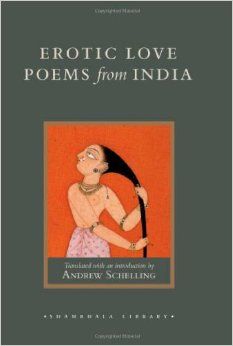
Erotic Love Poems from India: Selections from the Amarushataka
h3>Andrew (tr.) Schelling and Amaru (ed.)Schelling, Andrew (tr.); Amaru (ed.) (7th c.);
Erotic Love Poems from India: Selections from the Amarushataka
Shambhala 2004-12 (Hardcover, 128 pages $16.95)
ISBN 9781590300978 / 1590300971
topics: | poetry | india | sanskrit | anthology
On the whole, I found the quality of these translations uninspiring as English poetry. A little analysis on one poem that I found the sanskrit text for shows that his versions have arbitrary additions. But the main fault, in my view, is that Schelling tends towards verbosity, which can kill poetry faster than cyanate.
Amarushataka
The Amarushataka is a collection of a hundred poems by the 7th c. poet Amaru, and has been a classic in Indian literature at least since the aesthetician Anandavardhana (820-890 AD), in his dhvanyAloka, which deals with the art of suggestion in poetry, praised his poetry: "a single verse can provide a taste of love equal to whole volumes."
A 14th c. hagiography of Shankara links the poems to his debate with Ubhaya Bharati, wife of Madana Mishra, in which she challenges him with sexually coded questions. To answer her, he then identifies the Kashmiri king Amaru, who has just died, but he enters his body and enjoys his harem for 100 days, thereby learning about sexuality. Each day he composes one of the poems, before returning to his own body and vanquishing Ubhayabharati in her own art.
There are at least four variant manuscripts of Amarushataka, some with upto 115 stanzas. Some stanzas are clearly the work of other poets, though the Indian tradition has always treated Amaru as a single person. This translation uses the c.1420 version with commentry by Vemabupala.
Several other translations into English exist, of which the one by Daniel Ingalls is the most well known. Schellings poetry works as English, but without the originals it is hard to see how faithful they might be. Recently I found this cipherjournal page which gives the sanskrit versions against Schelling's translations for a dozen poems, but the sanskrit text appears to be suffering from some glyph inversions, due to which it is not decipherable.
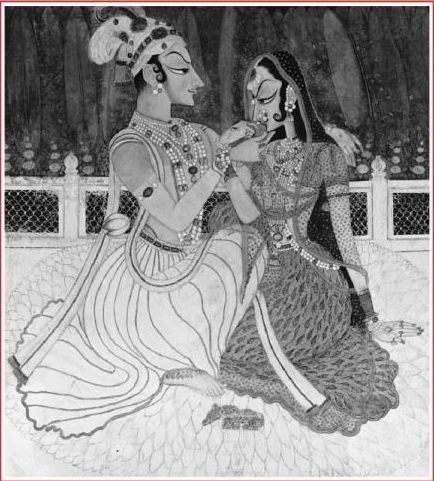
frontispiece: radha-krishna, c. 1740
Excerpts
3 Front curls tossed in disorder earrings scattered beads of sweat smearing the sandal paste on her brow— now her eyes droop as astride her companion she finishes. May the face of this lady protect you. Vishnu, Shiva, Brahma, the gods mean nothing. 4 Tender lip bitten she shakes her fingers alarmed— hisses a fierce don't you dare and her eyebrows leap like a vine. Who steals a kiss from a proud woman flashing her eyes drinks amrita. The gods -- fools -- churned the ocean for nothing. 5 Trembling with awakened love they dart off, then contract into two moist buds. An instant they shamelessly stare, a moment glisten with shy indirection. Dear girl so artless— who is it you look at as though the feverish spell lodged in your heart had rushed to your eyes?Comparing Translations: Schelling and Ingalls
Neither Schelling and Ingalls were poets, in the sense that they didn't write English poetry. However, Ingalls takes far fewer liberties on the original may be the more direct and hence slightly preferred. Also, surely he is the greater master of the language. For English versions of Sanskrit poetry which need not be too faithful to the originals, one can look at Rexroth. Here is an image of the messenger betraying the message -- a common theme in Sanskrit poetry: The female messenger or dUtI was entrusted with the task of mending quarrels and of describing the longing and impatience of the woman by whom she was sent. But the messenger might prove treacherous. Profiting by the quarrel, by the absence of the heroine, and by the lover's characteristic amorousness, she might taste herself the pleasures heretofore bestowed on her friend or mistress.Amarushataka poem 61
Schelling: The sandal paste is rubbed from your lifted breasts, your lip rouge is smeared, the kohl's gone from your eyes. Deceitful messenger, your soft skin's aroused and you can’t see your own sister's despair! Tell me you went to the bathing tank not back to that scoundrel. [orig. poet: ? Subhivoka ?] Ingalls: The slope of your breast has wholly lost its sandal paste, your lower lip has lost its rouge; your eyes are quiet without collyrium while your body runs with drops of moisture. Destroyer of my hopes! Messenger, oblivious of the pain you bring a friend! You went in bathing at the tank and never saw the wretch. [subhAsitaratnakoSa 837 (25.1)] sanskrit text: niHsheSha chyuta chandanaH stanataTo niryAtarAgo-adharo netre dUrmanan~jane jalalavaprasyandinI te tanuH | AshAcchedini dUti bAndhavajanasyAjnyAtapIDAgame vApIM snAtumito gatAsi na punastasyAdhamasyAntikam || 25.1 || [kosambi/gokhale p. 154; some versions of amarushataka have mithyAbAdini dutiH on l.3] comparing Shelling with the original, we find several extrapolations : * stanotaTe - is merely "slope (or bank) of the breast" - "lifted breasts" seems an attempt at eroticization * jalalavaprasyandinI te tanuH - "body spreading in moisture" - very far from "your soft skin's aroused", also, i feel schelling's version of the ending gives away the subtleness of the poem (see raging controversy from notes by Ingalls.)note on this verse, by Ingalls
The speaker knows that the messenger has lain with the lover she was sent to bring. But the speaker is vidagdha-uttama-nAyikA : 'a clever woman and a lady.' Instead of accusing her messenger with the true fault. she charges her with a remissness which might have produced much the same symptoms. Many references and several variants show that the verse has been a favorite. A long controversy has raged over the question of which particular words contain the hint of the speaker's true knowledge and in what way they contain it. Some follow Mammata in saying that the word adhamasya 'the wretch,' suggests that the lover would descend to just such a trick; in which case the suggestion is based on the primary power of a word (abhidhAshrayA vyan~janA). Others say that the evidence can really have been produced by lovemaking only and not by bathing. For example, bathing would have washed both lips free of rouge, not just the lower lip, etc.; in which case the suggestion is based on the secondary power of a word (lakSaNAshrayA vyan~janA). For full particulars see the excellent notes of P. V. Kane in his edition of Sahithyadarpana Of Vishvanatha (2.16).Amarushataka poem 93
Schelling: Sweat on your face? —the piercing sunshine. Your eyes look red and excited- —his tone made me furious. Your black hair scattered- —the wind. What about the saffron designs on your breasts? —My blouse rubbed them off. And so winded- —from running back and forth. Of course. But what's this curious wound to your lip? [shIlAbhaTTArikA ?] Ingalls: "Why such breathing?" "From running fast." "The bristling cheek?" "From joy at having won him over." "Your braid loose." "From falling at his feet." "And why so wan?" "From so much talking." "Your face is wet with sweat." "Because the sun is hot." "The knot has fallen loose upon your dress." From coming and from going. "Oh messenger, what will you say about your lip, the color of faded lotus?"
bookexcerptise is maintained by a small group of editors. get in touch with us! bookexcerptise [at] gmail [dot] .com. This review by Amit Mukerjee was last updated on : 2015 Mar 26