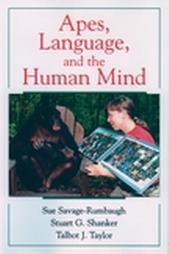
Apes, Language, and the Human Mind
Sue Savage-Rumbaugh and Stuart G. Shanker and Talbot J. Taylor
Savage-Rumbaugh, Sue; Stuart G. Shanker; Talbot J. Taylor;
Apes, Language, and the Human Mind
Oxford University Press NY 1998 (Hardcover, 254 pages)
ISBN 0195109864
topics: | neuro-science | biology | brain | +language-acquisition | primate-language
A fascinating look at a different mind
Within hours of his birth at the Yerkes Primate Research Center in Georgia in 1980, Kanzi was "adopted" by Matata, a female who had been born in the wild and captured to Yerkes. Since Matata already had an infant, she could nurse Kanzi.
Later, Matata and Kanzi were transferred to the Language Research Center of Sue Rumbaugh. Sue, Duane and a number of students tried to train Matata to use lexigrams on a keyboard, but Matata could not progress much. Kanzi would accompany Matata on these lessons, often playing nearby.
Then one day, Matata was taken back to Yerkes, and Kanzi reluctantly realized that he was entirely among humans, without his mother's protection. Overnight, he started using the lexigrams (and also became potty-trained). Rumbaugh suggests that this may have been because he now realized that with Matata gone, humans "were suddenly the most important individuals in his life." Hence his desire to please them.
He eventually learned over 200 pictures and along with a rich gesture vocabulary, he was able to communicate very effectively indeed.
Here is an early video of Kanzi responding to Sue Rumbaugh's spoken requests.
Note how Rumbaugh wears a mask. This is to deflect criticism that Kanzi may be understanding the sentences by following her gaze or other subtle cues. He also was able to use multi-word lexigrams and learned the rudiments of syntax, such as distinguishing between "Kelly chases Jean" and "Jean chases Kelly". Today Kanzi lives in the special habitat created by the Great Ape Trust at Des Moines, Iowa, spread over 140 acres. He lives with Matata and has a wife, Elikya (his cousin), and a son, Teco. They stay in a 13,000 foot lab, with a kitchen which has an ape-friendly microwave and vending machines that they can operate by pushing buttons. Here the family spends evenings sprawled on the floor, snacking on M & M’s, blueberries, onions and celery, as they watch DVDs they select by pressing buttons on a computer screen." - [Paul Raffaele, Speaking Bonobo, Smithsonian magazine, Nov 2006.Kanzi at the Great Ape Trust, Des Moines Iowa.
Bitter remonstrantions
Though the book opens magnificiently with Rumbaugh's personal memoirs
of Kanzi's early years, most of the text is concerned with defending even
the possibility of "animal language".

Reading it in 2010, we must understand that this work was done in the
heyday of the dualist chomsky-fodorian years, where language was
solely ("autonomously") about syntax, and the aspects of it that convey
meaning were not really important.

Indeed, even today, Chomsky remains a skeptic on semantics:
	if semantics is the relation between sound and thing, it may not
	exist. - The Architecture of Language	(2006) p.73

so it is not surprising that Rumbaugh's claims that Kanzi "understands"
language -  in the sense that he can express his intents and desires via
lexigrams - and understand many spoken words and phrases - is not
interesting to traitional linguists.

Language is viewed as "symbolic", and animals are almost by definition
excluded from the symbolic world.

	The linguistic competencies displayed by Kanzi and Panbanisha
	potentially undermine the assumptions that undergird much of modern
	linguistics, psychology, and philosophy. This is the reason why a
	large part of the “ape language debate” has centered around whether
	or not the capacities of the ape subjects are being represented in an
	accurate manner (Wallman 1992)  p.181

Clearly, Rumbaugh and co-workers were bitter.

Indeed, the majority of the book shifts away from the poignant tale to
argue this debate.  At several points the authors articulate how the
experiment goes against the prevailing Chomskyist assumptions:

This is the era when sign language is not language, when anything
subconscious is not thought.  Rumbaugh tries to argue against these
Cartesianist biases:

	The key to this argument lies in the categorial distinction that
	Cartesianism draws between natural expressive behavior and linguistic
	behavior. We showed how the critic of ALR is prepared to accept that
	Kanzi, like a fifteen-month-old child, may have acquired the use of
	some words. But this, the critic feels, does not constitute language
	use; for these “words [may be uttered] merely as a ritualized part of
	recurrent activity contexts, only nominally more linguistic than the
	nonverbal behaviors that also define these contexts, or it may be an
	attention-directing behavior, or both” (Wallman 1992, 51). [...]

	Once again, there is a residue here of eighteenth-century
	ideas. Recall Condillac's argument that the acquisition of speech
	enabled man to analyze and exercise voluntary control over the ideas
	coursing through his mind. p.102

or

	Critics of Ape Language Research (ALR), including Pinker (1994) and
	Wallman (1992), insist that no ape has ever developed truly
	linguistic skills, and that even the skills that Kanzi has manifested
	are more accurately termed “performative” and “effective,” but
	certainly not “linguistic.” p.77

Clearly, the anti-semantic bias was very hard on Rumbaugh:

	Suppose one wants to formulate a method of evaluation to determine
	whether it is justified to claim that Kanzi really understands the
	request “Press the red button” or whether, as the critics insist, he
	is merely behaving as if he understands it (that is, whether, as
	Steven Pinker insists, Kanzi “just doesn't get it” [Pinker 1994,
	340]).

	True, the fact that Kanzi acts as if he understands sentences forces
	the critic of ALR to come up with a different explanation of this
	behavior. Thus we are told that Kanzi possesses remarkable
	problem-solving abilities. We even get the argument that Kanzi may
	understand the meaning of specific words. But he doesn't — he
	couldn't — possess syntax. Instead, his “apparent” grasp of sentences
	is to be explained in terms of his atomistic grasp of the meaning of
	the words in an utterance. Apparently, the nature of these words is
	such that he is left no choice but to execute the desired action. For
	example, there is said to be “only one pragmatically sensible way” in
	which to respond to the words “give,” “trash,” and “Jeannine.” “No
	ability to decipher syntactic structure is required in order to
	respond appropriately” (Wallman 1992, 103). Accordingly,

		[t]he testing of Kanzi's sentence comprehension...demonstrates
		that he is able to put together the object or objects and the
		action mentioned in the way that is appropriate given the
		properties of the objects involved, what he typically does
		with them, or both. His performance provides no evidence,
		however, that he was attending to even so simple a syntactic
		Feature as word order. (104)  p.78

See also the review by Robert Mitchell (excerpted below), who has
written a book himself on how we sometimes get carried away by our
anthropomorphic biases.  Clearly, he does not find much that is interesting
in this data.

Though Sue Rumbaugh is clearly well-recognized for her work, detractors
still continue to haunt this work.  For example, see this letter by
Herbert Terrace in the NYRB, Mar 2012:

	I’m keenly aware of [ape signing] research, although I view most of
	it as gossip because it is based on anecdotal logic: i.e., If Dr. X
	reports that chimpanzee Y signed word1, word2, word3, etc., such
	signing is automatically equated with human language.

	Sue Savage-Rumbaugh, the best known of Singer’s references, provides
	an exceptionally clear example of primate anthropomorphism that
	Singer believes meets “the highest standards of scientific rigor.” At
	the beginning of her book on language learning by bonobos she states:

		When I observe a bonobo, it is as though I am standing at the
		precipice of the human soul, peering deep into some distant
		part of myself. This is a perception I cannot shake off or
		dissuade myself from, no matter how often I try to tell
		myself that I have no definitive scientific basis for these
		impressions.2

	In effect, she and Singer believe that anthropomorphic opinion trumps
	scientific conclusions when, clearly, they don’t.

		- http://www.nybooks.com/articles/archives/2012/mar/08/chimp-talk/

For balance, check out the more mellow Rumbaugh, in this gentle TED talk:


Points to note in this video:
 	- Kanzi's sister Panbanisha, who also is adept at lexigrams, draws
	  symbols on the floor with chalk!
	- Panbanisha's daughter, Nyota, looks into her mouth when she plays a
	  harmonica.
	- Bonobo's can walk bipedally, and often do so in the wild, sometimes
	  for long distances.


---

To me the most interesting part of this experiment was not that Kanzi is able
to construct multi-word sentences, but the fact tht he, like Ayumu in Japan
(see [below]), did this almost cssually, through mere exposure while on his
mother's lap.  This is, as Rumbaugh repeatedly points out, is exactly the
kind of effortlessness that the human child demonstrates.

But it is the first part of this book that remains a tour de force.
Written in a simple style, this is a delightful narrative, profoundly
human in many ways, both touching and thought-provoking.


[Review originally written 2008, substantially revised Apr 2014]
Excerpts
Chapter 1 : Bringing up Kanzi
Kanzi came to the Georgia State University Language Research Center in
Atlanta, Georgia, in 1980 with his mother, Matata, when he was just six
months old, but his story really starts even before he was born. Matata
arrived in Atlanta in 1975, the same year I did. I had elected to come,
because I knew bonobos were in Atlanta. Matata came because she was netted,
placed in a helicopter, and flown here.

In 1975, hardly anyone knew what a bonobo was.  Only in 1929 were bonobos
recognized as a distinct species of ape, and even in the 1980s many people
considered them to be merely diminutive chimpanzees.

Dr. Kano of Japan had just started studying the wild bonobos in Zaire, but
he had begun to learn some intriguing things: Bonobo social groups are very
stable compared to the fluid and dynamic gatherings of common
chimpanzees. Moreover, they are often large and composed of nearly equal
numbers of males and females. The males are unusually passive, and in all
groups there are close bonds between the sexes.

In contrast, chimpanzee males are domineering and aggressive. Common
chimpanzee traveling parties consisted of only a few individuals, and bonds
between the sexes are close only for a few days each month when females are
sexually receptive.

Bonobo females are nearly always sexually receptive, and they form close
friendships with males and with other females. Most surprising is the low
level of aggression among bonobos. They prefer making love to making war, and
are, by human standards, quite adept and profligate in their sexual
endeavors.
Sexual behaviour
Bonobos hold a special fascination for primatologists because of the way
their entire social organization pivots around sexual behavior. If they were
a primitive and only recently discovered human society, we would be compelled
to say that their groups are held together by love, expressed in a most
direct and physical manner, between all individuals, regardless of age or
sex. Human sexual behavior, widely touted among the animal kingdom for its
variety and its frequent nature, is overshadowed by the bonobo.

Unlike [humans], bonobos do not recognize that sexual behavior is linked to
the birth of offspring and all its consequent responsibilities. Therefore,
they have no need to define kinship and its attendant duties and
regulations. Sexual behavior is something that is freely enjoyed, without
consequence, by all group members. Just as we hug each other in happiness and
excitement, to make up after an argument, to seal an agreement, or to welcome
someone back, so does the bonobo, except their hugs often include sexual
contact, as they have no need for clothes and no need to regulate sexual
exchanges.
How the bonobos came to the US
... there was a debate in the US Academy of Science whether bonobos were
an indigenous resource that should be protected in Zaire.  Some scientists
maintained that bonobos were not sufficiently different from chimpanzees to
warrant such special treatment. Thus, three animals were captured from the
wild, with the permission of the Congolese government, and taken to the
Yerkes Regional Primate Center in Atlanta, Georgia, where researchers were to
determine whether they, in fact, differed sufficiently from chimpanzees to
warrant separate treatment.

A human does not need to read a catalogue of bonobo facial expressions or
vocalizations to understand the bonobo. When I observe a bonobo, it is as
though I am standing at the precipice of the human soul, peering deep into
some distant part of myself.

[Though] they cannot plan ahead as we do, ... the bonobo shares with man an
emotional capacity for understanding the feelings of others that can only be
described as almost human.
Kanzi
Many animals have learned to do tricks in response to spoken commands, but
this young bonobo was different. He did not just do what he was told; indeed,
he often refused to do what he was told even though he understood. This
bonobo came to understand language — how it works and how it may be used. He
was able to interpret spoken sentences that he was hearing for the very first
time. He also learned to read printed symbols and to use these symbols to
talk to people.

His name is Kanzi. In Swahili. Kanzi means “bold and brave.” p.8

Kanzi, as an adult, measures up to his name; he is bold and brave; he is also
large (165 pounds) and very strong — five times stronger than a 165-pound human
male in excellent physical shape.
I cannot tell Kanzi what he must do or what he should not do.
He listens to me, but he does not always believe me when he cannot understand
the reason for what I have said.
Exploring electrical outlets
Take, for example, electrical outlets. How does one explain electricity to an
ape? 1 have just tried to tell Kanzi that “shocks” come out of the wall — that
the small hole in the wall is dangerous and can hurt him badly. It is clear
that he understands something of what I have said to him, because he
approaches the outlet with extreme caution, his hair on end. He smells it, he
looks at it, he even throws something at it gingerly. The outlet just sits
there. Kanzi stares at me with a rather incredulous look on his face — why, he
wonders, do I think this thing is dangerous, and why did I lecture him so
when he started to stick a screwdriver into it? It appears perfectly harmless
to him. As I continue to maintain that this thing on the wall is dangerous,
his curiosity becomes fully aroused.

[One day] he decided to use the screwdriver to pry the thing off the wall and
see what was under it. That was when I presented him with an impassioned
explanation of “electricity” and its dangers. Kanzi did not understand the
word “electricity,” but he did know that I was saying the thing on the wall
could hurt him and that I was seriously concerned about this possibility.

At a certain age, Kanzi began to wonder if everything I told him was really
true. He had discovered that he could evaluate things for himself, and that
many things that I could not do, he could. He could, for example, climb
eighty-foot trees without falling or leap between them at heights that scared
me just watching him. So naturally he wondered why he could not stick a
screwdriver into the electrical outlet.

Waiting until I was not looking, he carefully hid the screwdriver under a
blanket. Then, when I was thoroughly occupied with going through a stack of
pictures to make a selection for a test of his comprehension, he removed the
screwdriver from its hiding place and placed it directly in the
outlet. Fortunately it had been insulated with a plastic handle, and Kanzi
was not hurt. However, there was no doubt that he experienced a shock. He
stood ramrod straight, and his hair rose two inches. He yanked the
screwdriver out of the socket and immediately burst into a series of emphatic
“Waa” sounds.

This time, Kanzi knew that this harmless-looking thing really was
dangerous. He began throwing balls, bowls, blankets, toys, and anything else
he could lay his hands on at the electrical outlet. He gestured for me to do
the same thing — thinking, I presume, that we needed to attack the thing and
get it out of there.

It certainly did not seem reasonable to Kanzi to have such a dangerous thing
right there in the room with us. I could understand his point of
view. Certainly, when we encountered snakes outdoors, that was exactly my
strategy — throw something at them and get them to go away. Quite obviously,
however, this strategy would not work with electrical outlets. One simply has
to let them, and all the dangers they entail, stay right in one's room.

Kanzi never really doubted me when I explained that snakes were
dangerous. Looking at them, he seemed to agree. However, it was not only
electrical outlets that he wanted to test but many other things, such as
every type of mushroom that grew in the forest, any dog that dared to bark at
him, those large funnel-shaped nests that hornets fly in and out of, any tree
or large tree branch that appeared a bit too rotten to support his weight,
every rooftop that he encountered, the cans of insect repellent we felt
compelled to take with us into the forest, and on and on.

Like any normal four- or five-year-old boy, Kanzi viewed danger as a
challenge to be overcome at the first opportunity. Only unlike a four- or
five-year-old human boy, Kanzi had the strength, the agility, and the speed
of a super athlete.
First meeting with Kanzi
[Matata is familiar with Sue, and lets her] care for Kanzi for short periods
of time.

What did surprise me was that Kanzi, who before this moment had never touched
or smelled a person, was even more eager to meet me than I was to meet
him. Without warning, he emitted an electrifying scream and propelled himself
from Matata's arms to mine by literally turning in the air as he leapt
through space.  P.10

He threw both arms and legs around my midsection and looked directly into my
eyes with his lips pulled back in a grin that was pasted across his face like
that of a clown, all the while screaming at the top of his lungs in the best
bonobo fashion that a six-month-old could muster.

My legs and arms began to tremble, for although Matata and I had been friends
in the past, we'd hardly had time to say “hello” before her son had jumped
onto me. I was scared that somehow she might think I was hurting him because
he screamed so loudly and held on so tightly.

Female bonobos, although generally gentle, possess [razor-sharp canines. and
can] do serious damage with their surgically sharp canines and lightning-fast
reactions.

Matata, knowing full well what to do, also did nothing.

As I was later to realize, this was just Kanzi's way of greeting me when he
was aroused, and just then he was extremely excited, since I was the first
human being to whom he had ever clung.  I later learned that the best way to
calm Kanzi down when he was so aroused was to scream back just as loudly
myself and pat him firmly on the back to show that I was happy to have him
holding onto me.

Though I did not realize it at the time, Kanzi was screaming only because he
was somewhat frightened of me and fearful that I might not want him to cling
to me, even though he had indicated, by his gestures and vocalizations, that
he was nearly desperate to meet me.

As soon as we got our messages of interest and acceptance across to each
other, Kanzi calmed down and
began to show a quiet fascination with my face, my hair, my shirt, my shoes,
my pockets, my raised nose — as opposed to the flat bonobo nose — and all the
other things that differentiated me from his mother.
Teaching Matata language
My immediate goal was to teach his mother Matata how to use symbols to
communicate her desires and needs.

Before Kanzi was born, I had been teaching language to common chimpanzees
for eight years. I knew that with patient and systematic training it was
possible for such apes to learn to read printed symbols. They could also
use these symbols to communicate simple things such as the kind of foods
and drinks they desired; whether they wanted to go outdoors, be groomed, or
play tickle or chase; and if they were frightened.

Matata appeared to be quite intelligent and, in addition, more naturally
communicative than most common chimpanzees. She had many natural means of
communicating simple desires. For example, when Matata wanted to be
somewhere, but was hesitant to go alone, she would take my hand and lead me
with her. If she wanted something that was out of reach and there was no
nearby tree, she would position my body just under the desired item so that
she could climb on my shoulders to attain her goal. When she heard unusual
noises in the forest, she would direct my attention toward them by looking
and gesturing in that direction. If she was hungry,
she would point to an empty bowl, then hand it to me and push me in the
direction of the refrigerator.
Apes don't have velar closure
The sharp angularity of the vocal tract and the decrease in the size of the
mouth resulted in the ability to completely close off the nasal cavity from
the oral cavity (velar closure).

Very young children and apes, as well as persons born with a cleft palate,
lack the ability to effect velar closure. Consequently, they can drink liquid
and vocalize at the same time — something a slightly older child cannot do
without choking. But they cannot speak.

velar closure is used to produce nasal sounds such as “m” and “n.” Velar
closure also permits the vocal tract to implode enough pressure to produce
plosive consonants such as “k” and “g.”
Teaching Matata
Unlike these common chimpanzees, Matata found lexigram symbols extremely
difficult to master. She could not even tell one from the other.
Consequently, a task was devised for Matata to get her to pay attention to
lexigrams and so to see that each one looked different from the others. One
of Matata's favorite foods was bananas, so we placed the “banana” symbol on
her keyboard along with some other nonsense-symbols. Each time Matata pressed
the banana symbol, she received a piece of banana; then, the banana symbol
and the nonsense-symbols all moved to a new location. Whenever Matata wanted
another bite of banana, she had to look at the keyboard and find the banana
symbol in a new place among the distractors. When she was able to find the
banana symbol in this way without error, other food symbols were similarly
introduced.

By this time, Kanzi was about one year old and big enough to get in his
mother's way. He did not hesitate to take the bananas, apples, or raisins
that she had worked so hard to earn, nor did he hesitate to slap any symbol
that attracted his attention while his mother was patiently searching for the
correct one. Every time Kanzi touched the wrong symbol, Matata's keyboard
automatically relocated all the symbols, forcing her to begin her search all
over again.

Kanzi also managed to cause problems for Matata by doing gymnastics on her
head and shoulders while she tried to locate the symbols, often knocking her
hand away from
the keyboard just as she was about to touch the correct symbol. Matata, like
most other bonobos, was a study in maternal patience. Clearly, she was not
happy with the difficulties her son caused and would often scowl at both him
and me. However, she never punished Kanzi at this age nor stopped him from
taking her food.

[Before this, the chimps Rumbaugh had worked with- Lana, Sherman,
Austin- and also Tetsuro Matsuzowa's chimpanzee Ai in Japan, had been
learning similar lexigrams.]

We found that while it was easy to get chimps to use symbols in a way that
looked like language, it was much more difficult to get them to understand
and use symbols in a [communicative] way...  Beyond comprehending words,
doing this required that apes would need to attend to others, take turns
speaking, and to recall the symbols even when the referent is not present.
They would have to learn to separate symbol use from reward or immediate
gratification so that their speech could function to convey information.

The other chimpanzees had attained vocabularies of between fifty and one
hundred and fifty symbols, which they employed in rather sophisticated
ways. By these standards, Matata was quite backward.
In fact, her progress was so dismal we were fearful that it would be
difficult to justify continued inclusion of bonobos in our research program.

It had been our hope that by studying a different ape, the bonobo, additional
insights into the mysteries of language would be achieved. Because bonobos
employed more elaborate gestures in the field, it seemed possible that they
had evolved a greater capacity for language than chimpanzees. It was even
possible that they utilized a simple language in the wild that no one had
been able to recognize. I had been optimistic that Matata would outpace all
of the chimpanzees ...  She was a willing student who worked very hard, but
after two and one half years of effort, we were forced to conclude that she
was not going to fulfill our expectations.
Mother and Child
during the first four to five years of his life, the only form of discipline
I ever observed Matata impose on Kanzi was to encourage him to settle down at
nighttime. Every evening, she began a solemn ritual of building the perfect
nest. Since she was not in the forest and lacked access to the tree branches
that  would normally serve as bedding material, we provided her with five
to seven large, rugged blankets made of heavy carpet.

Matata had very definite ideas as to how these blankets should be arranged
before sleeping. Each one was taken to a high location, where she carefully
straightened it and laid it down. Then, while seated on it, she artfully
pulled its edges into a half-circle around herself. She repeated the process
with each blanket, assiduously intertwining their edges until she had formed
a nest with high cushy sides, something like a large inner tube with a soft
center. Next, she reclined in this structure to test it out, and made any
adjustments or repairs that were needed. Finally, she groomed herself and
Kanzi before dozing off to sleep.

Kanzi, like many children, was never ready to go to bed when Matata was. He
always wanted to stay up and play, and he would try to pull Matata's blankets
into his own “play nest”—where the blankets ended up on top of his head as
often as underneath him. He would also flop on Matata with a full play face,
smiling and laughing while waiting for Matata to play bite and tickle
him. After being so indulged for fifteen to twenty minutes, Kanzi usually
nursed and then went to sleep as Matata groomed him.
Resisting sleep
By two years of age, Kanzi was large enough that these nightly nest antics
seriously began to bother Matata. Often I would stay as she settled down for
the evening. On these nights, she always invited me to sit in her nest once
it was properly constructed and groom with her. While we groomed, Kanzi would
display his acrobatics, which were always punctuated by flinging himself with
great abandon either onto my head and shoulders or into my lap.

When Matata could bear the distraction no longer, she would take Kanzi's hand
or foot into her mouth and, using her teeth, slowly begin to increase her
pressure until Kanzi looked at her and realized that she was serious. This
would cause him to quiet down for a while.

[Hilarious stories of how Matata would support Kanzi in his attempts to
reject potty-training.]
Separation
When Kanzi was almost two and one half years old, the Yerkes Center decided
that Matata should be bred with Kanzi's father Bonsondjo and become
pregnant. Like the females of common chimpanzees, bonobo females experience a
swelling of their genital tissues when they are sexually receptive. The
timing of their sexual cycles is similar to that of the human female, but
differs in that it is visually advertised to all by the engorgement of
genital tissue. After they give birth and while they are lactating, bonobo
females do not experience these swellings, nor are they able to conceive,
(like human females, however, and unlike all other nonhuman primates, bonobo
females continue to engage in sexual interactions during this time.)

[Matata is sedated and taken away while Kanzi is elsewhere.  On getting back,
Kanzi seemed to think that Matata must be hiding somewhere. He did not
vocalize or cry out in distress at all, but he asked to be carried to every
room in the laboratory over and over. In each room he looked in the cabinets,
under the furniture, behind curtains, on shelves, under the blankets, out the
window, and so on, as if he was bound to find Matata at any moment.

Even though Kanzi was preoccupied with his search for Matata on the day of
her disappearance, he still managed to use the keyboard a great deal. To
everyone's astonishment, on the first day of Matata's absence, Kanzi produced
120 separate utterances using twelve different symbols (“banana,” “juice,”
“raisin,” “peanuts,” “chase,” “bite,” “tickle,” “orange,” “outdoors,”
“swing,”
“bite,” “tickle,” “orange,” “outdoors,” “swing,” “cherry,” “sweet potato,”
and “ball”).
Sudden discovery of Kanzi's skills
Prior to Matata's absence, we had been encouraging Kanzi to use the keyboard
and, consequently, had added lexigrams such as “ball” and “chase” that might
prove of interest to him. However, his usage of symbols had been rather
sporadic, and we were not certain how many symbols, if any, he really
comprehended.

The following day, when his mother was gone, we saw a very different Kanzi at
the keyboard. Not only did he use many single symbols appropriately to tell
us what he wanted to eat or do, he formed the combinations “raisin peanut”
when he wanted both foods, “sweet potato tickle” when he wanted both to eat
sweet potatoes and be tickled, and “melon go” when he wanted to go outdoors
with some melon.

He even touched “juice” simply to comment on how happy he was that I had
given him a very large glass of grape juice, his favorite drink — carefully
holding it so that it would not spill while walking all the way across the
room to make this comment at the keyboard.

Simultaneously with this abrupt appearance of competent language skills, a
similar thing happened with regard to Kanzi's use of the potty. Whereas he
had previously appeared to have a great deal of difficulty remembering to use
the potty, upon Matata's departure we suddenly had a well-trained young
bonobo. ... his previous performance had been a reflection not of his
knowledge but of his motivation.

Matata's sudden absence caused Kanzi to become extremely attentive to the
kind of things that I and his other teachers had been attempting to show
him. With Matata gone, we were suddenly the most important individuals in his
life, and his desire to please us increased commensurately.

[pleasurable surprise.  goes through the records seeking evidence of Kanzi's
learning.]

One always hears stories of children who do not talk until they are three
years of age or older, then suddenly begin to speak in complete sentences,
never passing through the stages of babbling, baby talk, single-word
utterances, and ungrammatical sentences that characterize the early stages
of language learning in other children. Well, now I had a similar story to
tell, only it was not about a child, it was about an ape.

[But could not test him, since he was not used to sitting still]
Kanzi's routine
Kanzi's day typically started whenever he awoke. Jeannine was usually the
first to arrive; after relieving whomever had spent the night with Kanzi, she
would begin straightening up the group room while waiting for Kanzi. Kanzi
often announced that he was
awake by using his keyboard to say something to Jeannine. On one typical
morning, for example, Jeannine heard “peaches” and then “hug” and knew what
Kanzi wanted. She prepared him a bowl of peaches, took them into the bedroom,
and gave Kanzi a big hug while he happily consumed them.

Kanzi was so good at keep-away games that he nearly always won. He would
give the other party plenty of chances by pretending to drop the item near
them or pretending that he had forgotten the game and that he had laid the
item down while attending to some thing else. But the second you reached for
the item, Kanzi was there to grab it from under your very nose.

When Kanzi finally tired of the keep-away game, he asked Jeannine to take him
to the group room by first pointing to the keys in her pocket, then to the
lock on the bedroom door, and then toward the group room. Many of Kanzi's
complex communications entailed the use of multiple gestures such as these.

Kanzi enjoyed sharing food with me, with other people, and with the dogs that
lived at the laboratory. In return, he expected us to share food with him. He
wanted a bite of everything he saw someone eat... Only Kanzi was not content
with a separate piece of their food, he wanted some of the food that was
actually in their mouth. Sharing food, mouth-to-mouth, was something that his
mother had taught him. p.35

Until he was nearly seven years old, Kanzi continued to behave as though his
feelings had been deeply bruised whenever someone he liked refused to take
some of the food he offered from his mouth or would not let him have some of
theirs.
Syntax: The arguments of "Chase"
[Kanzi loves watching humans play games like chase, and needs to instruct
them.]

From a linguistic standpoint, requests designed to ask one person to chase
another are complex, in that they require Kanzi to specify the chaser and the
chasee, as well as the game itself. Unlike Kanzi, Sherman and Austin always
included themselves in these games, and generally they elected to be the
chasee. Thus they had no need for a grammatical rule that would mark the
different roles of two players. They needed only to specify who should play
chase with them and then to run toward, or away from, that person. However,
since Kanzi elected to observe the chasing activity rather than participate,
he needed a grammatical means of indicating who was to be the agent
and who was to be the recipient. p.50

Because the names of individuals involved in such games all belong to the
class of “agents,” without some means of specifying how the two agent terms
are to be related, vis-à-vis the verb, the meaning of a sentence is
unclear. Kanzi adopted the order of his gestures as a device to get his
messages across clearly, presumably because the language he was learning was
English, and English relies on ordering rules for such things.

[Given the above passage, involving a transitive verb, the following remarks
about a bitransitive are somewhat surprising]

Quite unexpectedly, Kanzi experienced the greatest difficulty with sentences
that had "X and Y" arguments.  When asked to “Give (or show) someone X and
Y”, he would only show the last thing spoken.  Then when asked for "X", he
would give or show it, without needing the verb to be given again.

[Difficulty may be arising possibly because Give me x and y is really
"give me x and give me y"]
"Good" and "bad"
Kanzi also talks to himself, particularly at nap time or other quiet periods
of the day. He does this by picking up the keyboard, moving a short distance
away from the rest of the group and turning his back. He then scans the board
and touches particular lexigrams. If try to look over his shoulder to see
what he is saying, he generally picks up the keyboard and moves further away.

When the lexigrams “good” and “bad” were first placed on Kanzi's keyboard, I
did not think he would use them frequently, or with intent. I put them on so
that everyone would have a clear way of indicating to Kanzi when we felt that
he was being good or bad. To my surprise, Kanzi was intrigued with these
lexigrams and soon began using them to indicate his intent to be good or bad,
as well as to comment on his previous actions as “good” or “bad.” When he was
about to do things that he knew we did not want him to do, he started saying
“bad, bad, bad” before he did them, as though threatening to do something he
was not supposed to do. He would, for example, announce his intent to be bad
before biting a hole in his ball, tearing up the telephone, or taking an
object away from
someone.

One day. when Kanzi was supposed to be taking a nap with Liz, who was
exhausted and went to sleep, Kanzi refused to lie down. After she had been
asleep about fifteen minutes, she suddenly realized that the blanket she was
using as a pillow had been rudely jerked out from under her head. She sat up
to look over at Kanzi who commented on his action, saying “bad surprise.”

Another time, when he was supposed to take a nap, he did not want to do
so. He asked to play “chase water” instead, and when told that he could not
do so, he commented “bad water” and proceeded to take the hot water hose and
spray it all over things.
Make-believe games
His favorite pretend game centers around imaginary food. He pretends to eat
food that is not really there, to feed others imaginary food, to hide such
food, to find it, to take it from other individuals, to give it back to them,
and to play chase and keep-away with an imaginary morsel.

He will even put a piece of imaginary food on the floor and act as if he does
not notice it until someone else begins to reach for it, then grab it before
they can get it.

[Also plays scary games -] pretend that a toy dog or toy gorilla is biting
him or is chasing and biting a person. He also likes to put scary monster
masks with large teeth over his head and then pretend to chase and bite
someone. He may also ask me to pretend to be such a monster and to chase and
bite him. Occasionally, as I chase him, he will even scream, as though he is
pretending to be afraid of me. When I stop in response to such screams to see
if he is really afraid, he seems puzzled as to why I have stopped the game
and gives no evidence of real fear at all.
A parallel tale: Ayumu
Tetsuro Matsuzowa started rearing the chimpanzee Ai a few years before
Kanzi. Eventually he went on to set up the Kyoto Primate facility, a
largely outdoor faciliity with a towering  steel structure that simulates the
forest environment.

Eventually, Ai had a son, Ayumu.  Much like Kanzi, he used to accompany
her mother to the training lessons.  Here too, one day the researchers were
surprised
to discover how much Ayumu had learned.  Ayumu can count, and like any good
schoolboy, he can reel off the numerals from 1 to 20 in order.  Well,
actually he touches the digits on screen.

This is where it gets truly amazing.  If you cover up all the other numerals
as soon as Ayumu has touched 1, he can still remember where they were on
screen.  A typical human can't remember more than a couple.
Thus, the chimpanzee visual working memory is far more powerful than ours!

See this video, if only to accept how the human brain may be deficient in
many respects, to animal brains:
Review: Robert W. Mitchell
Trends in Cognitive Sciences, June 1999

In 1927, comparative psychologists studied a dog, Fellow, who, according to
his owner, understood English ‘in much the same manner as a child under the
same circumstances would’ (Waren/Warner 1928, p. 17). Fellow had ‘been talked
to constantly almost from birth in much the same manner as a young child
during the years of taking on language’, and had never been ‘trained’ to
respond to English. With double-blind tests it was discovered that Fellow
understood over 50 English requests. Looking at the evidence today, however,
no one would claim that Fellow ‘understood English,’ because comprehension of
syntax was never tested.

Apes, Language, and the Human Mind reports on a bonobo chimpanzee, Kanzi,
‘the first animal ever to learn language without training, as a child does,
and thus the first to truly understand a spoken human language’ (p. 6). The
evidence (better portrayed elsewhere [*]) for Kanzi’s English comprehension is
more impressive than that for Fellow, and Kanzi is reasonably described as
having comprehension of English syntax in response to various requests,
comparable to that of the two-year-old child who was similarly tested.

[*] E.S. Savage-Rumbaugh et al. Language comprehension in ape and child
    Monogr. Soc. Res. Child Dev., 58 (3–4) (1993)


Surprisingly, we are never provided with actual norms for Kanzi.
Savage-Rumbaugh’s normative uses of psychological words to characterize Kanzi
is viewed as a scientific revolution, yet exactly this interpretational
method has been a mainstay for over two decades of Patterson’s (unmentioned)
work with signing gorillas. A similar ‘cultural anthropological’ approach has
been used in Miles’ (also unmentioned) work with a signing orang-utan. Oddly,
the authors’ interpretational technique is not employed in Chapter 4 when
they evaluate other ape-language studies. They exhibit their own ‘rhetorical
compulsion’ to ask for evidence beyond the narrative supplied by scientists,
and they accept Savage-Rumbaugh’s critiques as the best interpretation. It
seems the authors want it both ways – we must accept their interpretations on
faith, but not the interpretations by others.

From the beginning, we are told that Kanzi is an ape who has acquired
‘linguistic and cognitive skills far beyond those achieved by any other
non-human animal in previous research’ (p. v).

I had just the opposite feelings about the findings: everything here was
consistent with other accounts of apes, especially human-reared ones, who
show speech comprehension, gestural-sign invention, self-talk, meaningful
word combination, maternal tolerance, (limited) empathic responses, attention
to another’s wounds, pointing to their own pain, cooperation with doctors,
pretense with toys and imaginary objects, bodily imitation, deception,
concealment, planning, and self-recognition.
[R.W. Mitchell Scientific and popular conceptions of the psychology of great
apes from the 1790s to the 1970s: déjà vu all over again Primate Report, 53
(1999), pp. 1–118]

Strangely, statements later in Chapter 1 contradict the initial claims that
bonobos are more like humans than are chimpanzees, that bonobo vocalizations
are easily understood by humans, that apes have difficulty with gestures, and
that each English sentence was uttered only once in Kanzi’s comprehension
tests. We are also told that work with Kanzi represents a ‘scientific
breakthrough’ (p. v), yet the methods used to test for English comprehension
– double-blind requests for actions with objects – were the same as those
used with Fellow.

Elaborate everyday experience with any organism can provide novel insights,
but this does not indicate that people must simply accept eyewitness
testimony based on everyday experience4. The authors provide reasonable
evidence for language comprehension in Kanzi, but other researchers are
within their rights to offer different accounts, which can then be
examined.  [...]

Kanzi’s research project has received extensive funding, and the findings
have been repeatedly published, so it is not clear that critics have had a
negative impact. Why shouldn’t Pinker and Wallman, those critics who ‘refuse
to be convinced’ have their say, even if the authors don’t find their
arguments particularly compelling?
bookexcerptise is maintained by a small group of editors. get in touch with us! bookexcerptise [at] gmail [dot] .com. This review by Amit Mukerjee was last updated on : 2015 Aug 03