The Mismeasure of Man
Stephen Jay Gould
Gould, Stephen Jay;
The Mismeasure of Man
Norton, 1983, 352 pages
ISBN 0393300560, 9780393300567
topics: | biology | evolution | paleontology | genetics | sociology | postmodern
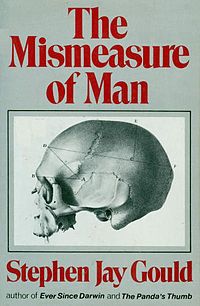
The 19th century science was a hotbed of skull measurements. It was popularly thought that cranial volume (1350cc for humans, 400cc for chimps / gorillas) - were indicative of intelligence.
This is Gould's first book (1981), as opposed to the collection of 33 columns that appeared as Ever Since Darwin (1977). It is a strongly anti-racist study of attempts in anthropology to propagate "biological determinism", the belief that "the social and economic differences between human groups — primarily races, classes, and sexes — arise from inherited, inborn distinctions and that society, in this sense, is an accurate reflection of biology." Also opposes positions that attempt to measure intelligence in terms of craniometry, or through psychological testing.
Gould challenges the basis of craniometry:
"the abstraction of intelligence as a single entity, its location within the brain, its quantification as one number for each individual, and the use of these numbers to rank people in a single series of worthiness, invariably to find that oppressed and disadvantaged groups — races, classes, or sexes — are innately inferior and deserve their status." p.21
As in many Gould articles, the historical perspective is beautifully presented. We get to know how Paul Broca [of Broca's area fame] defended the measurement of cranial volume as a measure of intelligence. Somehow in all these measures Black skulls came out worse than white skulls.skull shape measurement (craniometry). The cephalic index : width to length ratio -- varies in human heads from 58 to 90. Ratios less than 75 (dolichocephalic) are more prevalent among negroid races, whereas wider skulls (brachycephalic) are more common in Siberian Samoyeds. However, the entire premise of the brain volume to intelligence idea fell through in the early decades of the 20th century. It was found, for example, that the author Anatole France had a brain volume that was two-thirds the average, which would put him in the range of our hominid ancestor Homo Erectus, 200,000 years ago. However, the reason for big brains remains a dilemma: Whatever benefit big brains provide, it has to be big itself to offset the huge metabolic cost of feeding the organ--some 20 to 25 percent of all calories consumed--as well as the dangers involved in giving birth to a big-headed baby. Two recent papers in Science conclude that two genes affecting brain size expanded through the population, under the influence of natural selection, well after modern humans emerged; one was under selection as recently as 5,000 years ago. - http://www.scientificamerican.com/article/half-brained-schemes/ * Microcephalin, a Gene Regulating Brain Size, Continues to Evolve Adaptively in Humans, Patrick D. Evans etal, Science 2005 pdf * Ongoing adaptive evolution of ASPM, a brain size determinant in Homo sapiens N Mekel-Bobrov etal, Science 2005 [ftp://ftp.bork.embl.de/users/lercher/Ka/Mekel-Bobrov_Lahn2005Science_brain.pdf|pdf]
For a cogent but controversial argument that human brains may have had a runaway evolvution as sexual selection indicators, see Geoffrey Miller's fascinating Mating Mind (2000).
The IQ controversy
Gould's arguments regardiing IQ as a single measure of intelligence (chapter 5 onwards) have been widely challenged. the use of IQs for stereotyping racial groups has been found to be unwarranted, but Gould's position, that there is no evidence that IQ is inherited [he shows how very respected studies, such as Cyril Burt's studies of separated twins, may have increased their sample size by more than twice.]
However, subsequently, many researchers pointed out that despite such instances of dubious research, there was considerable ground for believing that whatever is measured by IQ tests may indeed be part of our genetic inheritance. Some opponents claimed that he was not familiar with their key literature. However, with Howard Gardener's Theory of multiple intelligences some aspects of his argument have perhaps been vindicated.One of the pieces of evidence cited by Gould is the fact that pictures of the "feeble-minded" Kallikak family, published by Goddard, had been altered. "Note how mouths and eyebrows are accentuated to produce an appearance of evil or stupidity." p.204 But it has been argued that while the pictures were definitely altered, this may not have been done deliberately by Gordon to give them a more disturbing appearance. "Photos in many books were retouched as part of the publishing process (Fancher, 1987), and little evidence exists that Goddard personally doctored the photographs to make the "bad" Kallikaks look more sinister than the "good" branch of the family." - http://www.intelltheory.com/kallikak.shtml
Writing style
Gould, on his writing style (from interview on Bookwire):

    I once made a division, a bit simplistic, between two great traditions
    of science writing.  One of them is Galilean, with a tendency to focus
    on the fascination of nature's puzzles.  I call it Galilean because
    Galileo wrote his two great dialogues in Italian and not as formal
    Latin treatises.  Darwin is surely in that tradition. Darwin can wax
    poetic but the power is mainly in the argument and the fascination of
    examples. People tend to think The Origin of Species is a popular
    version of some technical monograph he wrote. They don't realize he
    chose to present this great work as a book for the general public, and
    there is no technical monograph corresponding to it. I see myself in
    that tradition -- trying to write as clearly, elegantly, and broadly as
    possible about the fascinating intellectual puzzles of nature.

    The other tradition, which I call Franciscan, is nature poetry. I
    respect people who can do that, Loren Eisely, for example. Lewis Thomas
    is somewhat in between. Edward Wilson is somewhat in between; he can
    get quite poetic. I can for a paragraph or two every once in a while
    but it's not going to be my general style.
Cranial capacity, races and 19th-20th century scientific ideas (wikip)
Samuel George Morton (1799–1851), one of the inspirers of physical
anthropology, collected hundreds of human skulls from all over the world and
started trying to find a way to classify them according to some logical
criterion. Influenced by the common theories of his time, he claimed that he
could judge the intellectual capacity of a race by the cranial capacity (the
measure of the volume of the interior of the skull).

After inspecting three mummies from ancient Egyptian catacombs, Morton
concluded that Caucasians and Negroes were already distinct three thousand
years ago. Since the bible indicated that Noah's Ark had washed up on Mount
Ararat, only a thousand years ago before this, Morton claimed that Noah's
sons could not of possibly account for every race on earth. According to
Mortons theory of polygenism, races have been separate since the start.[3]

Morton claimed that he could judge the intellectual capacity of a race by the
skull size. A large skull meant a large brain and high intellectual capacity,
and a small skull indicated a small brain and decreased intellectual
capacity. Morton collected hundreds of human skulls from all over the
world. By studying these skulls he claimed that each race had a separate
origin. Morton had many skulls from ancient Egypt, and concluded that the
ancient Egyptians were not African, but were White. His two major monographs
were the Crania Americana (1839), An Inquiry into the Distinctive
Characteristics of the Aboriginal Race of America and Crania Aegyptiaca
(1844).

In Morton's Crania Americana Morton claimed based on Craniometry data, that
the Caucasians had the biggest brains, averaging 87 cubic inches, Indians
were in the middle with an average of 82 cubic inches and Negroes had the
smallest brains with an average of 78 cubic inches.

Stephen Jay Gould (1941–2002), an American paleontologist, evolutionary
biologist and historian of science, studied these craniometric works in The
Mismeasure of Man (1981) and claimed Samuel Morton had fudged data and
"overpacked" the skulls with filler in order to justify his preconceived
notions on racial differences. A subsequent study by the anthropologist John
Michael found Morton's original data to be more accurate than Gould
describes, concluding that "[c]ontrary to Gould's interpretation... Morton's
research was conducted with integrity."

In 2011, physical anthropologists at the University of Pennsylvania, which
owns Morton’s collection, published an study that concluded that almost every
detail of Gould’s analysis was wrong and that “Morton did not manipulate his
data to support his preconceptions, contra Gould.” They identified and
remeasured half of the skulls used in Morton’s reports, finding that in only
2% of cases did Morton’s measurements differ significantly from their own and
that these errors either were random or gave a larger than accurate volume to
African skulls, the reverse of the bias that Dr. Gould imputed to Morton.
[Lewis, Jason E., DeGusta, D., Meyer, M.R., Monge, J.M., Mann, A.E., et
al. (2011). The Mismeasure of Science: Gould versus Morton ]


link : The book keeps getting attention, 25 years + since publication.
	here is a recent piece in the guardian
bookexcerptise is maintained by a small group of editors. get in touch with us! bookexcerptise [at] gmail [dot] .com. This review by Amit Mukerjee was last updated on : 2015 Apr 27