Barmy British Empire
Terry Deary and Martin Brown (ill)
Deary, Terry; Martin Brown (ill);
Barmy British Empire (Horrible Histories)
Scholastic, 2008, 144 pages
ISBN 1407104217, 9781407104218
topics: | history | british-empire | india | australia
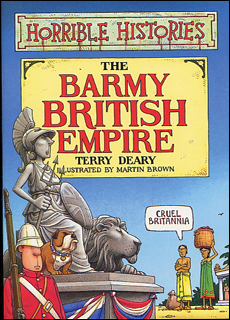
even among horrible histories, this is one of the most horrible. no doubt it is helped along by facts like the aborigine shootout picnics held in Tasmania. or how several hundred indian rebels were fired from cannons. or how the slavers would come and snatch up kids playing in villages.
about the Barmy British Empire, Terry Deary has said: "I'd basically concluded it was one of the worst things to happen to the planet. So I deployed the facts that illustrate that, such as the fate of the Tasmanian people: there were 10,000 of them when the British arrived, and 30 years later they were pretty much gone. We wiped out a whole people." (source: The Guardian: Terry Deary: The man behind the Horrible Histories)
the empire was grounded on the belief of inherent superiority of the British over other races, which of course, an iconoclast like terry deary loves to take apart.
Excerpts
modus operandi of the british empire
You're sitting at your house one day when in marches a bunch of soldiers and they say:
	 						(opening page)

[next frame:]
Now we're in charge, you will work for us, pay us taxes, supply us with
slaves, and die fighting for us.
Timeline
Every day, somewhere in the British Empire, someone suffered...
1562: England begins its slave trade thanks to her
Terrible Tudor superior sailors. They buy
people in Africa and sell them to S America.
[pic: ship with long row of slaves entering.
balloon: "Sail to slaves then slaves for sale"]
1607: British start to settle in America. They push the Indians out of the
way and start to grow tobacco and cotton and sugar (in the W Indies).
This is hard work and the Brits don't like it. So they need more
slaves.
[pic: man sitting on easy chair while man w pipe says: "We need more
workers". Man in easy chair: "Don't look at me"]
1619: The first slaves arrive in N America and the W Indies from Africa.
1620: Pilgrim fathers land on NE America and set up a colony. They will
cause trouble later.
1652: The Dutch set up a colony of "Boers" (farmers) in South Africa. They
will cause trouble later too!
1756-1773: Seven years war against France and Spain. The Brits win and become
the main rulers of India through East India Co, a powerful trading
company, backed by the British Army.
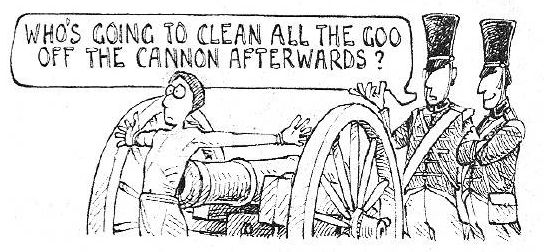 see F.C. Maude's account of a sepoy being blown from a cannon,
quoted in Spectre of violence.
1770: Captain Cook comes across Australia.
1776: Brits lose their big rich American colony so it's time to set off to
take over the rest of the world! Look out world!
[joke pic: brit man in period dress says "I've lost America". wife
who is knitting: "That was careless of you!"]
1789 Freed slave Olaudah Equiano publishes his life story. This helps the
growinng 'Abolitionist' struggle in Britain and the US.
1792: slave rebellion in Haiti led by Toussaint L'Ouverture (1743-1803). His
army of 55,000 blacks fight against the French and makes them think
slavery is not such a good idea.
1795: Brits take over S Africa from the Dutch (Boers), who move inland.
1818: Shaka, the Zulu chief, launches the Mfecane (Wars of crushing and
wandering) against his black African neighbours and the white Europeans
in S Africa.
1834: Slavery abolished throughout the British Empire... Four years before
all slaves to be set free.
1838: 768,000 slaves freed. But many native lords in Empire countries keep
slaves still.
1839: First opium war - Brits fight for the right to sell opium to the
Chinese. British drug dealers get very rich from opium... and the
Chinese very dead.
1851: Gold discovered in Australia. Hope those convicts don't pinch it!
1855: Scottish missionary David Livingstone explores the Zambezi and names
the Victoria falls after his queen. (What a creep!)
1857: The Indian mutiny. The Brits are shocked to find that the Indians do
NOT like the Brits! Vicious fighting and cruelty on both sides.
1860: The Maori wars in NZ. As usual the war ends in gore.
1876: Q Victoria crowned empress of India. No one has asked the Indians, of
course.
1879: THe Zulu war. William gladstone says: "Ten thousand Zulus died and
their only crime was to try and defend their families against the
British guns."
1899: Second Boer war. The mighty Brit empire struggles to beat a few
farmers. It's the beginning of the end for the empire. p. 7-10
1622 book of rules for Brit tobacco planters in Virginia:
"It is easier to conquer the Indians than to teach them. For they are
simple, naked people, scattered in small villages and this makes them
easy to defeat. In future it will be our job to make them obey by
destroying their villages and crops. They can then be chased on our
horses, tracked by bloodhounds, and torn to pieces with our mastiff
dogs for these people are no better than wild beasts." 13
see F.C. Maude's account of a sepoy being blown from a cannon,
quoted in Spectre of violence.
1770: Captain Cook comes across Australia.
1776: Brits lose their big rich American colony so it's time to set off to
take over the rest of the world! Look out world!
[joke pic: brit man in period dress says "I've lost America". wife
who is knitting: "That was careless of you!"]
1789 Freed slave Olaudah Equiano publishes his life story. This helps the
growinng 'Abolitionist' struggle in Britain and the US.
1792: slave rebellion in Haiti led by Toussaint L'Ouverture (1743-1803). His
army of 55,000 blacks fight against the French and makes them think
slavery is not such a good idea.
1795: Brits take over S Africa from the Dutch (Boers), who move inland.
1818: Shaka, the Zulu chief, launches the Mfecane (Wars of crushing and
wandering) against his black African neighbours and the white Europeans
in S Africa.
1834: Slavery abolished throughout the British Empire... Four years before
all slaves to be set free.
1838: 768,000 slaves freed. But many native lords in Empire countries keep
slaves still.
1839: First opium war - Brits fight for the right to sell opium to the
Chinese. British drug dealers get very rich from opium... and the
Chinese very dead.
1851: Gold discovered in Australia. Hope those convicts don't pinch it!
1855: Scottish missionary David Livingstone explores the Zambezi and names
the Victoria falls after his queen. (What a creep!)
1857: The Indian mutiny. The Brits are shocked to find that the Indians do
NOT like the Brits! Vicious fighting and cruelty on both sides.
1860: The Maori wars in NZ. As usual the war ends in gore.
1876: Q Victoria crowned empress of India. No one has asked the Indians, of
course.
1879: THe Zulu war. William gladstone says: "Ten thousand Zulus died and
their only crime was to try and defend their families against the
British guns."
1899: Second Boer war. The mighty Brit empire struggles to beat a few
farmers. It's the beginning of the end for the empire. p. 7-10
1622 book of rules for Brit tobacco planters in Virginia:
"It is easier to conquer the Indians than to teach them. For they are
simple, naked people, scattered in small villages and this makes them
easy to defeat. In future it will be our job to make them obey by
destroying their villages and crops. They can then be chased on our
horses, tracked by bloodhounds, and torn to pieces with our mastiff
dogs for these people are no better than wild beasts." 13
Moral justification for empire
Kind person, the Christian God! Can you imagine him saying:The Christians really believed this. Sadly, some Brits even in the 21st c. still believe they are better than others. 14 The Brits believed they were braver than foreign soldiers. In 1883 Valentine Baker led a force of a few Brits and a few thousand Egyptians against the Dervishes of Sudan. The Brits and Egyptians had machine guns - the Dervishes had wooden clubs and knives. Baker said the Brits showed courage while the Egyptians panicked - the Egyptians fell to their knees and begged for their lives as their throats were cut. Of course the Brits (Baker said) fought bravely on ... with machine guns against clubs, of course! 15
Slave Trade
A young slave described the journey of between 40 and 70 days, packed into
dark stinking rooms below the decks:

	The stench and the heat was dreadful. The crowding meant you hardly
	had room to turn over. The chains rubbed some· Africans raw. The
	filth was made worse by the lavatory bucket and manyy small children
	fell into it. One day two of my countrymen were allowed on deck. They
	were chained together and detided they would rather have death than
	such a life of misery. They jumped into the sea.

They were allowed half-litre of water a day and given a vegetable mush.

While the slaves were eating vegetable mush the slave-traders back in Britain
had more food than they knew what to do with. ln 1769 slave-trader William
Beckford had a feast. Six hundred dishes were servecd on golden plates. 24

In 1700 Bristol and Liverpool were small fishing ports.  Thanks to the slave
trade they grew over the next 100 years and many slave-traders became
enormously rich.  Many of Bristol and Liverpool's fine buildings were built
with the profits of slavery.
A Bristol historian wrote:
	Every brick in the city of Bristol is cemented with the blood of a
	slave.  [p.27]

After abolition in 1834,
Boswell:  Slaves are owned by people, so taking the slaves away from them is
	  robbery. ... There have always been slaves because God wanted it
	  that way.  Banning slavery is cruel to the slaves, especially the
	  Africans.  Being a slave  has given many of them a much happier
	  life! 		[p.31-2]

Punishments to slaves [shown w pictures]:
	1. Being nailed to a post by the ear
	2. Having ear cut off
	3. Having teeth pulled out.
	4. Having hands cut off
	5. Being fastened in tight steel neck collars
	6. Having eyes gouged out p.32-33
Horrible Histories Health Warning
 	The brits abolished slavery and ever since school history books have
	been patting the brits on the back for it!  The books sometimes
	'forget' to mention the millions of miserable slaves that made
	millions of pounds for brutal Brits for the 200 years before they
	banned it.
Rebellion in Jamaica
In 1865, the freed slaves rebelled in Jamaica.  A mob of 500, armed with a
sticks, cutlasses, and a few guns, marched to the town of Stony Gut.  Women
started throwing stones.  Mobs killed a soldier and some others.  Buildings
set on fire.  Friends of the Brits killed.

Governor Edward Eyre exacted a terrible revenge - at Fonthill village, nine men shot
down and then hung up in the local church.  (Henry VIII had done this 300
years ago).  Over 600 were flogged severely with wire in the lashes.  Many
were hunted down and hanged, often without any trial.  A thousand homes
burned.  439 Jamaicans killed.

Eyre wrote: I came up with a plan which struck terror into those wretched men
   FAR more than death.  I made them hang each other!  They begged to be shot
   rather than do this.... The effect on the living was terrifying.

A Jamaican priest Rev G.W. Gordon was hung this way.   Most of the hanged men
were probably innocent.

Men lined up next to a trench and shot so their bodies would fall into the
trench - same method used by Nazis.
    The Nazis were murderers... and so was Governor Eyre.
Eyre was sacked, but he escaped real punishment.  Many Brits thought he was a
hero. p. 37

In 1760:  W. Indies slave rebellion known as 'Tacky's revolt'.  One rebel was
caught and killed by 'slow burning' (burnt alive).
  - he was chained to an iron post
  - a fire was lit under his feet
  - he watched as his legs turned to ashes.
It is said that the rebel suffered this bravely and did not cry out or even
groan.

In 1832 in Bangalore, four muslims, concerned that they would be forced to
become Christian, plotted to massacre some Europeans.  They were
  - led to their place of execution by a band playing "Dead march".
  - they were tied to cannon barrels.
  - The canon were fired .. .and the men blown to little pieces.
Incredible India
Young Brits joined the army to see the world and fill their pockets with
loot.

At the time, India was made up of many small states, each with its own
wealthy ruler.  They were often at war with each other, and when the Brits
fought alongside an Indian prince he would reward them well.  And when they
fought against an Indian prince they usually won -- and took over their
kingdom and wealth.

The British empire came to India ... and robbed it.
Potted Prince
Tipu: his traitor general let in the Brits through a breach in the wall.
	Tipu died fighting - despite four deadly wounds he fought on till he
	was shot down.  His body was found after the battle - under a pile of
	other bleeding corpses.  Nasty! 43
Suffering sepoys
Indian soldiers (called "sepoys") were brilliant fighters and the Brits used
them all over the world.  Yet the British managed to upset these super
soldiers.  In 1857 the sepoys mutinied against their Brit officers.  Why?

[picture: cartridges greased with lard]

To make the bullet slide down, the cartridge was covered with grease. Of
course that meant that you'd get grease in your mouth when you bit off the
paper cover.

The sepoys were not Christians... Hindus were not allowed to rouch [dead]
cows (because they were sacred) and Muslims were not allowed to touch pigs
(because they were filthy).

So it should have been simple for the Brits. All they had to remember was:
'Do NOT use grease made from the fat of cows OR pigs.' Easy!

What did the Brits do? They used grease made from the fat of cows and pigs!
[though some historians say the Brits did no such thing] 45
Revenge
After the Kanpur massacre the nervous Brits punished
anyone on the slightest excuse. One Brit soldier boasted ...
I seed two Indians talking on a cart. Soon I hear one of them say
'Kanpur'. I knowed what that meant. So I fetched Tom Walker and he heard
'em say 'Kanpur', and he knowed what that meant. So we polished them both
off. [picture showing two soldiers bayoneting two natives] p.45
 Quiz: When the Indians rebelled in 1857 they took British babies and threw
them on their bayonets for sport. True or False?
Ans: False. ... probably.
British newspapers showed drawings of the Indians throwing babies on their
bayonets, but these pictures were meant to stir up British horror and they
aren't proof that it actually happened. 52
[image:
man showing a picture: here's a picture of me kicking the winning goal in
last year's cup final.
boy and girl watching: wow! must be true]
Robert Clive was a rogue who won lots of India for Britain - and made himself
a fortune, of course. 52
Quiz: When the Indians rebelled in 1857 they took British babies and threw
them on their bayonets for sport. True or False?
Ans: False. ... probably.
British newspapers showed drawings of the Indians throwing babies on their
bayonets, but these pictures were meant to stir up British horror and they
aren't proof that it actually happened. 52
[image:
man showing a picture: here's a picture of me kicking the winning goal in
last year's cup final.
boy and girl watching: wow! must be true]
Robert Clive was a rogue who won lots of India for Britain - and made himself
a fortune, of course. 52
Genocide in Tasmania
The Aborigines of Tasmania had lived on their island, cut off from Australia,
for 12,000 years. They were Stone Age people, and up to 20,000 lived on the
island when the Brits arrived in 1802. Eighty years later there were NONE.

Where did these simple (and fairly harmless) people go?
They were wiped out by a Great British idea: send the really rotten
convicts to Tasmania.   No need to build a prison- just
dump the convicts on the island and let them wander round
to live or die ... or KILL!

These wandering criminals were known as 'bushrangcrs'
and they brought terror to the natives of Tasmania.

The bushrangers killed the Aborigines as if it were a game. Aborigine men
were tied to trees and used for target practice. As one brutal bushranger
said: I'd shoot an Aborigine as easily as I'd shoot a sparrow.

In some posh areas of Tasmania (where the governor and soldiers lived) the
ladies and gentlemen hunted Aborigines for 'sport'. If one of these ladies
had written a letter home it may have looked like this:

	Risden
	Tasmania
	24 July 1821

	Dear Mummy,

	Here we are in this awful country.  I am so bored most of the time.
	But yesterday we had some sport.  I prepared a picnic for my dear
	Gerald and we set off with a bunch of friends into the bush to hunt
	natives.  We took the hunting dogs with us - usually they chase the
	natives out of the bush and the chaps shoot them down as they run.

	Yesterday the sport wasn't as good.  But clever Gerald had thought of
	that!  He'd brought with us a native woman prisoner.  He set her free
	to run home and she made a wonderful target for bullets.

	Did I tell you, Gerald has a barrel of vinegar?  Every time he kills
	a native he cuts off the ears and pickles them in the barrel.  Clever
	old Gerald almost filled the barrel!

	And my Gerald is so witty!  Last week he took two pistols - one
	loaded and one not.  He found a friendly native.  He then placed the
	empty pistol to his own head and pulled the trigger.  Of course, it
	clicked, but nothing happened.  Then he got the loaded pistol to the
	native... the simple chap blew his heads out against a tree trunk!
	Laugh?  I nearly wept with laughter.

	Must go and make another picnic for today's hunting party.

				Your loving daughter,
					Penelope
Awful for Animals
As they explored the world the British found plenty of new and exciting
animals to kill and even sometimes exterminate.  The British Empire was
certainly awful to animals.

[AM: i guess the britishers could say - why pick on us - everyone (i.e. all
europeans) were doing it! )

Evil for elephants:
African elephants had a bad time once the Brits arrived.  They were simply
massacred for their tusks. Why did the people of Britain need so many tusks?
For something important? Oh, yeah!

They were used for ...
  - knife handles
  - combs
  - billiard balls
  - chess
  - crucifixes
  - piano keys
  - false teeth (thousands of pairs could be made from one tusk)

Hippos were massacred for fun.  Sometimes the natives would then be given the
carcass.  They would make a hole on its side, big enough for a hand.  Then
they would put in a hand and pick out pieces of flesh and organs, and eat
them raw, dripping blood all over. p.70
Henry Morton Stanley - rubber farming in Congo
[same Stanley who found Livingstone.  he was hired by King Leopold of Belgium
to conquer Congo.  Objective:  supply rubber for bicycle tyres, as well as
ivory.]

villagers would be fooled into signing over land to them - The Africans
would be made to believe they had magical powers:

• Magnifying glasses were used to light cigars. The white man lied that he
  was a special friend of the sun, which lit his cigar. Then he threatened:
  If I ask the sun, he'll burn down your village.  So do what I say or
  else...

* they attached batteries to their arms under their coats.  When the white
  man grasped the black man's hand, the black man got an electric shock that
  nearly knocked him off his feet.  (Don't try this on your grotty little
  brother at home!)

Families were forced to work in the plantations.

Workers would be whipped by the sharp-edged chiquotte.

Many rebelled.  Their opposition was stifled by guns.

King Leopold and HH told the world they were freeing the Africans from Arab
slavers.  (Congo free state).

In fact, working for HH and his Belgian bosses was worse than slavery.  Men,
women and children had to carry huge loads for their white masters.  One
visitor reported:

	I watched a file of poor devils, chained by the neck. There were
	about a hundred of them, trembling and fearful before the overseer,
	who strolled by whirling a whip.

	For each strong, healthy fellow there were many skeletons dried up
	like mummies, their skin worn out, damaged by deep scars, covered
	with bleeding wounds. No matter how fit they were, they all had to
	get on with the job.
Catching rebels
the way the police daimed their reward for capturing rebels -· they chopped
off an African's hand and were paid for every hand they collected. But·there
wasn't just an odd hand here and there- there were hundreds of hands and
hundreds of bodies left to rot. At Lake Tumba, a Swedish missionary, E V
Sjoblom wrote:

	I saw .. . dead bodies floating· on the lake with the right-hands cut
	off, and the officer told me: It was all part of the war for
	rubber. When I crossed the stream I saw some dead bodies hanging down
	from the branches in the water.  As I turned away my face at the
	horrible sight one of the native policemen said, 'Oh, that is
	nothing. A few days ago 1 returned from a fight, and I brought the
	white man 160 hands and they were thrown in the river.  85

A British explorer who passed through Stanley Falls in 1895 reported that
africans' heads had been used by the head of police, Captain Rom, as a
decoration around flower beds in his front garden.

About half the population of Congo died under Henry's (and king Leopold's)
rule there.  Leopold died the richest man in the world.

[picture]
woman: Bud didn't the Brits punish Horrible Henry?
man: Not exactly.  the Brit people made him a member of parliament from 1895
	to 1890, and Victoria knighted him in 1899.

Note: the wikipedia article on Henry Morton Stanley does not mention
any of these aspects.  The only hint we find is:

	At the end of his life, he was embittered by the growing perception
	that his establishment of a Congo Free State was mitigated by its
	unscrupulous government; in his defense for having imposed Christian
	civilization, it was maintained that Stanley had "only been
	responsible for the death of six or seven hundred negroes....and all
	these negroes fell as the result of attacking Stanley."
				- [as of Nov 10, 2012]
Opium war
Through the early 1800s the Brits in India were making a fortune selling
drugs to the Chinese. The drug was opium, and the Chinese smoked the stuff
till they became addicts. Many smoked far roo much and killed themselves.

The Chinese emperor tried to ban the Brit dope dealers so
the British govemmenr went to war with him. They wanted
their drug dealers to carry on making money from the opium misery.

Of course the Brits had better weapons than the Chinese
and were happy to massacre them!

In 1842 the Chinese made peace, gave the British $21 million and
they also gave them Hong Kong.  But the Brits went on selling
opium, and the Chinese went on smoking it . . . and dying.
End of empire
The Indians celebrated 15 August 1947 and freedom by tearing down the statues
of the British Generals and the British rulers that the Brits had erected
over the past 200 years. p.127
Contents
Introduction 				 5
Terrible timeline			 7
Early Empire				ll
Savage slavers				20
Incredible India			42
Empress's quick eastern quiz		46
Dreadful down under			53
Awful for animals			66
Gruesome games and sick sports		74
Heroes of the British Empire		80
Nasty natives				95
Epilogue			       125
Who is Terry Deary
* The Guardian: Terry Deary: The man behind the Horrible Histories
* Terry Deary (wikipedia)

Terry Deary (b.1946) ia a former actor and drama teacher; his guts-and-gore
"history with the nasty bits left in" have sold more than 25m copies in 40
countries.

"I don't want to write history," he says, firmly. "I'm not a historian, and I
wouldn't want to be. I want to change the world. Attack the elite. Overturn
the hierarchy. Look at my stories and you'll notice that the villains are
always, always, those in power. The heroes are the little people. I hate the
establishment. Always have, always will."

Contrarianism doesn't just express itself in Deary's books. When Tony Blair
asked him to come to No 10, he never even bothered to reply. ("The only
politician ever to have entered parliament with honourable intentions," he
likes to observe, "was Guy Fawkes.") He has also declined invitations to meet
the Queen, and admits to being "deeply disappointed" that the BBC's diamond
jubilee coverage included a Horrible Histories sketch live from Tower
Bridge.

He still harbours a profound mistrust of all things school-related, and is
unhappy that Horrible Histories have become classroom texts in some schools
("If they're part of the curriculum, kids will get turned off them. Then how
can I be subversive?")

In the main, he believes, schools "teach what people in government tell them
to teach. And people in government are complete twonks. What they hell do
they know? School is an utter waste of 12 years of your life. It should be a
preparation for life, teaching the skills you're going to need, finding what
you're good at and developing it. Instead, it's trigonometry, chemistry,
French ... Never been any use to me. My skill was writing. I was clearly good
at it, getting good marks, but no teacher ever said to me: you should try to
do something with this."

[writing process:]
For the 15 years or so following the Terrible Tudors (1993) - a small army of
researchers furnished him with truckloads of facts, anecdotes and stories,
and the author, having established his "over-arching narrative" for the
period, picked those that told it best, including "the hardest-hitting
facts".
Deary on schooling: I have no interest in schools
"It worries me that my books are used so widely in schools," he says. "If
teachers use them and they are perceived as the establishment text, then kids
will stop reading them. And then where will they go for the alternative
voice?"

As if on cue, he then lets rip. "I've no interest in schools," he
continues. "They have no relevance in the 21st century. They were a Victorian
idea to get kids off the street. Who decided that putting 30 kids with only
their age in common in a classroom with one teacher was the best way of
educating? At my school there were 52 kids in the class and all I learned was
how to pass the 11-plus. Testing is the death of education.

"Kids should leave school at 11 and go to work. Not down the mines or up
chimneys, mind, but working with computers or something relevant. Everything
I learned after 11 was a waste of time. Trigonometry, Boyle's law: it's never
been of any use to me. They should have been teaching me the life skills I
was going to need, such as building relationships, parenting and managing
money. I didn't have a clue about any of these things at 18. Schools need to
change." - interview 2003, guardian

Terry Deary has said of historians: "They are nearly as seedy and devious
as politicians..They pick on a particular angle and select the facts to
prove their case and make a name for themselves... They don’t write
objective history... Eventually you can see through them all. They all come
with a twist."
Lessons for today
Beneath the goo and the gore, then, there is often a very serious point to
Horrible Histories. The last chapter of Ruthless Romans, for example,
portrays modern-day Zimbabwe and essentially asks, is this any different?
Barmy Britain, the current musical stage show co-written by Deary, features a
finale whose sarcastic references to burger bars, bankers and internet dating
leave its young audience in little doubt that whatever the crazed excesses of
our ancestors, future generations will doubtless consider us every bit as
loopy.
Juvenile jokes
the story is told with deadpan humour, with lots of humorous pictures. punning abounds, as in this joke after the dog Bobby has been given the afghan war medal:The world was also keen on ivory for billiard balls that grew on elephants in the Congo . . I mean the ivory grew on the elephants, not the billiard balls. p.82
Bio: Terry Deary
-Terry Deary: The man behind the Horrible Histories--
Jon Henley,  The Guardian, Saturday 14 July 2012
http://www.guardian.co.uk/lifeandstyle/2012/jul/14/terry-deary-horrible-histories

Since Terry Deary wrote Terrible Tudors in 1993, the 60-odd volumes of the
former actor and drama teacher's guts-and-gore "history with the nasty bits
left in" have sold more than 25m copies in 40 countries.

"It's the subversion," he says. "That's what appeals. If a little old lady
falls over, that's not funny. If a pompous priest, a policeman, some authority
figure, falls flat on their face, that's funny. Look, these aren't history
books. They are stories about people, in dramatic situations, in the
past. With jokes."

"I don't want to write history," he says, firmly. "I'm not a historian, and I
wouldn't want to be. I want to change the world. Attack the elite. Overturn
the hierarchy. Look at my stories and you'll notice that the villains are
always, always, those in power. The heroes are the little people. I hate the
establishment. Always have, always will."

Contrarianism doesn't just express itself in Deary's books. When Tony Blair
asked him to come to No 10, he never even bothered to reply. ("The only
politician ever to have entered parliament with honourable intentions," he
likes to observe, "was Guy Fawkes.")

He has also declined invitations to meet the Queen.

"People ask me what 'inspires' me to write; I say, I'm not 'inspired' – I'm
paid. I get letters from people telling me I 'inspired' them to go to
university and read history – I got one today, Australian girl saying she'd
discovered history at university is really turgidly boring. I say: don't blame
me."

So where did it come from, this ornery streak? Deary, 66, says, "I was beaten,
bullied and abused at school in the name of
passing exams. It taught me nothing and I had to break out. So I started
challenging authority at school, really, and just kind of never stopped."

He still harbours a profound mistrust of all things school-related, and is
unhappy that Horrible Histories have become classroom texts in some schools
("If they're part of the curriculum, kids will get turned off them. Then how
can I be subversive?")

At the age of about 30, [he wrote a novel "called The Custard Kid, about a
cowardly cowboy. So I wrote the book, and sent it to about 23 publishers who
all said thanks, but no thanks. The 24th said yes."

Deary had written 50-odd children's novels before the idea for Horrible
Histories was presented to him by his publisher. They wanted a "history joke
book" and – when he protested that he knew nothing about history – offered to
provide the facts to go with the gags. But the facts turned out, he says, to
be really interesting. So what emerged was "a fact book with jokes".

The rest, for the publisher and Deary's bank balance, is (not such horrible)
history. For the following 15 years or so – the last Horrible History, Deary
swears, has now been written – a small army of researchers furnished him with
truckloads of facts, anecdotes and stories, and the author, having established
his "over-arching narrative" for the period, picked those that told it best,
including "the hardest-hitting facts".

"Take the Barmy British Empire," he says. "I'd basically concluded it was one
of the worst things to happen to the planet. So I deployed the facts that
illustrate that, such as the fate of the Tasmanian people: there were 10,000
of them when the British arrived, and 30 years later they were pretty much
gone. We wiped out a whole people."
Terry Deary on libraries and on ending "Horrible Histories"
Cole Moreton, 11 May 2013,  The Telegraph

Within moments of our meeting, Terry Deary says something outrageous –
comparing Boadicea, the great British heroine, with the Taliban leaders
fighting our forces in Afghanistan.

“She was a freedom fighter,” says the creator of Horrible Histories, whose
books have opened the minds of countless children – and their parents – to the
gory glories of the past. “The Romans were invaders. The Americans are
invaders.”

“Boudicca [to use another version of her name] was fighting an army of
occupation.”

Deary’s wife Jenny, sitting beside us, flinches a little. Her husband has a
habit of saying controversial things, albeit ones with a kernel of truth.

“Somebody asks me my opinion. I open my mouth, I say something, then I forget
about it,” he says. “Then it causes a row.”

In the past, he has condemned schools as a waste of time, invented by the
Victorians to keep children off the streets

“Authors should have a little humility,” he says. “If the publishers are
saying Horrible Histories has run its course, then fine, I’ll move on.”
No more Horrible Histories
Deary told me on the phone last month that there would be no more [Horrible
Histories] – not because he had run out of ideas, as was reported, but because
the publishers had pulled the plug after 60 titles.

He’s now working on a four-book series for Orion called Dangerous Days, which
is “Horrible Histories for adults, but I can’t call it that”. Deary is racing
to finish the first book, which will be about the Romans. “They were evil. The
Romans were the only people to kill other people for sport. The Aztecs would
rip out your beating heart, but they were doing it to appease their gods so
the crops would grow. The Romans did it for fun.

The Dearys are private people who seldom invite reporters on to their 35-acre
smallholding in a former mining village in County Durham, 20 miles or so from
where he was born.

--Views against libraries--
Earlier this year, Sunderland council announced it was considering closing
libraries, to save money. Deary seemed to welcome the move, telling a local
paper: “Libraries have had their day.”

This provoked fury from fellow authors as far away as America and
Australia. “I got the most vile abuse from around the world, including people
I rated as friends,” he says. “One of them raged at me. She said, 'You’ve got
to realise, you’re a public figure.’ Woah. I’d never thought of it that way.”
Seriously? “No, I haven’t. I don’t say things in that spirit at all.”

He was reported as suggesting that libraries fed off the struggling books
industry and gave little back; but isn’t Terry Deary the seventh most-borrowed
author in Britain? “So what?” So presumably he makes money from all those
loans? There’s a silence, before Jenny breaks in: “This is where he made a
mistake.”

Deary smiles ruefully. “It was a mistake to talk about the money. People said
I was a greedy bastard. Oh, the guff I got.”

Deary says he’s a satirist. His books are affectionately irreverent and take
the side of the so-called little people every time. I’ve seen their powerful
effect on my own children, who love – and know – history in a way that was
unthinkable in my school days. But like all the best satirists, there is anger
burning within him.

“Primo Levi, the survivor of the Holocaust, said, 'It is the duty of all
righteous men to make war against undeserved privilege.’ He went on to say,
'Be warned, it is a war that will never end.’ I don’t care. I’m not going to
win against Paolo Di Canio. I’m not going to win anything. It doesn’t
matter. You’ve got to fight for what you believe in.”
amitabha mukerjee (mukerjee [at-symbol] gmail) 2013 Jun 09