Latifa Al-Zayyat and Marilyn Booth (tr.)
The Open Door
Al-Zayyat, Latifa; Marilyn Booth (tr.);
The Open Door [al-Bab al-maftuh, 1960]
American Univ in Cairo Press, 2002, c2000, 380 pages [gbook]
ISBN 9774246985, 9789774246982
topics: | fiction | egypt | arabic | gender
Book Review
Undoubtedly one of my most powerful novels about a girl coming of age.
That it happens in Egypt makes little difference - though the cultural
mores seem more restrictive (though India in the 50s was pretty much the
same)... and the outside world is not that much different.
Historical background
set during Egypt's war of independence, 1946 to 1956, when the masses
revolted against the monarchy established by the British in 1922.  The
insurrection culminated in the Free Officer's Revolution of 1952, and
Nasser's nationalization of the Suez Canal in 1956, leading to an
Israeli-British-French attack.

The specific period covered in the open door starts on February 21, 1946,
when there were massive demonstrations against the British (the Ismaliya
square episode mentioned in the opening pages).  Meanwhile the British
continued to occupy the Suez Canal Zone, which by a treaty from 1936,
should have reverted to Egypt in 1949.  The continued unhappiness resulted
in increased numbers of youth (including Layla's brother Mahmud) joining
the civilian fedayeen in guerrilla warfare in the canal zone.  The fedayeen
youth were very highly regarded in Egypt, and were tacitly supported by
much of the army and police.  On January 25, 1952 the British army
massacred dozens of weakly-armed egyptians at a police barracks harbouring
some fedayeen in the town of Ismailia (on the Suez).  The one-sided
killings led to widespread riots, called the Cairo Fires, in which 750
buildings were looted and many of them set afire.  This is the scene of
Layla's insane rage after discovering Isam's relationship with the maid.
Coming of age in troubled times
The open-door is perhaps a forerunner in a long line of postcolonial
literature featuring coming-of-age in troubled times.  In recent years, I
can think of Chimamanda Ngozi Adichie's Half of a Yellow Sun,
Shyam Selvadurai's Funny boy, Preeta Samarasan's ''Evening
is the whole day'', Romesh Gunesekera's Reef, and
from the same period as the Open Door, samaresh majumdar's kAlbelA...

Another interesting observation is how servants feature prominently in all
these coming of age novels set in the developing world; indeed, the servant
boy Triton is the protagonist in Gunesekera's Reef and his coming of age in
war-torn Sri Lanka forms the core of the narrative set against the distant
beats of the Tamil insurgency.  (This insurgency comes closer in The Funny
Boy).  Preeta Samaresan also uses the servant Chillam to frame a good bit
of her story set in riot-torn malaysia.  In the Open Door, servants hover
in the background, and except for the relationship one has with Isam, they
do not enter the main storyline.  As an aside, the presence of servants in
these novels reminds one of victorian era novels - in which also it is the
youngsters, like David Copperfield's Peggotty, who pay more attention to
servants.  Of course, it also attests to the disappearance of this sharp
class divide in the west of today.

While the turmoil and violence in the world around them gives a sharp edge
to these stories, in the open door, in the end it is the universality of the
conflict between the growing Layla and her parents that I found most
fascinating.
Background
When Gamal 'Abd al-Nasser nationalized the Suez canal in July 1956, the Arab
world heralded him as a hero... the moment ended a decade of turbulent
political activity in Egypt that was trying to free itself from British
oversight and the political system of the past.  ... a deacde of struggle, of
disullusionment and hardship, a decade of youth activism and of popular
optimism.

This is the decade that Latifa al-Zayyat chronicles in her classic novel. ix

In her autobiographical meditation, Hamlat taftish: awraq shakhsiya,
(Operation search: personal papers, 1992), al-Zayyat describes her childhood
in the Delta cities of Dimyat (Damietta) and Mansura... the rooftops of her
childhood homes become mysterious because they are unattainable, then sites
of desire, refuges, places of imagined freedom from the constraints of social
existence.  In one of her homes, the stairs to the roof is inhabited by a
snake that will not succumb to snake-charmers.  In another rooftop, the 7
year-old Latifa encounters the young poet (22) Sha'ir al-Hamshari (1908-38),
who had perhaps rented the room on the roof.

from Aisha Taymur (1840-1902), in preface to al-Taimuriyya

    Says the one with the broken wing, Aisha Ismat, daughter of Ismail Pasha
    Taimur (1830-1895, khedive 1863-79):
    Ever since my cradle cushion was rolled up, and my foot roved the carpet
    of the world, ever since I became aware of where enticements and reason
    dwelt for me, I gre conscious of the inviolable space around my father
    and grandfather -- ever since that time, my fledgling aim was to nurse
    eagerly on the tales - I aged while still young trying to get to the
    root of the words of those who have gone before.  I used to be
    infatuated with the evening chatter of the elderly women, wanting to
    listen to the choicest stories...

    Bearing the instruments of embroidery and weaving, [my mother] began to
    work seriously on my education.  But I had no desire to become refined in
    the occupations of women.  I used to flee from her as the prey escapes
    the net, rushing headlong into assemblages of writers, with no sense of
    embarrassment.

Here Layla grows up with an elder brother, who is measured by completely
different standards.  the coming of age under an era of the
liberation of women from centuries of oppression, mixed with with the
liberation the country and the uplifting spirit it brings, makes for a
powerful narrative.
Excerpts
chapter 1
[discussion on street after that morning's protest in Ismailiya Square -
mIdAn Ismaileyya, currently known as Tahrir Square or midAn at-tAhrIr.
Tahrir = freedom; name given in 1952.]
"Those boys were ripping off their gallabiyas, soaking them in gas, and
setting fire to them. They were totally in flames, might eat up a guy's
whole body but what did they care? They would just crawl along, bullets
pouring down like rain, paying no attention, no, sir, went on moving, right
to the attack. . . . " - p.4
[This square in Cairo continues to be the focus of protests. Here is an
image from 2013 june, during a protest against president Mohammad Morsi in
Tahrir Square.]
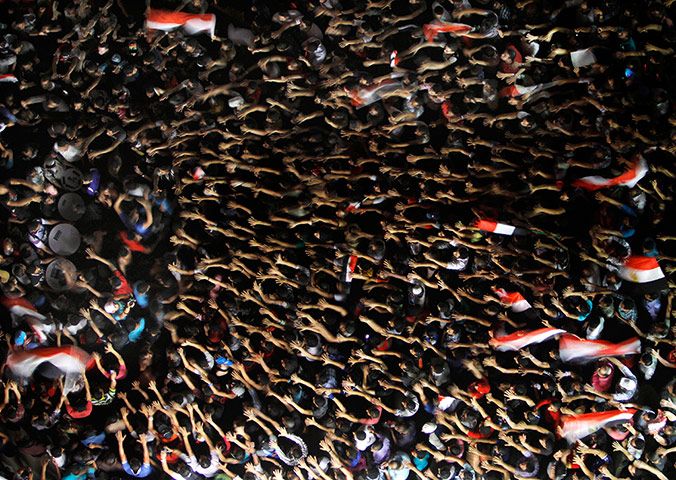 photo from The guardian
"Could there be any doubt?"
[Isam says this, 2x on two pages - p.13, 14; later Fuad says "Is there any
doubt?" - perhaps a colloquialism in Arabic? ]
"You know - you know when you slaughter a hen and the blood runs out" - his
voice was a whisper - "And the hen goes on moving, just for a moment, and then
falls down, boom, and that's it?" His eyes grew dark and his face went
gloomy. ... "People died, lots of people - and that's exactly how they died."
p.12
[gets up early to get to the paper before her father or brother. has to
refold the paper and keep it back as if new, "vexed at what what she had to
do out of fear of her father's scathing remarks."
[girl adoration of maths teacher miss nawal, who "preferred mannish
clothing", her "delicate lips would disappear whenever she tried to hold back
a smile." p.16]
[but she is weak in maths]
In Arabic composition her mind worked just fine; one word brought another,
and one sentence yielded the next, and her hand flew to keep up with her
mind: a flitting bird, streaking through the sky far above the flock... But
in arithmetic, where was she? With a grocer, selling sugar and buying oil.
With a faucet, dripping X number of times per minute. With a basin, filling
slowly to the brim with all those uncountable drops. She was with numbers
that danced before your eyes without any beauty or sense. 19
[her first period.]
"What is that bit of red on your pinafore, Layla?" her friend Adila asks.
Gamila gently drew Layla away. In the school bathroom she cut away the red
spot with a razor. 21
[I had understood the second sentence above to have occurred somewhat after
the first; and that it was Layla who cut away the spot. But the "she" in
S2 is Gamila, not Layla.
from Joseph Zeidan: Arab women novelists: the formative years and
beyond: bloodstain on Layla's skirt is removed by her cousin, not
herself.]
Her father would be happy to know [of her becoming a woman], she was sure.
as he had been when Mahmud's chin had sprouted a beard.
On that day, she recalled, her father had stopped Mahmud and had drawn him
over to the window where the light was stronger. ...
[but today] a sobbing wail - her father's tones... "Lord, give me strength!
She's just a helpless girl! Protect us, Lord, protect us! Shield us from
harm!"
[insider her bedroom] Layla tugged at the coverlet, yaning it over her body,
over her face, pulling it to the top of her head. p.23
It is only much later that she realizes why her friends had given her that
melancholy gaze, or why her father had wept.
To reach womanhood was to enter a prison where the confines of one's life
weere clearly and decisively fixed.... Prison life is painful for both the
warden and the woman she imprisons... 24
Layla's father had outlined those confines as the family sat around the
table, eating lunch.
"Layla, you must realize that you have grown up. From now on you are
absolutely not to go out by yourself. No visits. Straight from home to
school."
[Mahmud is told not to bring his girlie magazines and hide them.]
The worst of it was that she never knew what might turn out to be
"improper" or "inappropriate". A sudden laugh, straight from the heart,
was "improper." Too loud. Any frank or sincere statement was "out of
bounds". Out of what bounds? The bounds of polite conduct. 24
And then there was the matter of sitting. "Goodness, Layla! Either you
sprawl across the chair like a know-it-all or you swing one leg across the
other - what will people say?"
If she refrained from going into the living room to greet guests, her
mother accused her of being "a recluse - you don't like anyone." But if
she did go in and greet them, her mother scolded her for not conversing
animatedly. Yet if she spoke up, her mother said she was interfering in
adults' business. If she stayed, sitting in silent politeness, her mother
waved her out of the room. But whenever she tried to make a hasty retreat,
her mother would say, "Why were you in such a rush?"
"Mama I don't know what do do! You've completely confused me now.
Everything I do turns out to be wrong, wrong, wrong!"
"Whoever lives by fundamentals can't possibly go wrong."
"So what are these fundamentals?"
"The fundamentals are when one..." And so her mother would set new
limits, new restrictions... They were like water dripping rhythmically
onto a sleeping person, stealing the sleep from her eyes, drop by drop,
hour after hour, day by day, year after year.
And year after year, Layla grew. p.25-26
If she sat down she found it almost impossible to settle into any
position. She never knew where to put her hands ; they seemed bodies apart,
foreign to her. 27
in her room she could live, with her dreams and her joys, her bruises and her
longings for for things she could not even define, desires that now and
again she could feel cavorting through every speck of her being p.32
she would bury her open mouth in a heap of clothes and scream with all her
might. 33
[they are being served sherbets at Samia Hanim's] She could see her
mother's hand out, suspended in the air, while the sufragi who served
them, suddenly realizing his blunder, stepped swiftly back from her mother
with his full tray of sherbets, swinging around to offer them first to
Zaynab Hanim, the guest of importance.
The worst of it was that her mother had not even been angry.
Her mother says later: "Everyone has their own slot in this world"...
Layla: "And this Zaynab Hanim - what makes her better than you? Because
she's rich?"
Mother: Yes, because she's rich. 34
[Samia H looks to L, praising the quality of a singer. L says that "he
sounds like he's crying when he sings". SH gets up and leaves in a huff.]
Mother: If everyone said whatever was on their mind the world would have
gone up in flames long ago.
Layla: So people should just lie, you mean.
M: That's not lying -- that's being courteous. One has to make people feel
good. Flatter them.
L: even when you don't like them?
M: even when you don't like them. 35
Her father raised objections even to the thought of Layla studying
secondary school and if it hadn't been for Mahmud she would not have been
able to go on with her studies. Let alone university!! 36
photo from The guardian
"Could there be any doubt?"
[Isam says this, 2x on two pages - p.13, 14; later Fuad says "Is there any
doubt?" - perhaps a colloquialism in Arabic? ]
"You know - you know when you slaughter a hen and the blood runs out" - his
voice was a whisper - "And the hen goes on moving, just for a moment, and then
falls down, boom, and that's it?" His eyes grew dark and his face went
gloomy. ... "People died, lots of people - and that's exactly how they died."
p.12
[gets up early to get to the paper before her father or brother. has to
refold the paper and keep it back as if new, "vexed at what what she had to
do out of fear of her father's scathing remarks."
[girl adoration of maths teacher miss nawal, who "preferred mannish
clothing", her "delicate lips would disappear whenever she tried to hold back
a smile." p.16]
[but she is weak in maths]
In Arabic composition her mind worked just fine; one word brought another,
and one sentence yielded the next, and her hand flew to keep up with her
mind: a flitting bird, streaking through the sky far above the flock... But
in arithmetic, where was she? With a grocer, selling sugar and buying oil.
With a faucet, dripping X number of times per minute. With a basin, filling
slowly to the brim with all those uncountable drops. She was with numbers
that danced before your eyes without any beauty or sense. 19
[her first period.]
"What is that bit of red on your pinafore, Layla?" her friend Adila asks.
Gamila gently drew Layla away. In the school bathroom she cut away the red
spot with a razor. 21
[I had understood the second sentence above to have occurred somewhat after
the first; and that it was Layla who cut away the spot. But the "she" in
S2 is Gamila, not Layla.
from Joseph Zeidan: Arab women novelists: the formative years and
beyond: bloodstain on Layla's skirt is removed by her cousin, not
herself.]
Her father would be happy to know [of her becoming a woman], she was sure.
as he had been when Mahmud's chin had sprouted a beard.
On that day, she recalled, her father had stopped Mahmud and had drawn him
over to the window where the light was stronger. ...
[but today] a sobbing wail - her father's tones... "Lord, give me strength!
She's just a helpless girl! Protect us, Lord, protect us! Shield us from
harm!"
[insider her bedroom] Layla tugged at the coverlet, yaning it over her body,
over her face, pulling it to the top of her head. p.23
It is only much later that she realizes why her friends had given her that
melancholy gaze, or why her father had wept.
To reach womanhood was to enter a prison where the confines of one's life
weere clearly and decisively fixed.... Prison life is painful for both the
warden and the woman she imprisons... 24
Layla's father had outlined those confines as the family sat around the
table, eating lunch.
"Layla, you must realize that you have grown up. From now on you are
absolutely not to go out by yourself. No visits. Straight from home to
school."
[Mahmud is told not to bring his girlie magazines and hide them.]
The worst of it was that she never knew what might turn out to be
"improper" or "inappropriate". A sudden laugh, straight from the heart,
was "improper." Too loud. Any frank or sincere statement was "out of
bounds". Out of what bounds? The bounds of polite conduct. 24
And then there was the matter of sitting. "Goodness, Layla! Either you
sprawl across the chair like a know-it-all or you swing one leg across the
other - what will people say?"
If she refrained from going into the living room to greet guests, her
mother accused her of being "a recluse - you don't like anyone." But if
she did go in and greet them, her mother scolded her for not conversing
animatedly. Yet if she spoke up, her mother said she was interfering in
adults' business. If she stayed, sitting in silent politeness, her mother
waved her out of the room. But whenever she tried to make a hasty retreat,
her mother would say, "Why were you in such a rush?"
"Mama I don't know what do do! You've completely confused me now.
Everything I do turns out to be wrong, wrong, wrong!"
"Whoever lives by fundamentals can't possibly go wrong."
"So what are these fundamentals?"
"The fundamentals are when one..." And so her mother would set new
limits, new restrictions... They were like water dripping rhythmically
onto a sleeping person, stealing the sleep from her eyes, drop by drop,
hour after hour, day by day, year after year.
And year after year, Layla grew. p.25-26
If she sat down she found it almost impossible to settle into any
position. She never knew where to put her hands ; they seemed bodies apart,
foreign to her. 27
in her room she could live, with her dreams and her joys, her bruises and her
longings for for things she could not even define, desires that now and
again she could feel cavorting through every speck of her being p.32
she would bury her open mouth in a heap of clothes and scream with all her
might. 33
[they are being served sherbets at Samia Hanim's] She could see her
mother's hand out, suspended in the air, while the sufragi who served
them, suddenly realizing his blunder, stepped swiftly back from her mother
with his full tray of sherbets, swinging around to offer them first to
Zaynab Hanim, the guest of importance.
The worst of it was that her mother had not even been angry.
Her mother says later: "Everyone has their own slot in this world"...
Layla: "And this Zaynab Hanim - what makes her better than you? Because
she's rich?"
Mother: Yes, because she's rich. 34
[Samia H looks to L, praising the quality of a singer. L says that "he
sounds like he's crying when he sings". SH gets up and leaves in a huff.]
Mother: If everyone said whatever was on their mind the world would have
gone up in flames long ago.
Layla: So people should just lie, you mean.
M: That's not lying -- that's being courteous. One has to make people feel
good. Flatter them.
L: even when you don't like them?
M: even when you don't like them. 35
Her father raised objections even to the thought of Layla studying
secondary school and if it hadn't been for Mahmud she would not have been
able to go on with her studies. Let alone university!! 36
Hindi films in Egyptian romance?
the man she imagined, the man who would fall in love with her, would be
nothing like Sidqi.  Nor would he be like her father; in fact, he would not
be like any man she had ever met... [But there is no alternative]

Now supposing Sidqi were to fall in love with her...

They would walk into the garden.  The light of the moon would shimmer
through the tree branches, throwing golden patches onto the garden path;
the fragrance of narcissus would encase them.  In an unsteady voice from
which the usual arrogance had vanished he would say, "Layla....," as he
gazed into her eyes.  He sould sound flustered; his voice would wobble.
"Layla, there's something I want to tell you but I don't know where to
start." She would simply laugh and run ahead of him, and when he had almost
caught up she would whirl her head round and flash him a look out of the
corner of her eye.
    "What is it you want to say, Sidqi Bey?"
    "Please, Layla, please stop this Bey business."
    She would shrug lightly and bend over the basin of carnations.  She would
pick one - a red one - and bring it to her nose.  Then she would scatter the
petals, one by one, tossing them into the air.

[these origins of the romantic notion originated in persia perhaps - how
completely bollywood as well]

... but that was just Yusuf Wahbi in the movies. 37-38
[are egyptian movies stereotyped on bollywood dreams?]
Fetching a price: Women as slaves
[Layla recollects Dawlat Hanim (aunt).  She was 17 then:
    "No one's ever too young (for marriage).  Stand up, Layla."
    Dawlat Hanim facing her, probing her.  Pulling her closer, Dawlat Hanim
ran her right hand slowly from top to toe, and then from bottom to top,
stopping as it crept up to her waist and then again on her chest.
    "The girl has to have a proper dress, one that reveals her shape, and she
needs a corset to lift her breasts and keep her middle in.  As she is now,
she is a disaster."
    "Shame on you," she faced Umm Layla sternly.  "If she doesn't dress
right, she won't bring any sort of price in the market." 41
    Layla jumped up from bed.  She was nothing but a jariya, a slave in
the slave market.
    Layla sank into the cushions of the Asyuti armchair, hugging her legs to
her chest. This was life. Whenever a girl was born, they smiled in
resignation.

[There is a lot of the body in her -- which hand, which leg, how they
sprawl, how they move...]

They taught a girl to lie - to wear a corset that would pull in her middle
and lift her chest so her price would go up in the market and she could
marry.  Marry whom?  Any old person; after all, "the only thing that can
shame a man is his pocket." 41

Layla, to her mother, about Dawlat Hanim: Does she want to kill me like she
   killed her daughter?
M: Hold that tongue of yours if you want to keep it.
L (as if merely repeating a widely known fact): Didn't she kill her daughter?
M: ...Where did you hear that?
L: I just know.  I know why she killed herself too, Mama.  Did Dawlat Hanim
   make her swallow the poison?  She was the one who poisoned her life, and
   closed the doors of mercy in her face. Safaa had nothing else - no
   alternative but poison.
Her mouth wide open, Layla's mother hurried from the room 42

she heard that Safaa had killed herself by swallowing an entire bottle of
sleeping pills, which she had been taking to help her sleep in the shadow of
a husband whose pocket was the only thing that did not shame him.  What L did
not know then was that Safaa had  died on the very night that she had gone in
desperation to her mother.  Dawlat Hanim had gone by the rules -- by those
"fundamentals" - and had refused to shelter her.  She had slammed the door in
Safaa's face.  So Safaa had returned to her husband's home and killed
herself.  She had learned after a time of the love story and the request for
divorce and her husband's refusal... 43-44

At her wit's end, Layla struck her palms together soundlessly and got up to
pace the room 44
Layla joins the demonstration
The headmistress says, Woman's job is motherhood.  Woman's place was in the
home.  Weapons and fighting were for men.

A dark figure, her short curls bouncing, broke the ranks.  She mounted the
four steps and stood in front of the headmistress.  Her voice shook as it
came through the microphone.

    "Our esteemed headmistress says that woman belongs in the home and man
belongs in the struggle.  I want to say that when the English were killing
Egyptians in 1919 they didn't distinguish between women and men.  And when
the English stole the Egyptians' freedom they did not distinguish between
women and men... 48
    The woman is "Samia Zaki.  In her prep year, science division". 48-9

[She joins the demonstration despite Gamila's objections]
"Suppose your family sees you - your father, or Mahmud!" 49

[in the demonstration] she felt an embarrassed shyness about her full body
and was sure that every pair of eyes on the street was focusing on her.  The
rhythmic yells surged like waves... she felt a surge of energy.  She felt
alive, at once strong and weightless, as if she were one of those birds
circling above.  [her voice] seemed not her own, it united the old Layla with
her future self and with the collective being of these thousands of people -
faces, faces as far as she could see.  51

[this transcending feeling is like that of Bahiah in al-sadAwi's
movie, Two women in One ]

[on returning home, her father beats her with sandals]. 51-2

Everything she did, she did with her whole heart, she pitched right in, heart
and soul, and she always thought that was right, but lo and behold, every
time it turned out to be wrong.  Everything she did - mistake upon mistake,
and now, no one was left to love her. 54

Adila would have said: It was your mistake.  You didn't speak up when they
got on your case, because you're weak.  In the end, you're just a feeble
person. 54

[Isam comes to her room and is trying to pacify her.]
He leaned down and put his hand gently on her cheek, stroking it from
bottom to top, and pushing back a lock of hair that had fallen across her
forehead. 58

"Listen Isam, I'm not a child--" As angry as her voice was, she left her
sentence incomplete as she saw Isam's face convulse as if he were in severe
pain.  Beads of sweat shone on his forehead, and his breath flew hot into her
face.  She felt his body touching hers, and stepped back as far as she could,
until she was plastered against the window frame.  Isam's features relaxed,
his eyes softened, and they glowed in a way that pierced her body, a glow
that came to rest somewhere unfathomable inside of her... [59]

[The confusion of Layla's generation of women who have been exposed to a
broader education, is expressed by her friend Sanaa:]

	Our mothers were the harem - things possessed by their fathers, who
	passed them onto husbands.  But us? -- we don't have any excuses.  77

Even animals choose their mates.

For us the situation is so different, because the harem mentality has
changed.  Today's girl doesn't accept what her mother took as
given...  78

Adila: Wallahi, we're the ones in a real bind!
    At the very least our mothers knew exactly what their circumstances
    were.  We don't understand - are we the harem or not?  We don't know
    whether love is haram, prohibited by religion, or permitted, halal.
    Our families say it's haram while the state radio day and night
    sings love love love, and books tell a girl, "Go on, you're free and
    independent," and if a girl believes that, she's got a disaster on
    her hands and her reputation will to to hell.      79

diff transln :
    Our mothers knew their situation, whereas we are lost. We do not know
    if we are in a harem or not, or whether love is forbidden or
    allowed. Our parents say its forbidden, yet the government-run radio
    sings day and night about love. Books tell women they are free, and yet
    if a woman really believes that, a catastrophe will happen and her
    reputation will be blackened.
          - from http://www.aljadid.com/essays_and_features/RememberingLatifaal-Zayyat.html
[I think Booth is more lucid, and the reduplication love love love
 has a more Arabic ring to it]
ch 5 83
Isam doesn't show up for many days.  Then he comes.
   "But, you didn't come, Isam."
   He turns his face away.  "I was afraid, Layla".
   Layla's hand fluttered uncertainly to her own chest.  "Afraid -- of me?"
   "Afraid for you."
   "From what?"
   He hesitated. "From myself, and people, and circumstances... " 84

Mahmud: a man to marry he has to love, and also the girl, right?
Isam: Now suppose, for instance, that Layla was in love.  What would you do?
Mahmud: Layla! My sister Layla?
The colour drained out of Mahmud's face.
I: Just suppose.
Mahmud let out his breath and shrugged: Suppose why! Layla's young, she
   doesn't pay attention to these things.
I: See - just as I said.  It's all just high-flown, lofty talk.
   It's the one on shore who is the best swimmer.
L laughed: Yes, Mahmud.  If you found I was in love, what would you do?
M: grabbed her and yanked her:  I'd kill you.  That's what I'd do.  I'd just
   kill you.  90-91

mulukhiya: M dipped his spoon into the bowl of mulukhiya.
	[vegetable stew made from leaves of jute etc.] 91
tirmis beans : beans soaked one day w many changes of water, then boiled to
	remove bitterness 93
	http://cookeatshare.com/recipes/egyptian-tirmis-567813

Proverb: [after M decides to give up his doctor's job and fight in the Suez]
L: close the door from whence the wind comes 94
Ch 6
It rushes forth, a clear, bubbling spring.  The bogs though, have done their
best to block its passage.  Intent on sucking that lovely running water dry,
they try to absorb of it into themselves, to consume it completely, to
transform it with their sluggishness into a stagnant pond.  The spring is
still young, nevertheless, buoyant with life, excitable, and deep; and the
bogs are ancient, sedimented over their many years of existence, crouching in
quiet defiance across the land of Egypt.

The bubbling, ebullient water slowly carves a bed from the resistant
mud... pounding on, roiling, alive, moulding its destination.  Yet there, at
the end of its way, sits a dam of solid rock.

The bogs lie in sure wait, chiding the stream.  There is nothing to be gained
by pushing on, young friend, no use in rushing ahead.  The stagnant stillness
of those glinting patches speak for itself: quietude is partner to good
judgment. 98

[Mahmud and Isam will both go join the fighting in Suez]
Samira Hanim felt exactly like a beloved and loving wife who, with the sudden
discovery of her husband's infidelity, is benumbed by the shock.  98
ch 7
Mahmud's letters from the front:
I am so alive... touched by everything, every hour and minute.  When I was in
Cairo, I considered myself alive.  But now, after my latest experience, I
realize that I as mistaken.  Stasis is death, not life.
   Of course, I was afraid, at first.  Fear is what gives the struggle its
savor.  You go forward, feeling fear, for sure, but also sensing some
strength grander than yourself, greater than your fear, a force that pushes
you on ... And when it is all over youfeel so refreshed, because you realize
that you have prevailed over yourself, over your weakness as just one puny
person. 110

[Sanaa] was positively in love with love.

Sanaa: You know, Mahmud?  I must do something to prove to you how much I love
	you -- I want to die for you.
M (taking her hand tenderly): I want you to live for me, Sanaa.  Without you
	I am worth nothing. 211

---
The airplanes released more parachutists behind the wall of the airport, and
the parachutes ballooned, one after another, white, like abscesses full of
pus. 347
Characters
Muhammad Effendi Sulayman, civil servant in Ministry of Finance and resident
     of No. 3 Ya'qub Street 5
Saniya Hanim, mother - full figure and light skin is attractive.
Mahmud - elder brother, Sulayman's unquestioned favourite
Layla - young girl, good at Arabic, politically motivated
Isam, Gamila - same age [mother's sister's son / dtr, live in same bldg]
Husayn - friend of Mahmud, revolutionary
Samia Hanim, Zaynab Hanim: aunts on mother's side
Dawlat Hanim: Aunt - she follows the rules of society and marries her dtr
    Safaa to a rich old man; when Safaa runs away after being tortured, she
    refuses shelter.  Yet has high status in society
Adila : friend - tall, practical.
Sanaa : friend - romantic, loves beauty, well-off
remarks on the translation
the translation starts off very well indeed, but it becomes patchy later on.
Some plot aspects (e.g. how come Husayn knows Sana'a so well) are never
revealed.  One can sense the translator dithering in whether to give the
Arabic term or an english gloss -- halfway through the book, the term umm
starts appearing -- Umm Layla and Umm Gamrila (umm X= mother of X).

there are also some ambiguities - e.g. who removes the bloodstain of her
first period is a bit unclear in the translation (see above)

from Joseph Zeidan: Arab women novelists: the formative years_

  	father refers to daughter as wiliyyah, helpless girl.
	A huge wall always stood between [her father] and her, as if they did
		not speak the same language

--background history

By 1881, the egyptian elite was tired of European intervention.  After a
restive demonstration by the Army, the British-supported king, Khedive Tewfiq
dismissed his Prime Minister.  However, the unrest went on and in April 1882,
Tewfiq moved to Alexandria, which was protected by British warships.
Eventually, his officials were ousted by nationalists, and army officers
under Ahmed Urabi took over the government.  However, Britain landed an
army (called an "expeditionary" force) at both ends of the Suez canal, and by
September, this army had defeated the Egyptians at the Hoda Sharaawi would in 1923, be the first to remove
the veil in public, at a Cairo railway station.

[The Hizb al-Wafd حزب الوفد (Wafd Party; wafd=delegation) was an
influential political party in the 1920s and
30s, and were a key player in drafting the 1923
constitution which suggested a
constitutional monarchy for Egypt.]

Huda Sharaawi's book, "The Harem years" (mudhakkirati) (1987) is an account
of a woman's life in an egyptian elite family in the 20th century.  Sharaawi
was married off at 13, but eventually separated from her husband and was able
to complete her education.
[Badran, Margot. Feminists, Islam and Nation: Gender and the Making of Modern
Egypt. Princeton, NJ: Princeton U. Press (1995). gbook ]

In 1922, faced with increasingly violent demonstrations, Britain declared
Egyptian independence, establishing a Kingdom of Egypt under King Fuad.
After his death in 1936, Farouk became king.  At this time, Mussolini annexed
Ethiopia, leading to widespread anxiety in Egypt.  This was assuaged by the
treaty of 1936, in which Britain theoretically withdrew from Egypt, though it
retained control over the Suez Canal Zone, which was to be evacuated in
1949.

After the ignominous Egyptian defeat in the 1948 Arab-Israeli war (al-nakba)
there were widespread charges of royal incompetence and corruption.
Fedayeen
Widespread protests culminated in armed insurrections by small groups of
fedayeen, who were tacitly supported by much of the army and police.
These groups of civilians volunteers went to fight the British in the zone
around the Suez Canal.

On January 25, 1952, at Ismailia (on the Suez), a brutal one-sided
suppression of a police barracks harbouring some fedayeen led to widespread
riots, called the Cairo Fires, in which 750 buildings were looted and
many of them set afire.

On 22 July, an army coup led by Nasser evicted the King.

Latifa al-Zayyat wrote the immensely popular al-Bab al-maftuh_.  (1960).
In 1996, the American University of Cairo Press instituted the Naguib Mahfouz
Medal as an award for untranslated works of contemporary Arabic literature,
which would then be translated by the Press.  Though al-Bab al-maftuh_ had
been written decades ago, it was one of two books awarded in 1996, the
inaugural year of the award.  It was translated by Marilyn Booth in 2002,
but is no longer available on the press catalogue
author bio: Latifa al-Zayyat (1923-96)
was born in the city of Damietta in the Nile Delta of Egypt where she
received her schooling. Did her BA from Cairo University in 1946. As a
student she joined the nationalist movement and was elected General
Secretary of the Committee of Students and Workers, and was imprisoned in
1949.

In 1957, she took her doctorate on Arabic Literature from England and was a
professor of English at Ain Shams University, Cairo. Two of her novels, The
Owner of the House and The Open Door, have been translated into English.
Excerpts from Obituary by Amal Amireh
			Al Jadid magazine, Vol. 2 No. 12 (October 1996)
			http://www.aljadid.com/content/remembering-latifa-al-zayyat


Al-Zayyat came of age as a woman, artist, and intellectual through living
some of the most defining moments in her country's modern history. She was
shaped by events and she helped shape events, emerging in the process as a
new model for Arab womanhood.
A Moment of Transformation
In 1934, an 11-year old girl stood on the balcony of her Al-Mansoura house
looking at the street below. A battle was raging: on one side were fellow
Egyptians protesting the British presence in their country and a corrupt
palace complicit with imperial powers, on the other was the armed
police. Open-eyed, the girl watched, and 60 years later, al-Zayyat described
how she felt on that blood-stained day:

	I trembled with feelings of powerlessness, of misery, of oppression,
	as the bullets of the police killed fourteen demonstrators that
	day. I screamed for my inability to act, I screamed for my inability
	to go down to the street to stop the bullets from coming out of the
	black guns. I shed the child in me and the young woman came of age —
	prematurely — for I encountered knowledge that went beyond the home
	to include all of the homeland. My future fate was decided at that
	moment...

Not long after, as a secondary school-student, al-Zayyat took to the streets
herself, joining in the anti-British demonstrations. Her political activities
would only intensify with time. As an undergraduate at Cairo University, she
became involved with leftist groups on campus and in 1946 was elected
secretary of The Students’ and Workers’ National Committee, which led Egypt's
independence struggle during that period. The fact that the students and
workers should choose a young woman to lead them attests both to the
progressive nature of the national movement at the time and to the remarkable
abilities of al-Zayyat herself.

This early involvement in the national struggle affected al-Zayyat deeply and
transformed the polite middle-class woman into a fighter. In al-Zayyat's
words, "It was during those years that the timid girl, who had carried her
plump body as if it were a sin, developed into a group leader: daring,
confronting, arguing, making rapid decisions, and thriving with pride in her
abilities."

And for preferring the fiery speeches of the barricade to the polite
conversations of the living room, al-Zayyat paid a price. She was imprisoned
twice at the age of 26 and received a three year suspended jail sentence. But
it was worth it. For her early political experience enabled her to form a
sense of self that would guide her throughout the rest of her life. She
discovered that through activist work, "the personal self dissolved only to
be enriched by the collective one." Al-Zayyat described the effects of this
dynamic relation between the individual and the group: "I was rendered an
active responsible human being, open to my country and my people, and
preoccupied with their concerns." She insisted that "paradoxically, one can
only find one's self by initially losing it into a much wider issue than
one's own subjectivity, into a reality bigger than one's own."
The Open Door to a Glorious Future
"Al-Bab al-Maftooh" (The Open Door , 1960), al-Zayyat's first (and for a long
time only) novel, deals with the multiple layers of experience. While not
strictly autobiographical, the author revisits her university days and
creates a heroine after her own heart. The novel tells the story of Layla, a
young woman from the Cairean middle class. Layla's psychological, social, and
political growth takes place in the context of the years from 1946 to 1956 —
years that witnessed the revolt against the British and the Palace, the Free
Officer's Revolution of 1952, Jamal Abdul Nasser's nationalization of the
Suez Canal, and the Israeli-British-French attack that followed.

Layla's personal travails begin when she menstruates for the first time, an
event which brings tears of humiliation and distress to her father's
eyes. Determined to guard his honor against any future stains, he restricts
his daughter's movement and arranges for her to marry her cousin.

For al-Zayyat, the father represents not only an older generation unable to
cope with the realities of life, but also a rotten middle class with no
future vision to guide the country. Layla, however, is the New Woman who,
thanks to the education her class gave her, developed a different sense of
self from the one prescribed by her conservative upbringing. One of the women
characters describes her generation's dilemma this way: "Our mothers knew
their situation, whereas we are lost. We do not know if we are in a harem or
not, or whether love is forbidden or allowed. Our parents say its forbidden,
yet the government-run radio sings day and night about love. Books tell women
they are free, and yet if a woman really believes that, a catastrophe will
happen and her reputation will be blackened."

Layla begins to feel empowered when she takes part in anti-British
demonstrations: "She was fused in a whole, pushing her forward, embracing her
and protecting her. She shouted anew in a voice different from hers, a voice
which unified her being with a collective one." Eventually, she becomes a
school teacher in Port Said. When the Suez Canal war occurs in 1956 she
participates and gains the courage that allows her to break up with her
conventional fiancee and attach herself to a revolutionary colleague.

"The Open Door" is a pioneering work on many levels. According to the critic
Farida al-Naqash it

	was an expression of a new wave in the Arabic novel, one
	that combines poetic realism with committed literature.

In probing the relationship between nationalism and feminism — in showing
their interdependence — al-Zayyat dealt with a complex issue that is still a
hot topic of debate among Arab feminists. The novel expresses the optimism of
the post-revolutionary period, when a young generation of Egyptian men and
women looked forward to a hopeful future.

The same novel is now "an impossibility," al-Zayyat said a few years
ago. When she wrote it she shared with her audience a common language and a
common vision. But things have changed. According to her, "roads to salvation
are blocked; the common ground of shared values seem to break down into
multiple different sets of values according to the varied social strata; the
common sensibility and its language is no more; people lacking national unity
are divided and subdivided until each is turned into an insular island." One
Egyptian critic recently wrote that his female students don’t see themselves
in the heroine of "The Open Door. They no longer believe that what Layla
achieves by the end of the book is possible for them.

"The Open Door" was simultaneously a product of its time and ahead of
it. This is perhaps why the cinematic version of the novel, directed by Henry
Barakat and starring Fatin Hamama and Mahmoud Mursy, was a commercial failure
when it was first released in 1962. Barakat attributes this failure to the
audience's opposition to the theme of women's liberation (even though the
film alters the ending by showing that the change in the heroine is brought
about by the man with whom she falls in love). But the film is well-received
now whenever it is shown on Egyptian television, which probably reflects the
audience's nostalgia for the by-gone time of high revolutionary tide.

Setbacks

Ironically, al-Zayyat wrote her most optimistic book at a very difficult
period in her life, as if she were turning to the past for help. During her
thirteen-year unhappy marriage to Dr. Rashad Rushdi, a right-wing critic with
ideological and political views diametrically opposed to hers, she wrote
little and left political work altogether.

In her autobiography, "Hamlat Tafteesh: Awraq Shakhseyyah" (Search Operation:
Personal Papers, 1992) she dissects herself with brutal honesty, describing
her condition as one of "paralysis," in which she lost her ability to
act. Such a state, she believes, was brought about by her desperate search
for personal happiness, which led her to merge herself with her husband. But
al-Zayyat discovers that happiness sought at the expense of the integrity and
autonomy of the self is "illusionary happiness." "I realize now," she wrote
in 1992, "that my love was a loss in the other and that this is an
unforgivable crime because I was the one who committed it. For there is no
worse crime than burying one's self alive. My hands are stained with my own
blood." The marriage ended in 1965 with a painfully public divorce.

After the divorce, al-Zayyat resumed her suspended activities. Between 1965
and 1968 she contributed a column on women's issues for Hawa (Eve) magazine,
and in 1966 she wrote a three-act play called "Bay’ wa Shira" (Selling and
Buying). This play did not see the light until 1994; al-Zayyat felt that its
theme, love versus possession, was trivial next to the horrors of the 1967
Arab defeat against Israel.

In "Hamlat Tafteesh," al-Zayyat wrote that she felt personally responsible
for that defeat. A few days after the war, during a meeting attended by 50 of
Egypt's most prominent writers, she pointed an accusing finger at her
audience and herself: "Each of us is responsible for this defeat," she
proclaimed. "If we had said "NO" every time a wrong was done, we would not
have been defeated... If all the intellectuals said no, they would not have
been able to jail us all."

Overwhelmed with feelings of anger and guilt, al-Zayyat the artist stopped
writing. "After the 1967 defeat, I hated words and, consequently,
literature. I confined my readings to history and economics, and I wrote that
a single bullet against the enemy was more significant than all the words in
the world..."
New Beginnings
One of al-Zayyat's most important political activities was forming and
heading the Committee for the Defense of National Culture, which spearheaded
the efforts against the normalization of cultural relations with Israel. In
1981, along with 1,500 other Egyptians including her brother, al-Zayyat was
thrown in jail by Sadat. There she learned that her house had been under
surveillance for the previous three years. She also found that prison can be
a rich experience, "provided one manages to discover her inherent human
potential, and to hold to this with all the pride of a human being capable of
adapting to all circumstances and also capable of surmounting all
circumstances... this experience reveals that person's fundamental nature,
either as clay (lacking in form and will), or alternately as ceramic
revealing the human ability to shape the self and to create beauty."

Prison seems to have rejuvenated al-Zayyat's creativity. She wrote her
memoirs while incarcerated. Later, she published a collection of short
stories called "al-Shaykhukha wa qisas ukhra" (Old Age and Other Stories,
1986), the novella "Al-Rajul al-lathi ‘Arifa Tuhmatuh" (The Man Who Knew His
Charge, 1995), and the novel "Sahib el-Beit" (The House Owner, 1995 — the
English translation of this book is currently in press). Her autobiography is
forthcoming in French, German, and English translations. But for now, the
only work available by her in English is the short story "The Picture."

"I don’t have any regrets," al-Zayyat responded when asked to evaluate her
life and achievements. She went on to say: "Perhaps it would have been
possible for me to be a better writer, or a better fighter, or a better
professor if I had confined myself to one role. But my languages are
multiple. And it is through my use of these many languages that I have
enriched myself and others."


---blurb

The Open Door is a landmark of women's writing in Arabic. Published in 1960,
it was very bold for its time in exploring a middle-class Egyptian girl's
coming of sexual and political age, in the context of the Egyptian
nationalist movement preceding the 1952 revolution. The novel traces the
pressures on young women and young men of that time and class as they seek to
free themselves of family control and social expectations. Young Layla and
her brother become involved in the student activism of the 1940s and early
1950s and in the popular resistance to continued imperialist rule; the story
culminates in the 1956 Suez Crisis, when Gamal Abd al-Nasser's
nationalization of the Canal led to a British, French, and Israeli
invasion. Not only daring in her themes, Latifa al-Zayyat was also bold in
her use of colloquial Arabic, and the novel contains some of the liveliest
dialogue in modern Arabic literature.
bookexcerptise is maintained by a small group of editors. get in touch with us! bookexcerptise [at] gmail [dot] .com. This review by Amit Mukerjee was last updated on : 2015 Apr 02