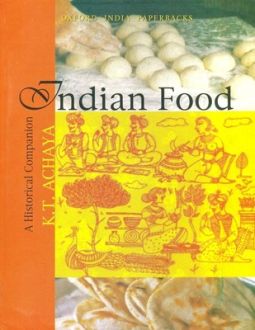
Indian food: A Historical Companion
K. T. Achaya
Achaya, K. T.;
Indian food: A Historical Companion
Oxford University Press, 1998, 340 pages
ISBN 0195644166, 9780195644166
topics: | food | india |
A chemist by training, Achaya was a polymath scholar who wrote on a wide variety of topics from technical texts on oil and oilseeds to the atharva veda.
This volume covers the history of food in India based on a fascinatingly wide range of evidence. Among the earliest are the stone age cave paintings at bhimbetka - about 30,000 years ago - that show hunting of boar and even elephant, and also what looks like women grinding spices. In the bronze and iron age, we have archaeological evidence from harappan times - pulses such as the pea and the chAnA or chick pea is found from middle Harappan site at Kalibangan and the late Harappan area at Daimabad in North Maharashtra.
Other ancient evidence cited includes clay tablet records from Mesopotamia (Sumer) dating to 2300 BC, which refer to a type of oilseed as se-gis-i, which is thought to be the sesame, which was brought in via trade routes from India.
Achaya, a noted sanskrit scholar who has also written a critical analysis of the atharva veda, now turns to the vedic texts. While finding that some of the food evidence in the vedas are hard to rely on, there is no doubt that cow sacrifice was a common practice; usually barren cows would be "destined for the gods" (p.55); clearly the prasAda would be consumed by the worshipper. This is a tradition that stopped a few centuries after Buddha. The prohibition for beef, as is well known today, is not a part of whatever may be "sanAtan" in our "dharma"...
Later texts like the mahAbhArata are cited for a wide range of facts - e.g. there was a systematic cultivation of beehives and procedures (laid out for apiaries) in order to extract honey.
In South India, the late sangam texts (6th c.AD) mention the dosai, but not
the idli, which in its present form, is suggested to be an import from
Indonesia with which wide trade links existed since the seventh cnetury.
Possibly a cook in a king's kitchen may have brought back the idea of
fermentation and steaming.

A Kannada text from 920 Ad refers to "iddalige".  In the five volume
encyclopedic compendium, mAnasollAsa, composed in sanksrit by the
Chalukyan king Somadeva, son of Vikramaditya Chola, c.1130 AD, we find a
reference to a fried urad ball called "iddarika" rubbing shoulders with
accounts of how to sexually pleasure a woman.
Food Rituals
Other chapters deal with fascinating details - such as the ritual use of
food, which always puzzled me as a child growing up in a brahmin household -
the logic of what is allowed, and what is debarred always baffled me.
Acchaya also mentions some rules for these distinctions -- such as the
separation between kaccha and pucca foods - mostly kacchA food (uncooked
food, non-cereals or fruits) are permitted on fast days - originated for
observing various hindu days such as Rama Navami, Shivaratri, or ekAdashis.

A chapter deals with Mughal food traditions,  It is interesting to note that
even a prototypical hindu food like khichri, eaten on observation days, also
came from the persian-arabic world, as did the quintessential indian
sweetmeat of jalebi (zalabiya in Arabic).


This volume is a more elaborate and scholarly text, but a short and
readable account may also be found in The story of our food by Achaya,
written a couple of years later to simplify the account presented here.

The following excerpts from two articles that appeared in the Hindu covers
a broad sweep through the text.

What I like about this scholarly work is how knowing the history of food
can reduce the vehemence with which some religious attitudes are
maintained. well it may not in practice, but at least it ought to.
Extensive Summary by D. Balasubramaniam
  	    The following is based on two articles titled "Changes in the
  	    Indian menu over the ages", published by D. Balasubramanian in
  	    the Hindu in 2004
		- Part I
		- Part II


It was two years ago that we lost the eminent food scientist
Dr. K.T. Achaya. His books - Indian Food, A Historical Companion, The Food
Industries of British India, and A Historical Dictionary of Indian Food (all
published by Oxford University Press, India) - are a scholarly fund of the
history and development of India cuisine.
Idlis : Indonesian import?
They educate as they enlighten and entertain, and occasionally shock us. For
example, he points out authoritatively that while Dosai and Vadai have a
hoary two-thousand-year history in Tamil country, Idli is a foreign
import. The earliest reference to something of a precursor to Idli occurs in
the Kannada writing of Sivakotyacharya in 920 AD.
[this work mentions 'iddalige', which may be the origin of idli; but this
was made from urad dhal batter only.]  The subsequent Sanskrit Manasollasa
(1130 AD) has 'iddarika', but again made from urad dhal flour only.
Tamil apparently only first mentions 'itali' in the 17th century. All these
references, Achaya notes, leave out three key aspects of idlis: "the use of
rice grits along with urad dhal; the long fermentation of the mix; and the
steaming of the batter to fluffiness."  Vikram Doctor, Eco Times

Indeed, the Chinese chronicler Xuang Zang (7th century AD) categorically
stated that there were no steaming vessels in India. Achaya writes that the
cooks who accompanied the Hindu Kings of Indonesia between 800-1200 AD,
brought fermentation and steaming methods and their dish Kedli to South India
(Thirai Kadal Odiyum Tinpandam Thedu!)

Happily enough, ancient Indian literature left a lot of information on extant
vegetables, pulses, meat, spices, fruits, cooking methods, and even an
occasional recipe or two. The history of Indian cuisine can be divided into
several stages or periods. The earliest period is before 1500 BC or the Vedic
period.

The Harappan civilization was known to have rice, barley, wheat, oat,
amaranths, jowar, sesame, mustard, chickpeas, masoor, mung and horsegram
(kulti, ulavulu), dates, pomegranates, and perhaps bananas. Bones of
numerous animals attest to meat (and fish) eating.  The large granaries of
Mohenjodaro, Harappa and Lothal attest to a sophisticated, aerated,
rodent-free storage practice. But, as of date, no recipe has been
discovered so that we do not know what a typical Indus valley supper menu
contained.
Vedic period
We are more fortunate when we turn to the Vedic period (approximately 1700
BC). The Rig Veda mentions rice, cereals and pulses (masha (urad), mudga
(moong) and masura (masoor)) green leafy vegetables (spinach), melons,
pumpkins and gourds and in particular lotus stem, cucumber, bottle-gourd,
water chestnut, bitter gourd (karavella), radish, brinjal, some aquatic
plants (avaka, andika), and fruits such as mangoes, oranges and
grapes. Spices such as coriander, turmeric, pepper, cumin, asafoetida,
cloves, sesame and mustard were well known, and at least the first four ones
are thought to be Indian in origin. Meat eating was prevalent. Pigs, boar,
deer, bovines and peacocks were eaten, though chicken (which, though
originated in India) was not that desirable. They seem to have been forbidden
or discouraged from eating eggs of any kind and in any manner.

Turning to Mahabharata, a graphic description of cooking at a picnic has been
provided on roasting large pieces of meat on spits, cooked with tamarind,
pomegranates and spices with ghee and fragrant leaves. King Yudishtira is
said to have fed 10,000 scholars with pork and venison, besides preparation
of rice and milk in ghee and honey with fruits and roots (Payasam).

It was after this time that a change in our food habits occurred. The Dharma
Sutras, Manusmriti and related texts of 500-300 BC began forbidding and
proscribing food items based on their `temper' (sattvik - peaceful and
ascetic, rajasik medium, energetic that can be either positive or negative,
and tamasic or coarse, rough and not all that nice), and prohibiting as many
as 54 items (in particular a variety of animals) from the `proper' kitchen.

The teachings of Buddhism and Jainism against meat eating had taken hold by
this time, and a turn towards preferential vegetarianism began to be
expressed in Hindu texts as well.

These, plus the diktats on satvik, rajasic, and tamasic practices changed the
face of Indian gastronomy already around 300 BC.
Medieval Foods
By the time we reach the Middle Ages (1000-1200 AD), we find several texts
and commentaries across the country that talk about culinary habits of local
people and their kings. A meal was now expected to have six components of
quality and taste:

	- madhura (sweet)
	- amla (sour)
	- lavana (salty)
	- kata (pungent)
	- tikta (bitter)
	- kasaya (astringent)
[These appear earlier, in Sushruta (around 600 AD)].
Shrenika's feast
The Bhavissayattakaha (of AD 1000) describes the royal meal of King Shrenika
thus. First were served fruits that could be chewed (grape, pomegranate,
ber), then fruits to be sucked (sugarcane, oranges, mangoes).

Food that could be licked came next and in the fourth course came solid sweet
items such as sevaka, modaka and phenaka. Rice followed next and the sixth
was of broths. Curd preparation made the seventh course and the eighth ended
with thickened milk flavoured with saffron. Items such as parpata (papad) and
vataka (vadam) were common.
Foods from the Portuguese
The extant vegetables ranged pretty much as before - cucumber, brinjal, snake
gourd and other gourds, yams, French beans and cluster beans, leafy greens,
onions and garlic, coconut, cowpea, sweet potato (?) and such. It was with
the entry of the Portuguese that a floodgate of new vegetables entered the
Indian land and kitchens.

They brought potato, tomato, tapioca, groundnuts, corn, papaya, pineapple,
guava, avocado, rajma (kidney bean), cashew, sapota (chiku), and of course
capsicum and chilli in all its forms (and I felt bad hearing about idli
importation!). Perhaps the cauliflower and cabbage came from Europe or Latin
America too, but certainly a particular form of cottage cheese did come from
the Portuguese. It was this that became the chhana of Bengal and Orissa - the
base for many Bengali sweets (Sandesh in its modern form, and of course
inventions called Rasogolla, Khirmohan, Mouchak, Pantua, Sitabhog, Chhena
Puda, and so forth).

The Portuguese word for grain, grao, was taken up to describe Indian pulses
as Bengal gram, horse gram and other grams. While the Arabs and Central
Asians brought bajra, jowar, lobia and forms of bread (roti) into India, the
Portuguese enriched Indian food through their diverse introductions. When we
eat Aloo-poori, we partake of the richness of the produce of people from West
Asia and Latin America!
Mughal influence
The next major influence on Indian cuisine came with the Mughals, starting
with Babar who came in 1526 to stay but four years here. While he remained
aloof to the Indian supper-tables, his son Humayun took to them easier and
also introduced a few new items to it. It is with Akbar, and through the book
Ain-i-Akbari, that we know of many new dishes, ovens and recipes that came
into India through the Mughal court, including dishes such as:
	- khichri                 	- kabab
	- palak-sag			- do-pyaza
	- biryani			- dumpukht
	- pilaf				- naan
	- haleem			- tandoori
	- harisa			- chapati (phulka)
	- qutab (samosa)		- khushka
	- yakhni

uzbek samsa
[AM: The samosa is believed to have originated in C. Asia in the
10th c.  It is a popular snack across Uzbekistan and Kazakhstan,
where it is known as samsa. It finds mention in the work of the
Iranian historian  Abul-Fazl Bayhaqi (d.1077).  It arrived
in India around 13th c. most likely through silk route traders.

from samosa-connection.com:

   Amir Khusrao, prolific poet of Delhi royalty, observed in 1300 that the
   royal set seemed partial to the "samosa prepared from meat, ghee, onion
   and so on". In 1334, the renowned traveller Ibn Battuta wrote about the
   sambusak: "minced meat cooked with almonds, pistachios, onions and
   spices placed inside a thin envelop of wheat and deep-fried in
   ghee". And the samosa obtained a royal stamp with its inclusion in the
   Ain-i-Akbari which declared that among dishes cooked with wheat there is
   the qutab, "which the people of Hind called the sanbusa".
]

Some things seem to have remain unchanged from the days of Akbar:
The delicious cold kulfi was made at court by freezing a mixture of khoa,
pista nuts and zafran essence in a metal cone after sealing the open top with
dough. (The only modification today is to use aluminium or plastic cones with
their own caps). Jahangir, unlike his father, enjoyed meat, but will be
remembered for popularizing falooda (a jelly made from boiled wheat
strainings mixed with fruit juices and cream).

With the Mughal introduction of the varieties of bread, meat dishes
(particularly of fowl) and the ovens to make them, and their methods to make
ice locally, the cuisine of much of North India transformed forever.

The Chinese had their influence too, though not to the extent of the
Portuguese and the Moghuls. Mulberry, blackberry and the litchi fruit came to
us through them. Of Chinese origin are also the sweet cherry and the
peach. China also developed the leafy variety of Brassica juncea (rai), which
we in India use as a vegetable. Camphor is a Chinese import and introduction
(it is even today called chinakarpura).

The soybean was imported from China into India in 1908 for cultivation,
though it caught on widely only after the U.S. variety was introduced in
1970s. And the most precious introduction of China to India (and to the world
at large) is of course their cha or teh, namely tea. Just imagine what we do
first thing in the morning - we pay obeisance to the Arabs with a cup of
coffee (they brought it to us in the 1600s) or to the Chinese with our
steaming cuppa.
British : meager food imports
Compared to this cornucopia, the British brought us little in terms of
food.

[Indeed most of the food exchange went the other way; one of the most popular
takeout food in britain today is curry ; going by spices sold, Indian food is
also cooked extensively in British homes.]

Local varieties of apple are recorded to have occured in Kashmir (called
amri, tarehli and maharaji), and Dalhara in 1100 AD talked about a "ber as
big as a fist and very sweet, grown in North Kashmir", which is likely an
apple. But it was the colourful Britisher Frederick "Pahari" Wilson who
established a flourishing apple farm in Garhwal, where they grow red and
juicy Wilson apples to this day.

Also, we must express our gratitude to the American Mr. Stokes, [who] settled
in Kotgarh near Simla in the 1920s and started apple orchards there, and
helped in the proper grading, packing and marketing of the fruit.

The two varieties he introduced, called `Delicious', have now become the
major Indian apple varieties, making the Himachal apple growers happy and
more prosperous than before. He married a local girl and settled down.
His descendants Smt. Vidya Stokes (politician) and Dr. Vijay Stokes
(scientist) are well known. Though Australian apples are increasingly found
in the Indian market, it is still the Delicious that rules the roost. Next
time you bite into an Indian apple, you are celebrating Indo-American amity!
Today's India : Not mostly vegetarian
Contrary to popular belief, India is not a predominantly vegetarian
country. But a quarter of the population is reckoned, based on census data,
to be vegetarian.
    Gujarat : 69 per cent is vegetarian,
    Rajasthan : 60 per cent
    Punjab-Haryana : 54 per cent
    Uttar Pradesh : 50 per cent
    Madhya Pradesh : 45 per cent
    Karnataka : 34 per cent,
    Maharashtra : 30 per cent
    Tamil Nadu : 21 per cent
    Andhra Pradesh : 16 per cent
    Assam : 15 per cent
    Kerala, Orissa and West Bengal : 6 per cent vegetarian

While part of this vegetarianism is economic, a more compelling force is
ethical and even religious. Jains avoid meat totally while many Buddhists
in India are vegetarians.

Brahmins, Saivite non-Brahmins of South India and several Vaishnavite sects
across the country avoid meat. Interestingly though Brahmins of East India,
Kashmir and the Saraswats of the Southwest are allowed fish and some meat.

Even among meat-eaters, beef was and is taboo. This practice seems to be at
least 2000 years old (Achaya quotes DD Kosambi, who quotes the Vedic sage
Yagnavalkya as preferring it. Vasishta, Gautama, Apasthamba and Baudhayana,
in their Sutras (ca. 300 BC) prohibit killing cows and oxen and eating
beef. It had become prevalent by 1100 AD across India, since Al-Biruni wrote
that while beef eating was prevalent earlier, it was not allowed later.

Achaya gives economic, ethical and respect for its use as reasons. Emperor
Humayun (16th century) is quoted as saying "beef is not a food fit for the
devout" and avoided it. Akbar too was similarly respectful. And while
Tamils of the Sangam period relished beef (Perumpanooru describes it), it
became taboo or discouraged after the advent of people from elsewhere. As a
result, much of India and certainly many Hindu communities avoid beef
eating.
Contents
Chapter 1 : Ancestral legacies
   The world, man and his food                       1
   Tools of early man in India                       1
   The first paintings                               5
   Language and food                                 7
   Words for food in Sanskrit                        7
     Box 1: A Word Puzzle                            9
   Indian words in foreign tongues                  11
Chapter 2 : Harappan spread
   Origins                                          13
     Box 2: Weighing, Measuring, Counting           14
   Foods raised in the Indus Valley                 15
   Raising crops                                    19
   Methods of storing food                          21
   Ways of preparing and eating food                23
     Box 3: Extracting Metals, and Using Them       25
   Trade                                            26
   Decline of the Harappan Civilization             27
Chapter 3 : Foods of the gods
   The Aryans                                       28
   Vedic Agriculture                                28
     Box 4: Sanskrit Sources                        32
   Cereals and pulses                               33
   Milk Products                                    34
   Fruits and vegetables                            35
   Oilseeds and oils                                36
   Salt, spices and condiments                      37
   Sweet foods                                      37
     Box 5: The Mysterious Soma                     38
   Water and other beverages                        39
   The expansion of the Aryans                      40
Chapter 4 : The foods of south india
   Influences on the food culture of the south      41
   Archaeological food finds in south India         42
   Food in Tamil literature                         43
     Box 6: Tamil Literature                        44
   Rice in southern diet                            45
   Other foods of the south                         46
     Box 7: Chewing the Betel Leaf                  48
   Trade in food in ancient south India             50
Chapter 5 : Meat and drinks
   The prevalence of meat-eating                                     53
     Box 8: The Dressing of Meat                                     54
   The emergence of prohibition and the spread of vegetarianism      55
   Alcoholic beverages                                               57
     Box 9: A Choice of Liquors                                      59
Chapter 6: Indian food ethos
   Aryan Food beliefs                                                61
   The idea of food                                                  61
   The classification of food                                        61
   Kaccha and pucca food                                             62
   Pollution and food                                                63
   Domestic cooking practices                                        64
   Eating rituals and ceremonies                                     64
     Box 10:  Hindu food taxonomy                                    65
     Box 11:  Good host and honoured guest                           66
   Festival and temple foods                                         69
   Fasts                                                             69
   Buddhist food concepts                                            70
   Jain ethos                                                        72
   The Sikh dispensation                                             72
   The Jewish food laws                                              73
   The Christian ethic                                               74
   Food among the Parsis                                             74
   Food and Islam                                                    75
Chapter 7 : Food and the indian doctors
   Hot and cold foods                                                77
     Box 12: Fathers of Indian Medical science                       78
   Recommended amounts and kinds of food                             79
     Box 13: A Widespread Food Theory                                80
   Foodgrains                                                        82
   Oilseeds and oils                                                 83
   Vegetables and fruit                                              83
   Milk and its products                                             83
   Flesh foods                                                       84
   Sweet items                                                       85
   Salt, Vinegar and asafoetida                                      86
   Water                                                             87
   Therapeutic diets                                                 87
Chapter 8 : Royal Fare
   Manasollasa                                                       88
   Rice, wheat and imagination                                       88
     Box 14: Royal Authors                                           89
   Meat for a King                                                   90
   The many wonders of milk                                          91
   Satisfying a sweet tooth                                          91
   Foods of a royal couple                                           92
   Karnataka                                                         92
   Royal feasts                                                      92
   Dining together                                                   92
   Sivatattvaratnakara                                               93
   The royal kitchen and cooking accoutrements                       93
   Kinds of food                                                     94
   Accompaniments                                                    94
   North India                                                       95
   Epic feasts                                                       95
   Three royal meals                                                 95
     Box 15: Royal Recipes                                           96
Chapter 9 : Utensils and food preparation
   Domestic operations                                               98
   Grinding and pounding                                             98
   Ways of cooking                                                   101
   Kitchen and table utensils                                        103
     Box 16: Utensils of the Vedic Sacrifice                         104
   Large-scale operations                                            108
   Professional cooking and dining                                   108
   Alcoholic drinks                                                  108
   Parched, puffed and parboiled rice                                110
   Oilseed processing                                                110
   Sugarcane pressing and juice processing                           112
   Honey                                                             114
   Salt                                                              114
   Cold Water and ice                                                115
     Box 17: Water-ices and Ice-Creams                               116
Chapter 10 : Regional cuisines
   South India                                                       118
     Box 18: Karnataka Food Progression                              119
   Karnataka                                                         118
   The Kodavas                                                       122
   Hyderabad                                                         123
   Kerala                                                            123
     Box 19: Snacks of the South                                     125
   Eastern india                                                     128
   Bengal                                                            128
   Assam                                                             128
   Orissa                                                            133
   Western India                                                     133
   Gujarat                                                           133
     Box 20: Sixteenth-Century Gujarathi Dishes                      135
   Bohri Muslims                                                     136
   The Parsis                                                        136
   Goa                                                               136
   The East Indians                                                  137
   North India                                                       137
   Kashmir                                                           137
     Box 21: Breads of India                                          138
   Rajasthan                                                         140
   Uttar Pradesh and Bihar                                           140
Chapter 11 : Food tales of the early travellers
   The Greeks and the foods of India                                 142
   Seekers from China                                                145
   Arab reactios                                                     151
     Box 22: Foreign Snapshots of Indian Kings                       146
     Box 23: Trees of the Buddha                                     149
Chapter 12 : Muslim bonus
   The Sultan's etiquette                                            154
     Box 24: The Jilebi                                              155
   The food of the gentry                                            156
   Kings' drinks                                                     157
   The Imperial cuisine                                              158
   The fruits of Hindustan                                           159
     Box 25: Only Ganges Water for the Emperor                       161
   The common fare                                                   162
Chapter 13 : The coming of the europeans
   The early comers                                                  163
   On the wonders of Vijayanagar                                     165
     Box 26: Cities of Yore                                          166
   Scientist travellers                                              168
   The Jesuits                                                       169
   British narratives on Indian food                                 170
     Box 27: Heady Stuff                                             171
   The diaries of a mixed bouquet of visitors                        173
   Colonial repast                                                   176
Chapter 14 : Staples of yore
   Cereals                                                           179
     Box 28: Plant Evolution                                         180
   Pulses                                                            188
   Oilseeds                                                          193
     Box 29: Seeds as Weights                                        195
Chapter 15 : Pleasing the palate
   Tubers                                                            198
   The edible aroids                                                 198
   Yams                                                              198
   Sweet potato                                                      199
   Vegetables                                                        199
   Green leafy vegetables                                            199
   Radish and carrot                                                 200
   Brinjal, bhendi and ambadi                                        201
   Fruits                                                            202
   Melons, gourds and pumpkins                                       202
   Early fruits                                                      204
   Major cultivated fruits                                           206
   Plums, pears, apples and their like                               206
     Box 30: A Bunch of Bananas                                      207
     Box 31: Citrus Relatives                                        211
   Spices and condiments                                             213
   Pungent spices from below the ground                              214
   The Pepper family                                                 214
   Other spices                                                      215
   The Sugarcane                                                     215
   Origin                                                            215
Chapter 16 : Bounty from the new world
   Oilseeds                                                          218
   Nuts                                                              222
   Fruits                                                            223
   Vegetables                                                        225
   Pleasurable foods                                                 227
     Box 32: Early Animal Transfers                                  234
     Box 33: Reaching America Before Columbus                        236

   References                                                        239
   Glossary and Index of non-English words                           260
   Index of Latin names                                              285
   Author Index                                                      291
   General Index                                                     298
Reviews : product descr (amazon)
The cuisine of India is as ancient as it is varied, and in this attractive,
oversized volume, food expert A.K. Achaya captures the full range and history
of the Indian diet, from prehistoric times to the modern era. An informative
volume that boasts over 150 black-and-white illustrations (including line
drawings, photographs, and maps) and 55 color photographs on 20 plates,
Indian Food draws on archaeology, anthropology, literature, philology, and
botany to cook up a smorgasbord of fascinating facts about this exotic fare.

Achaya begins with the earliest food preparations of paleolithic and
neolithic times, the cooking of the Harappan people (archeological evidence
suggests they may have eaten baked chapati--griddle-roasted wheat cakes--food
still popular today). He covers the diet of the Aryans (using information
found in their rich Vedic literature); examines regional cuisines, such as
those of Karnataka, Hyderabad, Bengal, Gujarat, Kashmir, and Uttar Pradesh;
describes the customs, rituals, and beliefs observed by different communities
and religious groups; and traces the gradual shift towards vegetarianism with
the advent of Buddhism and Jainism.

In thirty-three boxed sections, he takes the reader on various sidetrips,
touching on the Indian use of Bhang (cannabis) and opium, the history of ice
cream (ranging from Marco Polo to Dolly Madison), the use of natural grains
as the basis of early weight systems (3 black mustard seeds equaled 1 white
mustard seed; 6 white mustard seeds equaled 1 middle-sized barley corn), and
the names of alcoholic drinks that appear in Sanskrit literature, ranging
from pre-Aryan Sura (made from barley or rice flour) to Harahuraka (wine made
from black grapes from Afghanistan).

Achaya also discusses non-Indian foods, such as tapioca, which was an
important commodity for trade in South America as far back as 3000 BC, and
the potato, first domesticated near Lake Titicaca, sometime between 5000 and
2000 BC. Indeed, the book provides a wealth of historical information on food
in general, revealing that coffee may have been first used in Ethiopia, that
the coconut evolved 20 million years ago in New Guinea, that carrots were
first domesticated in Afghanistan (where they were greenish colored and rich
in anthocyanin), and that the word banana is of African origin and may be
connected with the Arabic word banan (fingers or toes).

With illustrations ranging from neolithic cave paintings from Madhya Pradesh,
to full color photographs of modern Indian foods, Indian Food offers a rich
cornucopia of information on this flavorful and popular cuisine.

---blurb :
This Companion outlines the enormous variety of cuisines, food materials and
dishes that collectively fall under the term 'Indian food'. Drawing upon
material from a range of sources - literature, archaeology, epigraphic
records, anthropology, philology, and botanical and genetic studies - the
book chronologically details the history of Indian food, beginning with
prehistoric times and ending with British rule. Achaya discusses the various
regional cuisines, theories and classification of food, as well as the
customs, rituals and beliefs observed by different communities and religious
groups. This book won an international prize awarded by the Italian food
promotion organization, Premio Langhe Ceretto in 1995. Extensively revised
since its first publication in 1994, this rich storehouse of fascinating
information on Indian food will interest food aficionados, historians,
anthropologists, and general readers.

About the Author :

K.T. Achaya (1927-2002) pursued scientific research in the areas of oilseeds,
vegetable oils, processed foods and nutrition. His other books include The
Food Industries of British India (OUP, 1994) and A Historical Dictionary of
Indian Food (OUP, 1998).


see also: bio in Current Science (http://www.iisc.ernet.in/currsci/oct252002/1037.pdf)
Relevant information
Food in India,  Olivelle, Patrick,  Journal of Indian Philosophy,  23,  3,  367--380,  1995},

This is a review of
	The Eternal Food: Gastronomic Ideas and Experiences of Hindus and Buddhists.
	by R. S. Khare (ed.) Albany, NY: State University of New York Press, 1992.

Issues relating to food -- what one is permitted to eat, how one should
prepare it, when and how much one should eat, from whom one can accept it,
with whom one can eat -- these are central questions both in the legal
literature of dharmaddstra and in the minds of ordinary people.

An ancient Vedic text uses food and eating to classify all reality -- food
and eaters of food, that's all there is!  [satapatha brAhmaNa. 11.1.6.19 ]

The historian Caroline Walker Bynum (1987) has shown how the study of food
can open new avenues of inquiry into the religious history of medieval
Europe. Bynum has drawn our attention to the close relation between food and
women; men may be involved in the production of food, but it is usually women
who convert food into a meal. At least within the family, food is one social
product over which women have control.

In pregnancy and lactation, women transform their own body as food for their
offspring. These unique experiences make food a stronger symbol and
experience for women than it is for men. Food, Bynum has shown, permitted
medieval women to gain some form of control over their selves and their
circumstances, often through extraordinary means such as the refusal to take
food at all.

Phenomena related to food and fasting play a more central role in the claim
to holiness of female saints than they do in the lives of their male
counterparts. Bynum's work demonstrates how important the study of food is
for understanding the lives and histories of women in medieval Europe; but
its importance surely applies as well to other times and to other parts of
the world.

Good and proper food not only creates a good body (medicine) but also a good
mind (yoga). What you eat both reflects what you are and determines what you
will be (Khare 1992, 27-- 52; White 1992). What one eats both demarcates
one's social boundaries and demonstrates one's spiritual aspirations.

The connection between food and sex is, of course, well known.
An old and famous Upanisadic text, for example, connects food
with semen and eating with sexual intercourse:

	Man, Gautama, is in fact a fire .... In that very fire gods offer
	food. Semen springs from that oblation. Woman, Gautama, is in fact a
	fire .... In that very fire gods offer semen. The fetus springs
`	from that oblation.  [3 Brhaddranyaka UpaniSad, 6.2.12--13;
	Chandogya Upanisad, 5.7--8.
bio: Thammu Achaya - tribute to a gastronome scientist
					D. Balasubramanian, The Hindu 2002

On the 5th of September, India became poorer by losing a distinguished
citizen - the food and nutrition expert K. Thammu Achaya of Bangalore. Born
79 years ago, of Coorgi parents in Kollegal, Tamilnadu, Dr. Achaya
distinguished himself as a scholar, specialist in oils and fats, historian,
writer, music analyst, photographer and conversationalist. The term
`renaissance man' is no longer used in the media - and for good reason since
there are so few of such people who excel in diverse fields; he was one of
them.
Good Lord! Idli is not Indian!!
But where he really pricked my Tamilian bubble was with his well argued case
that Idli is not really an Indian invention, but might have been imported
from Indonesia! In Box 19 of his Indian Food: A Historical Companion, on the
snacks of the South, he first points out that while early Tamil Sangam
literature talks of Dosai, reference to Idli comes only after 920 AD. Even as
late as the 17th century, the Indian Idli missed three elements of its modern
version - use of rice grits, fermentation overnight and steaming of the
batter. Steaming is an ancient Chinese method and Xuan Zang, the Chinese
traveller to India in the 7th century, says that India did not have a
steaming vessel. Apparently, cooks who accompanied the Hindu kings of
Indonesia during their visits home during the 8th to 12th centuries AD
brought fermentation techniques with them, as also perhaps steaming methods
and vessels.

As can be seen, his research into food science was thorough and imbued with a
sense of historical continuity. For example, he points out how in 300 BC, the
Arthasastra described the balanced meal of a gentleman as 500 g rice, 125 g
dal, 56 g oil and salt. This is the same in essentials as the recommended
balanced diet that the Indian Council of Medical Research laid down in 1987
AD.

Dr. Achaya had a cosmopolitan, yet demanding taste in art and music, and
readily told apart the inspiring from the imitative or the
inflicting. Listening to some pleasing film songs of Ilayaraja, he at once
pointed out to me how they were direct lifts from the Brazilian Samba and
Bossa Nova songs. I am told that while at Hyderabad he was one of the singers
of a city choir.
bookexcerptise is maintained by a small group of editors. get in touch with us! bookexcerptise [at] gmail [dot] .com. This review by Amit Mukerjee was last updated on : 2015 Sep 08