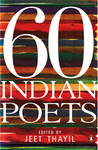
60 Indian poets
Jeet Thayil (ed.)
Thayil, Jeet (ed.);
60 Indian poets
Penguin, 2008 Pages 424
ISBN 0143064428
topics: | poetry | anthology | india | english
Review: What is "Indian poetry"?
Although the title says "Indian poets", the representation excludes all work in Indian languages other than English. Being Indian means being sensitive to multilinguality - so a better title might have been "Indian English poets". Many Indian authors - both Indian English and in the "vernaculars" (a word whose use-by date is perhaps long gone) take umbrage at this kind of arrogation of the rubric "Indian" by the small noisy group that writes in English. This is especially irksome for Indian English poetry, where the readership, compared to other languages of India, is rather limited (though growing).
This is the same sin for which Rushdie and West's Mirrorwork: 50 Years of Indian Writing was widely criticized a decade ago. Rushdie took the bull by the horn, stating boldly:
Prose writing — both fiction and non-fiction — created in this period by Indian writers working in English, is proving to be a stronger and more important body of work than most of what has been produced in the '16 official languages' of India, the so-called 'vernacular languages', during the same time; and, indeed, this new, and still burgeoning 'Indo-Anglian' literature represents perhaps the most valuable contribution India has yet made to the world of books. This sees "contribution" as the contribution to an essentially western sensibility; in terms of its effect on the literary circles in India, this is patently untrue. The position was strongly opposed by many Indian authors who happened to live in India, including those writing in English. Amit Chaudhuri bristled enough to produce a counter-volume, the Picador Book of Modern Indian Literature, where he says: Can it be true that Indian writing, that endlessly rich, complex and problematic entity, is to be represented by a handful of writers who write in English, who live in England or America and whom one might have met at a party?" Also Tarun Tejpal: (Rushdie And The Sea Of Prejudice) gives a long list of authors whose work Rushdie does not consider fit to be called "Indian Writing": O.V. Vijayan, Nirmal Verma, Gopinath Mohanty, Qurratulain Haider, Ismat Chughtai, Ananthamurthy, Mahasweta Devi, Thakazhi Pillai, Basheer Manik Bandopadhyaya, M.T. Vasudevan Nair, Sunil Gangopadhyaya Thayil, while adopting the title "60 Indian poets", facilely defines "Indian poets" as "poets of Indian origin writing in English". The reader becomes aware quickly that some of Amit Chaudhuri's critiques hold for the poets selected here as well - those "who live in England or America and whom one might have met at a party". The introduction plunges directly into English and its association as a language of India, thus dismissing without comment the entire indigenous poetic corpus that has influenced English poetry in India - the tradition of Kunwar Narain, Sunil Gangopadhyay, Ayyappa Paniker, Amrita Pritam, S. Rege, and so many others. Even more suspect, for many Indians, is the degree to which some of the expatriate authors of Indian origin may even be called "Indian". For such Indians (including myself, clearly), this usage smacks of an superciliousness that Indian English poetry, embattled as it is, can perhaps do without.English in India
The introduction runs through the familiar problems faced by Indian authors writing in English - "a small, Westernized, middle-class minority": Where a Malayalam poet has a distinct readership, English language poets do not. They are known only unto themselves. This has led to crises of identity, to a few inelegant labels for the writing -- 'Indo-English', 'Indo-Anglian', 'Indian English' -- and to a charged debate that has carried on for at least eighteen decades. Quoting Buddhadev Basu from 1963: As for the present day "Indo-Anglians", they are earnest and not without talent, but it is difficult to see how they can develop as poets in a language which they have learnt from books and seldom hear spoken in the streets or even in their own homes... English poetry written by Indians is 'a blind alley, lined with curio shops, leading nowhere'. As it is, "Indian" is perhaps very difficult to define; and Thayil says he is expanding "Indian" to include second generation diaspora. This makes the Indian-ness of the volume further suspect, and this is reflected in the poems as well; e.g. how many Indians would be able to relate to Srikanth Reddy's Esperanto poem, a long diatribe with grammar rules and other affectations. That Thayil has some doubts about including some of these authors shows in his author intros, e.g. "If India appears at all in these poems - "my country?" - it is a blur of sense impressions glimpsed in passing" (about Subhashini Kaligotla, who lives in the US since age nine). Frankly, if we are to broaden "Indian", I would broaden it to "South Asian" before moving to expatriate Indians. There are voices in Bangladesh and Pakistan that deserve to be heard. Unfortunately they are not the kind you would bump into in clubs in the west... Going through the selections, it seems that the voices who grew up in the West adopt a more radical innovativeness of form and fail to touch one emotionally, as in the vacant postmodernism of Mukta Sambrani that verges on incomprehensibility. This is however, only a minority, and even among the highly experimental, voices like Mani Rao's clearly have a central register that connects. And the poetic voices on display span a vast range from the devotion-nostalgia of Ramanujan's Murugan to the small-town lyricism of Anjum Hasan, and many shades in between. Given the diversity of voices, it is hard to find a theme. If there is one aspect that ties the poets together it could be (borrowing from Upamanyu Chatterjee's English, August) that most of the poets are "shallow and urban". But how much of "India" is this? A tiny number of poems do address non-urban concerns, (e.g. Parthasarathy's village of memory). The search for a theme is rendered even more difficult by the idiosyncratic arrangement of the authors - by some sense of style or content rather than any other possible cue (such as mother-tongue, or period). This, together with a lack of contents or first lines index, makes it actually hard to navigate the book. However, there is no dearth of good poems in the book. The longer sections are devoted to more established poets like Adul Jussawala (19 pages), Vikram Seth (17 pages) or Arun Kolatkar (15). By devoting some space to Kolatkar's newer poems (released in the year of his death), the book brings us up to date on him.Missing : Agha
Among the missing voices are Agha Shahid Ali and Sujata Bhatt, which is surprising given the diaspora emphasis. Though Agha is mentioned in the intro, still, he is, along with Kolatkar and Ramanujan, perhaps, inevitable in any discussion of Indian poetry. And even beyond Agha's extensive oeuvre about the pain of Kashmir, paeans to Begum Akhtar or K.L. Saigal, his later poems are also coloured by an Indian sensibility, e.g. in the structure of the ghazal that he single-handedly made into a respectable poetic form for English. Sujata Bhatt is perhaps going through a downturn in her image - in fact, personally, I find much of her poetry rather uneven. Apparently both were included in an earlier version of the anthology by Jeet Thayil published by Bloodaxe Books; Gopi K. Kottoor, writing in The Hindu, finds the "logic of the deletions ... baffling". Reviewer Sridala Swami surmises that this might be due to copyright problems.Do the poems work?
Whatever the basis of the selection and whatever the qualms about their indian-ness, most of the poems in the anthology do seem to work for me. Among diaspora poets who write with an Indian theme, I excerpt below a lovely nostalgia by Srinivas Rayaprol, who migrated to the US. Also, in the powerful "Reasons for Staying" by G. S. Sarat Chandra, the central theme, for me, is loneliness and loss - the poet talks to the the furniture in Kannada, trying to find "reasons to stay", a common dilemma of the migrant soul. One refreshing newer voice is that of Anjum Hassan b.1972, whose poems speak of a unique Meghalaya stream of consciousness: We come here from the long afternoon stretched over the town's sloping roofs, its greasy garages and ice-cream parlours, its melancholic second-hand bookshops with their many missing pages. - from To the Chinese restaurant Another northeastern voice is that of Mamang Dai, from Arunachal Pradesh, who left the IAS to pursue writing : Where else could we be born, where else could we belong, if not of memory, divining life and form out of silence? - from Missing Link Among the other poets of note is Vijay Nambisan b.1963, most of whose poems ("Millennium", "First Infinities") have won prizes earlier. CONTENTS: ?? Bruce King 195 ?? 2004: Ezekiel, Moraes, Kolatkar
Contents
In what seems to be an inexplicable omission, the book has neither a list of poems nor an index. Nor are the authors arranged in any discernible pattern. This makes it rather difficult to determine if a particular poem is in the selection or not. In fact, even identifying if a poet is there or not is a challenge - the alleged table of contents merely lists the poets - and since they are in no order, you have to search them all to see if someone's not there. The only place where the names of the poems are available compactly is in the Copyright section, where they appear by poet name, which has no order (also no page numbers). If you have a copy of the book, you may wish to make a printout of the following contents and stick it at the back. Nissim Ezekiel 1 A morning walk 1 Night of the scorpion 3 Two nights of love 5 The patriot 5 Aimee Nezhukumatathil 7 Small murders 7 One bite 8 Making Gyotaku 8 Dinner with the Metrophobe 9 Srikanth Reddy 11 Burial Practice Corruption Fundamentals of Esperanto Aria Sudesh Mishra 18 Joseph Abela Suva; Skye Sea ode ... I come across traces of you (as one stumbling upon the perfume of a fugitive era is suddenly made fugitive )-- Winter theology Mukta Sambrani 24 The insurgence of colour, or Anna thinks Anne Carson is God, no smaller than Marx Names Anna forgets: Narayan, Vishwanat, Padmapani What the postman might translate Sashi, or how moon could mean sun G.S. Sharat Chandra 29 Reasons for staying 29 Vendor of fish 30 Consistently Ignored 30 I feel let down 31 Rule of Possession 31 Encircled 32 Friends 33 Seeing my name misspelled, I lok for the nether world 33 Brothers 34 Mamang Dai 36 The Missing Link 36 Remembrance 37 No Dreams 38 Sky Song 39 Small towns and the river 40 Srinivas Rayaprol 42 Oranges on a table 42 Poem 43 A taste for death 44 Travel Poster 45 Married Love 46 Middle Age 46 I like the American face 47 Life has been 48 Poem for a birthday 49 David Dabydeen [b. Guyana 1955 --> UK] 50 from Turner: New and selected poems Tabish Khair 59 Nurse's tales, retold (2000) 59 The Birds of North Europe (2000) 60 Lorca in New York (2006) 60 Monsters (2005) 61 Falling (2005) 62 Vinay Dharwadker b.Pune 1954 --> U.Wisconsin-Madison/Chicago 65 Houseflies [1998] 65 Words and Things [2005] 66 Walking towards the Horizon [1994] 66 Life Cycles [2003] 67 Mani Rao b. Bombay 1965 F 69 Untitled R. Parthasarathy 74 Remembered Village [2007] 74 from The concise Kamasutra 75 East window 76 from A house divided 77 Vijay Nambisan 79 Millennium [2005] 79 Holy, holy 80 First infinities 1, 2 & 3 [2005] 81 Madras Central [1992] 82 Cats Have No Language [1992] 83 Dirge [2005] 84 Vivek Narayanan 85 Learning to drown 85 Three Elegies for Silk Smitha 87 Ode to prose 89 No more Indian women 90 Not far from the mutiny memorial 90 Manohar Shetty 93 May [2005] The Hyenas [1997] Stills from Baga beach [2000] The old printer [1994] Torpor [1994] Gifts [1981] H. Masud Taj 99 The Travelling Nonvegetarian 99 Approaching Manhattan Vikram Seth 103 Unclaimed 103 Love and work 104 Ceasing upon the midnight 105 He gets a bottle, pours a glass, A few red droplets on the grass, Libation to the god Of oak-trees and of mud, On the fiftieth anniversary of the Golden Gate bridge 107 The stray cat 110 Things 111 The gift 112 A little night music 113 Souzhou park 113 Qingdao: December 114 The crocodile and the monkey 114 Ravi Shankar 120 Plumbing the deepening groove 120 A Square of Blue Infinity 121 Landscape in Chelsea 124 A story with sand 125 Bibhu Padhi 127 Stranger in the house 127 Midnight consolings 128 Something else 129 Remembering Raymond Carver There's always something else to these lines, always someone behind you, watching. You and the women and men who are elsewhere, sharing our children's request to be near them, always. from Sea Breeze 130 Grandmother's soliloquy 131 Tishani Doshi 133 Countries of the body 133 Pangs for the philanderer 134 At the Rodin Museum 135 Homecoming 136 The day we went to the sea 137 Evensong 137 Eunice de Souza 139 Poem for a poet 139 Miss Louise 141 This Swine of Gardarene 142 Women in Dutch painting 142 Pilgrim 143 She and I 144 The road 144 Unfinished Poem 145 Outside Jaisalmer 145 Saleem Peeradina 147 Still life 147 Landscape with locomotive 147 Keki Daruwalla 149 The Poseidonians 149 Roof observatory 152 The glass-blower 153 Wolf 154 Map-Maker 155 Jane Bhandari 158 Steel Blue 158 Arundhathi Subramaniam 162 To the Welsh Critic Who Doesnt Find Me Identifiably Indian 163 Home 164 5.46 Andheri Local 164 Anjum Hasan 166 Shy 166 To the Chinese restaurant 167 March 168 Jealousy Park 169 Rain 170 Amit Chaudhuri 171 St. Cyril Road Sequence [2005] 171 Nissim Ezekiel [2005] 174 Subhasini Kaligotla 175 In freezing light the Chrysler Building [unpub] 175 Lepidoptera [2007] 176 from The Lord's prayer 176 How versatile the heart / How xenophobic the heart 178 Ascent to Calvary [2008] 179 Deepankar Khiwani 181 Delhi airport [2006] 181 Night train to Haridwar [2006] 182 Collectors [2006] 182 Leela Gandhi 184 Sex 184 Noun 184 Homage to Emily Dickinson, after Pain [2000] 185 Copula [2005] 186 On Reading You Reading Elizabeth Bishop [2000] 186 On Vermeer: Female Interiors [2000] 187 A catalogue for Prayer [2000] 187 A.K. Ramanujan 189 Bruce King 195 2004: Ezekiel, Moraes, Kolatkar Dom Moraes 217 Another weather 217 At seven o'clock 219 [about a massage experience] A deep ironic knowledge of the thin Or gross (but always ugly) human flesh. Visitors 220 Absences 220 The tireless persuasions of the dead ... Two from Israel 222 from After the operation 224 Jeet Thayil 227 To Baudelaire 227 I am over you at last, in Mexico City, in a white space high above the street, [...] The heroin sestina 228 Malayalam's ghazal 229 Spiritus Mundi 230 The two thousands 231 Depending on who was winning I shaved or I didn't. Poem with prediction 232 Because he's old and unsure he counts on your faith in images The art of seduction 233 The new island 234 Prageeta Sharma 235 On rebellion 235 Blowing hot and cold 237 The silent meow 237 Birthday poem 238 Release me from this paying passenger 238 Underpants 239 Ode to badminton 239 Miraculous food for once 240 Anand Thakore 242 Departure 242 Chandri Villa 243 Creepers on a steel door 243 What I can get away with 244 Ablutions 245 Kersy Katrak 247 from Malabar Hill 247 Ancestors 249 I followed him as he left the body Imtiaz Dharker 251 Living space 251 There are just not enough / straight lines. Its face 252 Before I 252 Dreams 253 Purdah I 254 Object 255 Rukmini Bhaya Nair 256 Genderole 256 [words run into each other, as in an old sanskrit manuscript] Renoir's umbrellas 257 Usage 258 Convent 259 Kamala Das 260 The descendants 260 Luminol 261 A request 261 The looking glass 262 The stone age 262 The maggots 263 The old playhouse 263 Menka Shivdasani 265 Spring cleaning 265 At Po Lin, Lantau 266 Epitaph 267 No man's land 267 Gopal Honnalgere 269 The City 269 You Can't Will 274 A Toast with Karma 275 Nails 276 Theme 276 How to Tame a New Pair of Chappals 277 The Donkeys 278 Daljit Nagra 280 The speaking of Bagwinder Singh Sagoo! 280 Look we have coming to Dover! 281 Singh song! 282 Gieve Patel 285 Post mortem 285 The ambiguous fate of Gieve Patel, he being neither muslim nor hindu in India 286 Servants 286 Squirrels in Washington 287 Melanie Silgardo 289 Bombay 289 Sequel to Goan death 290 1956-1976, a poem 290 Stationary stop 291 from Beyond the comfort zone 292 Dilip Chitre 294 from Twenty breakfasts towards death - The first breakfast: Objects 294 - The second breakfast : Intimations of mortality 295 - The fourth breakfast : Between knowing and unknowing 296 Ranjit Hoskote 298 Passing a ruined mill 298 Ghalib in the Winter of the Great Revolt 301 Footage for a Trance 302 A view of the lake 304 Colours for a Landscape Held Captive 305 Mamta Kalia 307 Against Robert Frost 307 Brat 307 Tribute to Papa 308 Untitled 309 Sheer good luck 309 I'm not afraid of a naked truth 310 After eight years of marriage 310 Jayanta Mahapatra 311 A day of rain 311 Rain of rites 312 Summer 312 The quest 313 The moon moments 314 I did not know I was ruining your life 314 Unreal country 315 A Hint of Grief 316 Karthika Nair 317 Zero degrees 317 Interregnum 318 Visiting hours 319 Snapshot on the Parisian metro, or landscape on line 3 321 Jerry Pinto 322 House repairs 322 Drawing home 322 Window 323 Rictus 323 Adil Jussawalla 325 Missing Person 325 Lawrence Bantleman 344 Movements 344 Words 345 In Uttar Pradesh 346 Ghosts 346 Septuagesima 347 D- to J- 348 One A. M. 348 Gauguinesque 349 E.V. Ramakrishnan 350 Terms of seeing 350 Stray Cats 351 from For All Things Dying 352 Sampurna Chattarji 354 Still life in motion 354 A memory of logs 356 Crossing 357 Boxes 358 K. Satchidanandan 359 Stammer 359 The mad 360 Genesis 361 Gandhi and poetry 361 C.P. Surendran 363 Milk still boils 363 A Friend in Need 363 Curios 364 Family court 364 Conformist 365 from Catafalque 366 Vijay Seshadri 368 The Disappearances 368 The Long Meadow 370 North of Manhattan 371 Lifeline 374 Arvind K Mehrotra 381 Genealogy 381 Continuities 383 Canticle for my son 384 To an unborn daughter 385 Where will the next one come from 385 Approaching Fifty 386 The house 386 Scenes from a revolving chair 387 What is an Indian poem (essay) 389 Arun Kolatkar 393 from Pi-Dog 393 The Ogress 400 Bon Appétit 405
Excerpts
Nissim Ezekiel (1924-2004)
Nissim Ezekiel, the grand old man of Indian English poetry, passed away recently. He is a master of a range of forms of narrative poetry, and his "Indian-ness" shows up in some poems such as Ms. Pushpa and the Patriot below. A more direct intensity is felt in Night of the scorpion, also anthologized here.The patriot
p.5 I am standing for peace and non-violence Why world is fighting fighting Why all people of world Are not following Mahatma Gandhi, I am simply not understanding, Ancient Indian Wisdom is 100% correct, I should say even 200% correct, But modern generation is neglecting- Too much going for fashion and foreign thing. [...]Aimee Nezhukumatathil
[b.1974 Chicago. Father from Kerala, mother from Phillippines. Miracle Fruit (2003), At the drive-in volcano (2007). As with Lawrence Bantleman, the poems are almost entirely contained in the last lines. teaches at SUNY Fredonia. ] links: * publisher's site for miracle fruit * review by Carlene Bonnivier : Her multi-cultural background informs her poems with colors and texture; her language is open, playful and killingly accurate. Her poems cast not a net but a spell, and I was under it from the first parchment page to the last salvo.Small Murders : Aimee Nezhukumatathil : p.7
When Cleopatra received Antony on her cedarwood ship, she made sure he would smell her in advance across the sea: perfumed sails, nets sagging with rosehips and crocus draped over her bed, her feet and hands rubbed in almond oil, cinnamon, and henna. I knew I had you when you told me you could not live without my scent, brought pink bottles of it, creamy lotions, a tiny vial of parfume — one drop lasted all day. They say Napoleon told Josephine not to bathe for two weeks so he could savor her raw scent, but hardly any mention is ever made of their love violets. Her signature fragrance: a special blend of these crushed purple blooms for wrist, cleavage, earlobe. Some expected to discover a valuable painting inside the locket around Napoleon's neck when he died, but found a powder of violet petals from his wife's grave instead. And just yesterday, a new boy leaned in close to whisper that he loved the smell of my perfume, the one you handpicked years ago. I could tell he wanted to kiss me, his breath heavy and slow against my neck. My face blue from the movie screen— I said nothing, only sat up and stared straight ahead. But by evening's end, I let him have it: twenty-seven kisses on my neck, twenty-seven small murders of you. And the count is correct, I know — each sweet press one less number to weigh heavy in the next boy's cupped hands. Your mark on me washed away with each kiss. The last one so cold, so filled with mist and tiny daggers, I already smelled the blood on my hands.Making Gyotaku : Aimee Nezhukumatathil p.8
In Osaka, fishermen have no use for the brag, the frantic gestures of length, blocks of air between their hands. They flatten their catch halfway into a tray of sand, steady the slick prize. The nervous quiver of the artist's hands over the fish – washing it with dark ink, careful not to spill or waste, else feel the wrath of salty men at sea. It is a good print, the curves and channels of each scale will appear as tidy patterns to be framed and hung in the hallway of his house. But perhaps the gesture I love most —- before the pressing of rice paper over inked fish, before the gentle peel away of the print to show the fish's true size -— is the quick-light stroke of the artist's thumb, how deftly he wipes away the bit of black ink from the fish's jelly eye – how he lets it look back from the wall at the villagers, the amazed staring back at the amazed.One Bite : Aimee Nezhukumatathil p.8
Miracle fruit changes the tongue. One bite, and for hours all you eat is sweet. Placed alone on a saucer, it quivers like it's cold from the ceramic, even in this Florida heat. Small as a coffee bean, red as jam – I can’t believe. The man who sold it to my father on Interstate 542 had one tooth, one sandal, and called me ‘Duttah, duttah.’ I wanted to ask what is that, but the red buds teased me into our car and away from his fruit stand. One bite. And if you eat it whole, it softens and swells your teeth like a mouthful of mallow. So how long before you lose a sandal and still walk? How long before you lose the sweetness?Dinner with the Metrophobe 9
Metrophobia is the fear of poetry. I could tell from our onion blossom this was all a mistake. There was no "flower" of fried petals, but a soggy mess in a napkin-lined wicker basket instead, a bad corsage at the end of prom night. But at work he was kind — always had an extra envelope, a red pen, offered to get me coffee from the machine downstairs. He was the only one who didn't gasp when I cut eight inches off my hair. There was no competition over publications (he never even read The New Yorker), and sometimes, he'd hold my elbow as we climbed staircases. So when he asked me out for dinner over e-mail, I thought it was just his way. I had to lower my silly poet-standards of expecting roses with each question, a clever note snuck in my coat pocket about my eyelashes breaking his heart or how he must see me right now. I never expected this guy's hands to shake all over our appetizer of clams casino — shook so hard his shell spilled its stewy contents on his tie. The clatter of his teeth on his sweaty water glass as he dribbled. The hives. All I said was Don't be too nice to me. One day I might write this all down.
Sudesh Mishra
Sudesh Mishra teaches literature at the University of the South Pacific, Suva, Fiji.Suva; Skye : Sudesh Mishra p. 19
A half-spent mosquito coil mounted on an upended fork buoyed inside a squat jar brimming with smoky water is nothing like the swan he saw that neutral day arching its ancient ashen neck upon the flood of a loch crammed with brilliant sky. Nothing like.
G.S. Sharat Chandra
[ b. 1935 Karnataka 1960s-> USA U. Missouri prof]Reasons for staying : G.S. Sharat Chandra : p. 29
I am talking to the kitchen table full of roses The language is my own, I tell them I own them. There are roses because I say so, the vase is mine, so is the kitchen. I like them red, I pay for the water. The chairs immediately respond, the table, the knives and plates, the salt shaker, join in.Vendor of fish : G.S. Sharat Chandra : 30
all night he waits at the harbour his eyes the colour of the sea the sea the colour of trawlers he grabs the finest wipes them on his shawl his shawl the colour of blood fish the colour of rupees he thinks of the meal he'll buy the meal of chapattis and kurma the fish in the smell of kurma he packs them in the basket with ice his hands the colour of fire he leaps on the tar road faster than sweat can print his feet the distance is the colour of dreams the fish in the basket shine sawdust daubst their finds he sings in praise of their colourConsistently Ignored : G.S. Sharat Chandra : p. 30
for my mother Consistently ignored in a family of ten I asked mother, 'Ami I your real son?' She paused from grinding spice 'No, I bought you from a beggar for a handful of rice!' From behind, sisters giggled. I matched features, spied on beggars, Roamed the backyard thinking of distant huts, certain My mother sat busy in one Scheming to trade another son For fish to add to that bushel.
Mamang Dai
[b 1959 Arunachal Pradesh, F; IAS officer --> Journalist]The Missing Link : Mamang Dai : p.36
I will remember then the great river that turned, turning with the fire of the first sun, away from the old land of red robed men and poisonous ritual, when the seven brother fled south disturbing the hornbills in their summer nests. Remember the flying dust and the wind like a long echo snapping the flight of the river beetle, venomous in the caves where men and women dwelt facing the night, guarding the hooded poison. There are no records. The river was the green and white vein of our lives linking new terrain. In a lust for land, brother and brother claimed the sunrise and the sunset in a dispute settled by the rocks, engraved in a vanished land. I will remember then the fading foices of deaf women framing the root of light in the first stories to the children of the tribe. Remember the river's voice: Where else could we be born, where else could we belong, if not of memory, divining life and form out of silence? Water and mist, the twin gods, water and mist, and the cloud woman always calling from the sanctuary of the gorge Remember, because nothing is ended, but it is changed, and memory is a changing shape, showing with these fading possessions in lands beyond the great ocean that all is changed but not ended. And in the villages, the silent hill people still await the promised letters, and the meaning of words. http://www.geocities.com/kavitayan/mamang.htmlNo Dreams : Mamang Dai : p. 38
The days are nothing Plant and foliage grow silently at night a star falls down a leopard leaves its footprint But I have no dreams. The wind blows into my eyes sometimes, it stirs my heart to see the land so plain and beautiful But I have no dreams If I sit very still I think I can join the big mountains In their speechless ardour Where no sun is visible the hills are washed with light The river sings Love floats! Love floats! But I have no dream.Sky Song : Mamang Dai : p. 39
The evening is the greatest medicine maker testing the symptoms of breath and demise, without appointment writing prescriptions In the changing script of a cloud's wishbone rib, in the expanding body of the sky. We left the tall trees standing. We left the children playing. We left the women talking and men were predicting good harvests or bad, that winged summer we left, racing with the leopards of morning. I do not know how we bore the years. By ancient, arched gates I thought I saw you waving, in greeting or farewell, I could not tell; when summer changed hands again only the eastern sky remained; One morning, flowering peonies swelled my heart with regret. Summer's bitter pill was a portion of sky like a bird's wing, altering design. A race of fireflies bargaining with the night. Attachment is a gift of time, I know, the evening's potion provides heaven's alchemy in chromosomes of light, lighting cloud fires in thumbprints of the sky.Small towns and the river : Mamang Dai
Small towns always remind me of death. My hometown lies calmly amidst the trees, it is always the same, in the summer or winter with the dust flying, or the wind howling down the gorge Just the other day someone died. In the dreadful silence we wept looking at the sad wreath of tuber rose. Life and death, life and death, only the rituals are permanent The river has a soul. In the summer it cuts through the land like a torrent of grief. Sometimes sometimes, I think it holds its breath seeking the land of fish and stars The river has a soul. It knows, stretching past the town, from the first drop of rain to dry earth and mist on the mountaintops, the river knows the immortality of water A shrine of happy pictures marks the days of childhood. Small towns grow with anxiety for future generations. The dead are placed pointing west. When the soul rises it will walk into the golden east, into the house of the sun In the cool bamboo, restored in the sunlight, life matters, like this. In small towns by the river we all want to walk with the gods. source: http://www.museindia.com/showcont.asp?id=295
Srinivas Rayaprol
(1925-1998) b Secunderabad, AP. son of leading Telugu poet Rayaprolu Subbarao. BHU -> Stanford U. Civil Engg. founded and ed East and West magazine (1956-61). Among contributors were William Carlos Williams. Three books w Writers' Workshop, Calcutta. Bones and Distances 1968, Married love and other poems 1972, Selected Poems 1995. "I have realized indeed rather painfully that I am no longer the genius I thought I was." died in Secunderabad.]Oranges on a table
acquire the subtle distinction of Mahogany No longer a thought on the tree in spring but made as green its body a summer arm Yellow and slow women-close Not an ultimate order of the orange sky but the angular desire of the stone that blocks the river's run.Srinivas Rayaprol : Poem : p.43
In India women Have a way of growing old My mother for instance Sat on the floor a hundred years Stirring soup in a sauce pan Sometimes staring at the bitter Neem tree in the yard For a hundred years without the kitchen walls.Married Love : Srinivas Rayaprol : 46
Every evening I am met at the gate by my wife her hair in disorder and her dress a mess from the kitchen and the girls hand on the leaves of the gate while my ancient car rolls in. One carries my bag, the other my lunch basket. The day's work is over and I am home. I have forgotten them all day and now suddenly remember that I must disappoint them again for my evening is planned for a meaningless excursion to the bars. And the coffee which my wife has served is cold in my mouth and the tales the children have brought from school are dull on my ears. In spite of my love for them I must disappoint them again tonight.I like the American face : Srinivas Rayaprol : 47
I like the American face successful, clean shaven closely clothed with arrogance of chin but soft of eye and always ready to break into a false-toothed smile The kind of face that photographs so well in _Time a face with the races so well mixed Yet wholly new and all American as apple-pie Individually interesting but pointless on the whole sexless on the surface ...Poem for a birthday : Srinivas Rayaprol : 49
I have never been more than the occasion demanded have never been in an occasion which demanded more than me I have never had the mind's argument dislodged by the horses of the heart have never ridden horses who did not know their riders I have never risen above the immediate moment have never had a moment which demanded my immediate answer I have never needed a new face to meet the faces of my friends have never had friends without faces that did not smile back at me.Tabish Khair
[b 1966 Gaya Bihar professional Muslim family of doctors Associate Professor, English, U. Aarhus, Denmark]Nurse's tales, retold: Tabish Khair 59
Because the east wind bears the semen smell of rain, A warm smell like that of shawls worn by young women Over a long journey of sea, plain and mountains, The peacock spreads the Japanese fan of its tail and dances, And dances until it catches sight of its scaled and ugly feet. Because the koel cannot raise its own chicks -- Nature's fickle mother who leaves her children on doorsteps In the thick of nights, wrapped in controversy and storm -- Because the koel will remain eternally young, untied, It fills the long and empty afternoons with sad and sweet songs. Because the rare Surkhaab loves but once, marries for life, The survivor circles the spot of its partner's death uttering cries, Until, shot by kind hunters or emaciated by hunger and loss, It falls to the ground, moulting feathers, searching for death. O child, my nurse had said, may you never see a Surkhaab die. (from Where Parallel Lines Meet, Penguin, Delhi, 2000) links: * http://www.el-ghibli.provincia.bologna.it/id_1-issue_02_10-section_3-index_pos_1-inlingua_t.html * poems from wasafiri 2004 (subscription)The birds of North Europe : Tabish Khair 60
Twenty four years in different European cities and he had not lost His surprise at how birds stopped at the threshold Of their houses. Never Flying into rooms, to be decapitated by fan-blades or carefully Herded through open windows to another life, never Building on the lampshade Or on some forgotten, cool corner-beam where droppings and straw Would be tolerated until the fateful day hatched And the world was fragile Shell, feathers, a conspiratorial rustle of wings above and of An intrigued girl below. Even the birds in their neat towns Knew their place. They Did not intrude into private spheres, demanding to be overlooked Or worshipped. They did not consider houses simply Exotic trees or hollowed Hills. Not being particularly learned he did not know the thread Of fear that knots the wild to the willed; not Being well-read he Did not remember the history behind their old and geometrical Gardens, could not recall a time when the English Parliament had killed a bill, Shocked by a jackdaw's flight across the room. He simply marked The absence of uncaged birds in their homes. He thought It was strange.Lorca in New York : Tabish Khair 60
Federico García Lorca lonely in New York With his list of English words to get by barely (Shishpil: sex appeal), on the edge of hecho poético Where an image falls together not like clouds in the sky But a hurt's shadow on the great cold wall of show, Writes about a hurricane of black pigeons splashing, Writes about the furious swarming coins that devour children, Writes about the poisonous mushroom (this is pre-Hiroshima), Writes about wiping moonlight from the temples of the dead, Writes about the fire that sleeps in dark flints, sleeps, Awakes to his own private memories of sorrow and loss, That blue horse of his insanity that makes him see The three who were frozen, the three burned, the buried three. Spanish Siddhartha, Buddha of the beautiful body, poet Of crystallised fish dying inside tinfoil tree trunks, Hear the pain in her smile here where only teeth exist And flints have long been caped in satin, dogs stay dogs, Watch the voice outside that ethnic shop – Fucking Paki Place is like always open – put a stainless steel lock On Earth and its timeless doors which lead to the blush of fruits.Monsters : Tabish Khair 61
Theirs the city of the sayable. Hers its suburbs, Filling with the screamed obscenities of graffiti, gestures At coherent articulation, the word within that world Of splashed red, aerosoled blue, skulls and crossbones, Crashing cars, rose out of a gun barrel, space monsters, all Unable to utter a sound that will count as speech. It is in such a moment of sheer scream, unsayable, That Shakuntala looks in the mirror and is surprised To see fangs and fire, a gaping mouth like Kali's, Goddess culled from the anger of colonisation: It is a vision that lasts only a second, but in it Are contained the silent stories of her history. Her lineage is monstrous. Scylax said so: Daughter of the dog-faced and blanket-eared. Such many-armed, hydra-headed ancestors Shocked the evangelising white man, puzzled The aesthetes of Europe in later centuries: Truth and beauty have long been denied her. Did her mothers know what she has forgotten: The choice was between mirror and monster? How to keep their devdasis from turning nuns In Danse des servantes ou esclaves des dieux, They loosened their limbs in the cosmic dance Of the oppressed -- fingers, arms, heads flew off Leonardo da Vinci's symmetrical bodies And the mirror of that white gaze shattered On Develish formes and uglie shapes. Adam Stood speechless before monstraous Ada, Which hath foure hands with clawes... The better to rip you with, coloniser? Faced with humanity, they could not look Into those eyes and fail to be struck blind By the injustice of it all, their own greed: Monsters filled their mirrors. It was safer To lose in that adytum of demons the truth Of bodies with blackened teeth, minds on fire.Vinay Dharwadker
[ 1954 Pune S.AsianLit at U.Wisc-Mad --> U. Chicago ]Houseflies : Vinay Dharwadker 65
Like a pair trapped indoors by the summer screens on the windows we flit about in zigzag flight in a corner of the ceiling's inverted floor, from where the giant room seems to loom u0pside down above us, we nuzzle up to each other, twelve hairy legs intertwined at once giddy with the vertigo of watching our mirror selves multiplied a thousand times, as we mate in every facet of our big domed eyes.Words and Things : Vinay Dharwadker p.66
words evaporate like water in a dish leaving you with a sense of something meant, but not the memory of what was said, or how, or when. Things stay as they are (call them facts) even with the names you learn to give them; poems (you tell yourself) are so many ways of naming things you've seen once and may not see again, except for tricks of remembering; for words forget themselves and move among the things you cannot name, and what you know by touch and tact seems merely a vanishing thing.Walking towards the horizon : vinay dharwadker : 66
Maybe it will be like this: a notebook left open the previous night on the desk his glasses set down on a half-finished page; in the early morning light, blue lines crossed by a thin red vertical on the left, the hand sloping neatly, in the black ink he liked; close to the edge of the desk, a box of clips, pens and pencils in a silver cup he meant to polish for months, but never did; a cheap stiletto for letters, five envelopes slit open; an ashtray; a chequebook in a brown plastic jacket. In the other room, toys scattered on the rug, his wife's coat flung on the arm of the couch, a bunch of keys and magazines on the coffee table; pots and pans in the kitchen sink, three dinner plates and forks, waiting to be scrubbed in the morning; outside the window, a parking lot shared by a school and a hospital, half empty; a few leaves fallen between the sidewalk and the street, brown lumps of dog-shit under the maple tree turning red; a van, newspapers in vending machines, a woman walking; a patch of blue, and a horizon, out of sight, somewhere. [scene in the room, then rest of the house, moving beyond the window, to the horizon unseen]Life Cycles : vinay dharwadker : 67
In Chattisgarh, near Bilaspur Clouds drift low above the monsoon town: loose wads of wool, not yet spun to yarn, swirling slowly in the wind. The sky drips all day, all night, bringing down a foot of rain: red mud in puddles; pools of saffron water; sludge squelching underfoot: a foot of rain. A liquid sheet, mirroring the sky, is stretched across the paddy fields squared off by banks of matted clay: blue, green, ocher smeared with gray. Uneven squares, trapeziums, sewn like patches on a checkered cloth: the paddy, standing in a foot of water, velvet green. So many butterflies swarming in the brush: orange, purple, white, electric-blue, their yellows bright as ripened mustard fields. Brown, furry caterpillars; fat centipedes, black and amber. A newborn calf, wobbling in the grass: coat white as wool, eyes like glistening marbles. Young rice plants, emerald filaments, calf-deep in ruddy water. Rows of men and women, bent over, moving through the fields in rhythm, like combs through hair. Fingers grasp the saplings, scoop them out, tie them up in bundles, in tandem. Far in the distance, a single tractor, plumed with diesel fumes, turns up the soil in mechanical clods. But here all the work is done by hand: bare bodies, bare heads, bare hands. Trees blur into the sky, their hues washed like watercolors: the earth, fresh, full of life, swells and sways beneath them. --- VINAY DHARWADKER is the author of Sunday at the Lodi Gardens (Viking, 1994), and has recently completed his second collection, Someone Else's Paradise: Poems 1971-2001. Among the books he has edited or coedited are The Oxford Anthology of Modern Indian Poetry (1994), The Collected Poems of A. K. Ramanujan (1995), and The Collected Essays of A. K. Ramanujan (1999), all published by Oxford University Press. http://www.kenyonreview.org/issues/sf03/dharwadker.phpMani Rao
Untitled: Mani Rao
1 If you smile when you wake up, if you don't smile when you wake up. When we woke up dreaming of each other. When I slept right through your dream. She wakes up slowly, still talking to her dreams. He is spat out by the night, turns to the tide of the radio. 2 I leave myself in the terrace and go downstairs. I leave myself in the living room and go to the kitchen. I get together sometimes, a hall of mirrors, swearing different stories, playing you-know-that-I-know-that-you-know-that-I-know. They are all true, some truths you know, some you don't. You look for too much explanation. I can go back to fetch a better memory. And I can recur if you wish. [...]R. Parthasarathy
b. 1934 Tamil Nadu --> Skidmore College, Saratoga Springs oft quoted: "My tongue in English chains" [1977]Remembered Village : R. Parthasarathy
If you love your country, he said, why are you here? Say, you are tired of hearing about all that wonder-that-was-India crap. It is tea that's gone cold: time to brew a fresh pot. But what wouldn't you give for one or two places in it? Aunt's house near Kulittalai, for instance. It often gets its feet wet in the river, and coils of rain hiss and slither on the roof. Even the well boils over. Her twelve-house lane is bloated with the full moon, and bamboos tie up the eerie riverfront with a knot of toads. A Black Pillaiyar temple squats at one end of the village -- stone drum that is beaten thin on festivals by the devout. Bells curl their lips at the priest's rustic Sanskrit. Outside, pariah dogs kich up an incense of howls. And beyond the paddy fields, dead on time, the Erode Mail rumbles past, a light needle of smoke threading remote villages such as yours that are routinely dropped by schedules and no trains are ever missed.
Vijay Nambisan
[b.1963 neyveli TN; studied at IIT Madras, presently at Lonavala]Millennium : Vijay Nambisan : 79
There was not much light in the world when we left The stairs were dank and smelled of anger. At their foot was a heap of straw, soaked in blood: We did not ask whose, for all was conjecture, and this Fresh sign would have yielded us little more. They say there are signs in all things; well, there were some we could have done without that day. For the sun set The instant we had emerged from the passage-way And we had to grope our road to the little shed where, Little and unannounced, our mission lay. Frost streamed the air. Our blood pulsed thin and shrill. My brother pushed open the door. In the wild light Of a torch, we saw the mother's breast was white and plump, And the child's lips were red as any rose. None of us Dared hesitate, or be afraid; we drew our swords. It is long after that I tell this, and it may differ From the tales you must have heard. What matters? There was no light in the world when we did our deed. There is no light now. Is it all possible That I should say more or less than I know? Yes I have heard the stories. Yes, there was some talk Of a brave man whose bravery passed all foolishness. Yes, we are a weak people now but we were not so When lured by gold but hardly less by strength, We let our faith die and put away our books And enrolled ourselves under the Idumean. He was a false king, at last, but what would you have? There have been falser. One rules now, in Rome. But this one thing I can say, because upon my steel There sang the blood, and almost on my lips; with That blade which now rotten hangs upon the wall, With that blade and no other, I slew David's heir.Holy, Holy : Vijay Nambisan p.80
The rain threatens this ordinary day With magic. Things that grow manifest Plainly, the unnatural: more sure And permanent is the unwalked way, Lifeless air, stone unencumbered With feelings; not obsessed, therefore pure. Yet even metal has a life that cries For use, even crystals ask to be touched-- How much weaker are those green and clinging loves, These hollow souls which populate the skies With what they aspire to. Reality In itself is content, and needs no proofs. When I was young enough to treat these things Withough consciousness, I could cast my mind To that emptiness whereof all is made And ask, Without my imaginings, What is? Nothing answered nothing, and in that space I knew myself unliving, unafraid.Madras Central : Vijay Nambisan 82
The black train pulls in at the platform, Hissing into silence like hot steel in water. Tell the porters not to be so precipitate: It is good, after a desperate journey, To rest a moment with your perils upon you. The long rails decline into a distance Where tomorrow will come before I know it. I cannot be in two places at once: That is axiomatic. Come, we will go and drink A filthy cup of tea in a filthy restaurant. It is difficult to relax. But my head spins Slower and slower as the journey recedes. I do not think I shall smoke a cigarette now. Time enough for that. Let me make sure first For the hundredth time, that everything's complete. My wallet's in my pocket; the white nylon bag With the papers safe in its lining-fine; The book and my notes are in the outside pocket; The brown case is here with all its straps secure. I have everything I began the journey with And also a memory of my setting out When I was confused, so confused. Terrifying To think we have such power to alter our states, Order comings and goings: know where we're not wanted And carry our unwantedness somewhere else. http://www.indianpoetry.org/compititions.htmCats have no language : Vijay Nambisan
Cats have no language to tell their world. The moon is a midsummer's madness That satisfies foolish chroniclers; But their paws gloat on the captured mouse (The slither beneath the stair); the silent bat That drifted on a moonbeam into the house Slashed a slitted eye into a flicker And was gone. The moon is too much for the cat. The light is too much for cats: that is why, At the human snarl behind the torch The keen eyes turn slate, a careless slouch Replaces the studied artistry, frozen flash Before the kill. They do not like the light But have no language save the curving slash And the sideways sculpture at a whisker's touch. Cats are dumb when they walk in the night. Cats are clever at night; but the sun Melts the moon's glitter out of their eyes, Leaves them children's toys and the green trees. Now how can fingers soothe the shoulder knots, Trust the silken purr, the kind eyes? My cat, I know, I have seen her sleeping thoughts Tense and stalk savagely in the night's peace. But cats need no language to do that.Dirge : Vijay Nambisan : 60
The poets die like flies but I am lying slightly to one side, ... How well they wrote, those friends now fettered, how the Indo-Anglian tongue Allowed them to be lovely-lettered, their lives lived when the world was young I'll live and hold my words in, for I am wearied of hypothesis; And, in place of getting glory, kisses I take from my missis. Then the world shone, by their showing; then publishers seemed to care; Then calls for cheques of last year's owing did not fall on empty air. Then newspapers asked them for pieces; and printed them unchanged; and paid; But now there are so many wheezes which make the craft a thrifty trade. In a wilder whirl of weeklies, tabloids titting on page threes I will shirk my duty meekly and kisses take from my missis. ... So Arun and Dom and Nissim -- I will shun their hard-earned grief And much though I will always miss'em, in softer shadows find relief. And when I'm ninety and young writers ask why I wrote no more than this I will answer, "But, you blighters! I kisses took from my missis."Vivek Narayanan
1972 Ranchi, Tamil parents; --> New DelhiElegy for Silk Smitha
She's the slut among white hippies on the beach, behind the campfire, hot pants and an upright pony tail for style; she's the dancer in metallic feathers and red plastic shoes. Foil to the gangster's bait, the woman you never brought home to mother, she is and is not the salt of what she is. [...]Manohar Shetty
born 1953 Bombay.May : Manohar Shetty : 95
The gardens are agog With bougainvillaea and buttercup. Wild berries carpet the backyard. Pepper vines blister round Tree trunks, and pumpkins, Fecund as eggs, fatten in the shade. Incense in the frangipani. Succulence in the cactus. Dreadlocks of dates Garland the wild palm. This, then, is your plot of heaven O heaven's plot, his wry response. [...]H. Masud Taj
born 1956 Moradabad, Uttar Pradesh.The Travelling Nonvegetarian p.99
The man who spoke with suitcases Said wisdom was hydrogen peroxide, Wore a white wig of fibre optic cables, And dentures that were pure African ivory. When he smiled, elephants burst into tears. The man who spoke with suitcases Said homing pigeons were edible pagers And grey parrots that spoke too many languages Tasted no better than those that were dumb, And all birds on TV were cyber-tandooris The man who spoke with suitcases Said the onion was the final package That packed the process of packing itself, Which explained the missing mass of the universe And the tears onion-peelers and stargazers shed. The man who spoke with suitcases Said the banana skin was a continuum of zippers, And all coconuts were neo-colonials Smashed on occasions of celebration; All brown outside, all white within. The man who spoke with suitcases Said neckties were nooses, wristwatches handcuffs, And honest heroes who wore underpants outside Were neurotics packaged in designer masks Which they removed only to eat. The man who spoke with suitcases Said brinjals were boiled with equine eyeballs, Applied gold glitter-dust to horses’ eyebrows, And powder-coated his finger and toe nails. He ate candle-lit dinners in fireproof stables. The man who spoke with suitcases Said hunchbacks were born-again backpackers, And slim briefcases made of crocodile skins Were chromium-plated mouths to snap off space To declare at the last border crossing.Approaching Manhattan: H. Masud Taj
Charred threads of calligraphy Lamenting as they lose themselves To thoughts that turn from north to south Return via yellow earth, green hills, blue sky: White clouds inhale and drift away, Winds die, we escape the frame: exhale. Return to slip slide on red and yellow Synapses of a scorching Internet. Electronic diagram wiring together While keeping apart three floating squares: Blood in one, with a green horizon Displaced in a sky unbelievably blue. Airplane leaving another, Leaving boarders as yet intact. Water, in the final frame, Approaching Manhattan. Nothing can stall what happen next But that is not what I mean, I swear, That is not what I meant at all.
Tishani Doshi
b. Madras 1975 Welsh-Gujarati parents. more poems: http://www.tishanidoshi.com/poems.html clivejames.com (pdf)Tishani Doshi : At the Rodin Museum 135
Rilke is following me everywhere With his tailor-made suits And vegetarian smile. He says because I’m young, I’m always beginning, And cannot know love. He sees how I’m a giant piece Of glass again, trying To catch the sun In remote corners of rooms, Mountain tops, uncertain Places of light. He speaks of the cruelty Of hospitals, the stillness Of cathedrals, Takes me through bodies And arms and legs Of such extravagant size, The ancient sky burrows in With all the dead words We carry and cannot use. He holds up mirrors From which our reflections fall — Half-battered existences, Where we lose ourselves For the sake of the other, And the others still to come.Tishani Doshi : The day we went to the sea p.137
The day we went to the sea Mothers in Madras were mining The Marina for missing children. Thatch flew in the sky, prisoners Ran free, houses danced like danger In the wind. I saw a woman hold The tattered edge of the world In her hand, look past the temple Which was still standing, as she was — Miraculously whole in the debris of gaudy South Indian sun. When she moved Her other hand across her brow, In a single arcing sweep of grace, It was as if she alone could alter things, Bring us to the wordless safety of our beds. [written in Madras after the tsunami of 2004]Eunice de Souza
Poem for a poet : Eunice de Souza : 139
It pays to be a poet. You don't have to pay prostitutes. Marie has spiritual thingummies. Write her a poem about the Holy Ghost. Say: 'Marie, my frequent sexual encounters represent more than an attempt to find physical fulfillment. They are a poet's struggle to transcend the self and enter into communion with the world." Marie's eyes will glow Pentecostal flames will descend. The Holy Ghost will tremble inside her. She will babble in strange tounges: 'O Universal Lover in a state of perpetual erection! Let me enter into communion with the world through thee.' Ritu loves music and has made a hobby of psychology. Undergraduate, and better still, uninitiated. Write her a poem about woman flesh. Watch her become womanly and grateful. Giggle with her about horrid mother keeping an eye on the pair, the would-be babes in the wood, and everythiing will be so idyllic, so romantic so _intime. Except that you, big deal, are forty-six and know what works with whom.Miss Louise : Eunice de Souza : 141
She dreamt of descending curving staircases ivory fan aflutter of children in sailor suits and organza dresses till the dream rotted her innards but no one knew: innards weren’t permitted in her time... Shaking her greying ringlets: 'My girl, I can't even go to Church you know I unsettle the priests so completely. Only yesterday that handsome Fr Hans was saying, "Miss Louise, I feel an arrow through my heart." But no one will believe me if I tell them. It's always been the same. They'll say, "Yes Louisa, we know, professors loved you in your youth, judges in your prime"'Saleem Peeradina
born 1944 in BombayStill Life : Saleem Peeradina
Face-up in a crook of brown, the river breaths. Out of the sub-lit air from the rim of a small town's still repose Her ankles ringing the quiet path a woman descends. The river mumbles, stirs where the woman bends, as if the ripples were shifting circles Of some dream and pot displaced. Her people wake, imagining she brings The stream: unaware of water's separate consciousness swinging into shape on her hip. Behind her the river curls up to the brim in heavy-lidded sleep.Keki Daruwala
born 1937 Lahore into a Parsi family.Map-maker
Perhaps I’ll wake up on some alien shore in the shimmer of an aluminum dawn, to find the sea talking to itself and rummaging among the lines I’ve drawn; looking for something, a voyager perhaps, gnarled as a thorn tree in whose loving hands, these map lines of mine, somnambulant, will make and pulse and turn to shoreline, sand. the spyglass will alight on features I’ve forecast- cape, promontory-he’ll feel he's been here, that voyaging unlocks the doorways of the past. And deep in the night, in the clarity of dream, the seafarer will garner his reward, raking in his islands like pebbles from the stream.Jane Bhandari
born Edinburgh 1944. --> Bombay 1960s.Jane Bhandari: Steel Blue p.158
The sea under rain-clouds Was blued steel, And the black boats Flying orange and magenta flags, Cut silver streaks in the blue. A white line of rain Divided the islands from the sea. The sea milk-white The sea dark blue The sea carved by boats Into silver scimitars against the dark The lighthouse rising Out of the dark and wooly blue, Then fainter, diminished by mist, But still blue. [... 1 of 6 parts]
Arundhathi Subramaniam
born 1967 Bombay where she still lives.Home : Arundhathi Subramaniam
Give me a home that isn’t mine. where I can slip in and out of rooms without a trace, never worrying about the plumbing, the colour of the curtains, the cacophony of books by the bedside. A home that I can wear lightly, where the rooms aren’t clogged with yesterday's conversations, where the self doesn’t bloat to fill in the crevices. A home, like this body, so alien when I try to belong, so hospitable when I decide I’m just visiting.5.46 Andheri Local
read this poem in the excerpts from this excellent collection of Indian women poets writing in English: We speak in changing languages (2009)Arundhathi Subramaniam : To the Welsh Critic Who Doesnt Find Me Identifiably Indian
You believe you know me, wide-eyed Eng Lit type from a sun-scalded colony, reading my Keats - or is it yours - while my country detonates on your television screen. You imagine you've cracked my deepest fantasy - oh, to be in an Edwardian vicarage, living out my dharma with every sip of dandelion tea and dreams of the weekend jumble sale... You may have a point. I know nothing about silly mid-offs, I stammer through my Tamil, and I long for a nirvana that is hermetic, odour-free, bottled in Switzerland, money-back-guaranteed. This business about language, how much of it is mine, how much yours, how much from the mind, how much from the gut, how much is too little, how much too much, how much from the salon, how much from the slum, how I say verisimilitude, how I say Brihadaranyaka, how I say vaazhapazham - it's all yours to measure, the pathology of my breath, the halitosis of gender, my homogenised plosives about as rustic as a mouth-freshened global village. Arbiter of identity, remake me as you will. Write me a new alphabet of danger, a new patois to match the Chola bronze of my skin. Teach me how to come of age in a literature you've bark-scratched into scripture. Smear my consonants with cow-dung and turmeric and godhuli. Pity me, sweating, rancid, on the other side of the counter. Stamp my papers, lease me a new anxiety, grant me a visa to the country of my birth. Teach me how to belong, the way you do, on every page of world history.
Anjum Hasan
born 1972, Shillong, Meghalay; F links: poems : komma magazine (pdf) poetryinternationalweb leakstev.blogspot.com (three poems)) review: The HinduAnjum Hasan: To the Chinese restaurant p.167
for Daisy We come in here from the long afternoon stretched over the town's sloping roofs, its greasy garages and ice-cream parlours, its melancholic second-hand bookshops with their many missing pages. Life's not moving. We sit at a red table, among the dragons, near the curtained-off street-facing windows with their months’ old orangeade. Out in the streets there are schoolboys with their ties askew and the garish fruit-sellers. We eat more than we need to. We eat so that our boredom's no longer dangerous, so that from the comfort of soup, with the minor pleasures of chopsuey, we can fend off the memory of cities unvisited, unknown and unknowable affairs, people with never-fading lipstick and confident gestures who we will never be. One day soon we’ll be running, our lives will be like the blur seen from a bus, and we won’t read each other's letters thrice. But right there we’re young, we count our money carefully, we laugh so hard and drop our forks. We are plucked from sadness there in that little plastic place with the lights turned low, the waiters stoned from doing nothing, the smells of ketchup and eternally frying onions.Anjum Hasan: March
Between the gravestones going with flowers, newspapers, minutes in its teeth the March wind suddenly returns and then starts off again, with some other fragment of life present to its thin chest. Its mad rhythms confuse the trees. This wind is the language of indecision that winter speaks when it opens its slow mouth to let April in. Dark vacancies of forest fire, shifting planes of pollen: cold fills one window, a sort of spring the other.Anjum Hasan: Rain p.170
You will hear it waking to the roar of a ceiling fan in the rustling of dry palm leaves, in pebbles pouring from a lorry onto the dusty street. the lips of the warm wind, trapped between scaffolding and terrace, will whisper soundless words of memory through the window's grating. you will hear it in the last aeroplane of the night (whose sound you will mistake for thunder), in the alphabets of the birds, in indignant pressure cookers. your thirst will be vast as the sky. you will look for it in the evening, searching for one cloud among tremendous shadows, and at night when it might come from a great distance and touch the city with a new light. You won’t find it in the few grey leaves of march or behind the thin red crescent burning itself out on a fevered patch of sky. your hair will grow electric with the dry heat of the day, your dreams shot with the silver lightening of monsoon nights, the blue green violet nights celebrated by crickets, the mountain nights where fate is linked to umbrellas, and feeling to the violent hours that clatter on those heights. But venus’ eye is clear here. you will look for it in refrigerators at night, slice water-melons with its taste on your tongue - unfeeling, red-hearted fruit - and buy cucumbers in despair. you will almost forget the sadness of mist, but remember how quickly mirrors darkened and streets turned grim, and wait for the same blanket to be fastened over the sky and change the quality of this harsh, unvarying light. Always the 'where' of where you are is a place in the head, established through skin, and you recognise the address not in numbers or names but through familiar patterns of bird-song, traffic, shadows, lanes. And when you go away only envelopes bear the name of that tiny dot of geographical space where everyone knows you now stay. for the memory of each of the body's ancient senses remains the same, for years remains the same: bewildered by dry winds in april, aching for rain.
Amit Chaudhuri
Born Calcutta 1962.Amit Chaudhuri : Nissim Ezekiel p.174
This man, in a room full of papers in the Theosophy Building. still young in fifty-five the centre of his small universe told me, for fifteen minutes, that my poems were ‘derived’ I was seventeen I listened only to the precision of his Bombay accent, juxtaposed in my mind with the syllables of his name. In some ways, he did not disappoint. I went out and had a cup of coffee at an Udipi restaurant and did not see him again until seventeen years later in Paris when he recognized my name but had forgotten who I was.
Subhashini Kaligotla
born 1969 Vishakhapatnam, --> 1978 USASubhashini Kaligotla :from The Lord's prayer
You see advantage in this recent gazing in your direction. Nothing could be closer to falsehood. Since collecting the faithful is vital to your traffic, perform an easy feat. Why don’t you? Not one of your phony miracles. Not a stay against memory or a nostrum for blindness No, a simple thing for one so used to ruining. Learn, simply, to talk back. At least consider my shame. Stop showing by not showing. [...] Talk is cheap lord, and yours has grown cheaper by the hour.
Deepankar Khiwani
born 1971 New Delhi. business consultant in mumbai.Deepankar Khiwani : Delhi airport p.181
Delhi Airport Both close and distant as a fading dream, this day now nearly gone. My sleepless eyes rest on that single sign that makes it seem I still am in this city; then realise how it could well be any other name on this departure screen, for these bright halls in every airport begin to look the same, the same grey polished floors, the same white walls. And yet this city somehow clings to me in smells, exhaustion, dust yet in my hair; I glance at my watch, rise and stretch, then see the restrooms down the hallway, and head there. It was a day's stopover, and I found no time for memories, but summon here into the rancid stillnes, tense, around this large bare room, the anger, hatred, fear: But these bright halls, although as dirty white, these basins, mirrors ageing just the same, were different that adolescent night I vowed not to return, though still I came... Here, in this hour I have, my flight delayed, I wait to be unmanned by bitterness, splash water on my face, and feel betrayed, as looking up, I blink at emptiness.Collectors: Deepankar Khiwani
These coloured stones are what we treasured then, and here's the last you found that June. It was your birthday, and on the beach, racing with me, you cried out at its blue. The base of this little pyramid's still as orange. We were both ten that year; and in this box, that hot and brittle day, we added one more stone to twenty-two. Now thirteen years long past that boyhood when we chose what we collected, and what we found would stay, I count these twenty-three and look at you for what we were before we were the men that close our fists round things we wish away: Here, open your hand-you can feel it too.
Leela Gandhi
born Bombay 1966 ; professor of English at U.ChicagoNoun : Leela Gandhi
Let me call you lover once and I’ll agree this love's a tenancy. Just one tenacious arrangement of our mouths, some tactile synergy -you’re good at that-to announce the vowels, corporeally, with tongue's fluency. then lips, catching the sharp descent of teeth and sound. For this small bribery, my lover-turned-landlord, overnight, my occupancy will be light. I’ll pay what rent I owe in kind, behave, keep passion, confined to small hours, the darkened stairs, and what gets damaged, lover, I’ll repair.Dom Moraes
(1938-2004) born Bombay into Roman Catholic family.Absences : Dom Moraes 220
Smear out the last star. No lights from the islands Or hills. In the great square The prolonged vowel of silence Makes itself plenty heard. Round the ghost of a headland clouds, leaves, shreds of bird Eddy, hindering the wind. No vigil left to keep. No enemies left to slaughter. The rough roofs of the slopes Loosely thatched with splayed water Only shelter microliths and fossils. Unwatched, the rainbows build On the architraves of hills. No wound left to be healed. Nobody left to be beautiful. No polyp admiral to sip Blood and whisky from a skull While fingering his warships. Terrible relics, by tiderace Untouched, the stromalites breathe. Bubbles plop on the surface, Disturbing the balance of death. No sound would be heard if So much silence was not heard. Clouds scuff like sheep on the cliff. The echoes of stones are restored. No longer any foreshore Nor any abyss, this World only held together By its variety of absences.Jeet Thayil
Jeet Thayil: Malayalam's ghazal p.229
Listen! Someone's saying a prayer in Malayalam. He says there's no word for ‘despair’ in Malayalam. Sometimes at daybreak you sing a Gujarati garba. At night you open your hair in Malayalam. To understand symmetry, understand Kerala. The longest palindrome is there, in Malayalam. When you’ve been too long in the rooms of English, Open your windows to the fresh air of Malayalam. Visitors are welcome in The School of Lost Tongues. Someone's endowed a high chair in Malayalam. I greet you my ancestors, O scholars and linguists. My father who recites Baudelaire in Malayalam. Jeet, such drama with the scraps you know. Write a couplet, if you dare, in Malayalam.Prageeta Sharma : Underpants
p. 239 My sweetie's underpants have argyles on them and grip his thighs. O his European underpants with pastel colors, how they illustrate his unassuming ways. His secrets are feasts and traumas and he is sometimes the loneliest under blankets. His underpants represent the unconscious, innocent, nervy, and true. I can't help feeling eager. O how he is an old man in his underpants. When he is sleeping he has the softness of a child, unquestioning and quietly fitful, I kiss his head and wings, for he in his underpants travels like a Griffin to himself, a fabled monster of certain sadness, when he sleeps it all goes inward, in his lion and eagle.Anand Thakore
Anand Thakore is a Hindustani classical singer by profession, a disciple of Pandit Satyasheel Deshpande and Pandit Baban Haldankar. He has been writing poetry in English since his teens. Waking in December (Harbour Line, 2001, ISBN 81-902981-0-0) is his first collection of poems. His more recent work has appeared in New Quest, The P.E.N. Quarterly and in Poetry Wales. Some of his poems have been published in Reasons For Belonging, an anthology compiled by Ranjit Hoskote for Penguin India; in Fulcrum, an anthology published yearly, at Harvard; and in Confronting Love, a Penguin anthology of Indian love poems in English. He lives in Mumbai where he teaches and performs Hindustani vocal music. He is currently working on his second book of verse. from openspaceindia.org see also: poems : http://www.museindia.com/viewarticle.asp?myr=2006&issid=8&id=348Anand Thakore : Departure 242
I see them across the rim of a fogged lens, Amidst the swiveling glare of party lights - Too bright now, now too dark, to do What they have asked me to; these two, Arm in arm, their eyes aslant with impatient poise, Awaiting the brief redemption of a flash - Now? Perhaps, but I am a poor photographer, And prefer to see what open eye and shutter Conspire so closely to conceal; Her, fastening her seat-belt three nights hence, Content to believe, as she leans to the left To watch grey buildings grow tiny below her, That her flight home is also a journey out. She is not thinking of the man who wades Through the familiar spaces of her absence, Into the exquisite hovel of his home; Floundering, lip-deep, in the gravy of speech As he reaches out for the lost island of the flesh: Words that may conjure the ghost of a caged green bird, Who never answered back, even when alive - Quick - My fingers say, as they tighten, and click. ==Menka Shivdasani-- Bilingual Marathi-English poet from Mumbai.Menka Shivdasani : Spring cleaning 265
That was your skull on the bottom shelf, staring socketless at my ankle. It was a surprise find among those bunches of old clothes. Once I would have screamed; now I’ve learned to discard what doesn’t fit, and especially, all that's ugly. Carelessly draped on a hanger, I found an arm leaning bonily towards the perfumes; in another corner, a dislocated knee. Did you run away so fast, you broke your leg? I wish you’d wipe that foolish toothless grin off your stupid face. You needn’t be embarrassed about letting me down. Other men have too, and they didn’t disintegrate like you. What the hell does one do with human remains? Should I put them in the waste basket, let the sweeper see? Or, struggling under the weight, dump a gunny bag off the beach? You really are a nuisance, turning up on a lethargic Sunday. Now go away. When I want to say hello, I’d rather walk up to the graveyard with a sweet-smelling bunch of flowers, look sad, and pretend you are still below the earth.Gieve Patel
born 1940 Bombay. graduated from Grant Medical College; practices as a GP. His work is informed by his medical practics, which brings in an acute sense of the physicality of the human body. See (see more poems in our excerpts from his How do you withstand body)Gieve Patel: Post Mortem
It is startling to see how swiftly A man may be sliced From chin to prick, How easily the bones He has felt whole Under his chest For a sixty, seventy years May be snapped, With what calm Liver, lung and heart Be examined, the bowels Noted for defect, the brain For haemorrhage, And all these insides That have for a lifetime Raged and strained to understand Be dumped back into the body, Now stitched to perfection, Before announcing death As due to an obscure reason.Gieve Patel : Servants 286
They came of peasant stock. Truant from an insufficient plot. Lights are shut off after dinner but the city blur enters picks modulations on the skin The dark around them is brown, and links body to body or is dispelled, and the hard fingers glow, as smoke is inhaled and the lighted end of tobacco becomes an orange spot. Other hands are wide Or shut it does not matter one way or other They sit without thought mouth slightly open, recovering from the day, and the eyes globe into the dim but are not informed because never have travelled beyond this silence. They sit like animals. I mean no offence. I have seen animals resting in their stall, the oil flame reflected in their eyes large beads that though protruding actually rest behind the regular grind of the jaws
Melanie Silgardo
born 1956 Bombay to Roman Catholic parentsStationary Stop
This station has no name. No king was born here. No president died here This station breathes with people who breed each other. There are one way tracks diverging at the signal 'go'. No train has ever passed this way. No commuters have tired of waiting. They have lost count of each other. J and K. are very much alike, are they brothers? Rats burrow through bones. Scavengers are never hungry. The perfume of dead flowers stinks in compromise. J. and K. are brothers, their mother says so. When the train arrives it will be disastrous to say 'go'. If the people had resources they would build an airplane. But the air is crowded too. In fact J. and K. are identical twins, they compare in every way. Today there is hope. Old men are dressed in youthful attire. Babies are still born. A train may come. It is Sunday. One man begins to walk.Melanie Silgardo : From beyond the comfort zone
1 Between Salthouse and the Arctic a great, grey water stretches. I run my finger along the horizon. Holkham beach is the span of my hand. I can bounce a message off that star and reach someone in Bombay or Beirut. Everything is within reach. 2 The housemartins, small and sure as darts, bullseye into their mud huts under the eaves. Birds of dual nationality, they winter in Africa (ornithologists don’t know exactly where) and return for the summer, masons from another land. This place is home and also a long way from home. 3 In London, Mrs Patel is laying her Avond catalogues on the counter. Beneath the scents of lavender and rose lurk the base notes of asafoetida ghosts of last night's dinner. crossed from a small town in Gujarat to a small town in Kenya. Her cousin who never left Gujarat works in a call centre. He knows the weather in Derby, and all the names of the new family in Eastenders. [... 2 more parts]
Ranjit Hoskote
b. 1969 into a family of Sarswat Brahmins in Bombay.Passing a ruined mill : Ranjit Hoskote : 298
in memoriam: Nissim Ezekiel (1924-2004) His mind's gone blank as a fax left untouched for months in a drawer, his faded words a defeat of grammar and the continuities we prize. Passing Lower Parel, the train slows by a ruined mill: my eyes settle on chimneys stripped down to brick, look away from crippled sheds, twisted gantries, rusting flues and cranes overrun by creeepers that loop across the city, explode in prickly flowers, drape the windows of the room in which he breaks his hoarded silence with visitors whose names escape him. They pour tea into his hours, waiting for the clouded marble of his eyes to spark a relay in the burnt-out tungsten of his thoughts. * ... The sea outside his window, he knew that sea long before God parted it for Moses: He’d probed the edge where shelves drop into trenches, he knew where the oysters slept, their dreams growing in rings around a stone. Who would believe he’d begun to dream the ebb would suck him in, that he’d forgotten how to swim? One last time he dived. When he surfaced, the havoc birds were waiting: they swooped to peck at the few pearls he’d retrieved. [...]
Mamta Kalia 307-310
b. 1940. published two books of poems in English and more than twenty novels, plays and short story collections in Hindi. The language she writes in depends on the city - in Bombay she writes in English, in Allahabad in Hindi; there are 'no transit problems' between cultures. Currently lives in Calcutta.Tribute to Papa : Mamta Kalia : 308
Who cares for you, Papa? Who cares for your clean thoughts, clean words, clean teeth? Who wants to be an angel like you? Who wants it? You are an unsuccessful man, Papa. Couldn’t wangle a cosy place in the world. You have always lived a life of limited dreams. I wish you had guts Papa To smuggle eighty thousand watches at a stroke, And I'd proudly say, "My father's in import-export business, you know." I'd be proud of you then. But you've always wanted to be a model man, A sort of an ideal. When you can't think of doing anything, You start praying, SPending useless hours at the temple. You want me to be like you, Papa, Or like Rani Lakshmibai. You're not sure what greatness is, But you want me to be great. I give two donkey-claps for greatness. And three for Rani Lakshmibai. These days I am seriously thinking of disowning you, Papa, You and your sacredness. What if I start calling you Mr. Kapur, Lower Division Clerk, Accounts Section? Everything about you clashes with nearly everything about me You suspected I am having a love affair these days But you're too shy to have it confirmed What if my tummy starts showing gradually And I refuse to have it curetted But I’ll be careful, Papa, Or I know you’ll at once think of suicide.Untitled 309
There he was flirting away With the fastest would-be-artist While I was sulking on this New Year's Eve When I asked him what he thought of loyalty He laughed, ‘don’t expect dog's virtues from a full-limbed man’I’m not afraid of a naked truth : Mamta Kalia : 310
I’m not afraid of a naked truth Or a naked knife or a naked drain. That doesn’t mean I’m not afraid of a naked man. In fact, I am very much afraid of a naked man.After eight years of marriage : Mamta Kalia : 310
After eight years of marriage The first time I visited my parents, They asked, "Are you happy, tell us". It was an absurd question And I should have laughed at it Instead, I cried, And in between sobs, nodded yes. I wanted to tell them That I was happy on Tuesday I was unhappy on Wednesday. I was happy one day at 8 o'clock I was most unhappy by 8.15. I wanted to tell them how one day We all ate a watermelon and laughed. I wanted to tell them how I wept in bed all night once And struggled hard from hurting myself. That it wasn't easy to be happy in a family of twelve, But they were looking at my two sons, Hopping around like young goats. Their wrinkled hands, beaten faces and grey eyelashes Were all too much too real. SO I swallowed everything, And smiled a smile of great content.
Vikram Seth
born Calcutta 1952 [though better known as a novelist, his earlier work - including the epic verse novel Golden Gate clearly mark Seth as a poet first. His translations are also remarkable (Three Chinese Poets, 1997)Unclaimed: Vikram Seth
To make love with a stranger is the best. There is no riddle and there is no test- To lie and love, not aching to make sense Of this night in the mesh of reference. To touch, unclaimed by fear of imminent day. And understand, as only strangers may. To feel the beat of foreign heart to heart Preferring neither to prolong nor part. To rest within the unknown arms and know That this is all there is; that this is so.A little night music : Vikram Seth
White walls. Moonlight. I wander through The alleys skein-drawn by the sound Of someone playing the erhu. A courtyard; two chairs on the ground. As if he knew I’d come tonight He gestures, only half-surprised. The old hands poise. The bow takes flight And unwished tears come to my eyes. He pauses, tunes, and plays again An hour beneath the wutong trees For self and stranger, as if all men Were brothers within the enclosing seas.Ravi Shankar
born 1975 Washington, DCRavi Shankar : A story with sand : 125
after James Dickey's A Birth Inventing a story with sand, I find grey anklebones broken By the shore and not a horse To graze upon my sand. Better off. I haven’t a lasso And my trousers are too tight. Like one side of a medallion The sand clarifies the point That these lines cannot hold. Afternoon beats its ton-tom. The shore gathers gull-cries Contingency is the new god. Not an umbrella on the beach. Wheels of clouds cross the sky. That that happened, this does. Mouth murmur ears of shale. Waves came to the shore. From before came the sand And the sand lacked a horse. The afternoon held no plan. Driftwood sprains the shore You had to be here for this. We could have been different But past shapes still remain. driftwood and anklebones. Afternoon beats its tom-tom. Nor an umbrella on the beach. Elsewhere horses ruminate.Bibhu Padhi
born 1951 Cuttack, Orrissa.from Sea Breeze : Bibhu Padhi
Hold you breath and watch: the strong whisper runs over the total blue uninterruptedly. Now, don't think about it, spare a moment: it shows itself at where your eyes can go; the final blue shakes a little at its touch. It sails over the seawater, its large features hover, fall melt, and then are born again; it fulfils its slow dance towards the beach. Look how it makes the last waters feel the love of my waiting fingers, how the sun filters a rainbow. I told the colors wrapped round my fingers. Suddenly they are blown away; I wait for your touch.Tishani Doshi
born in 1975 in Madras.Evensong : Tishani Doshi
After John Burnside It's moments like this when the animals down by the river are singing their lament for rain- when fractured pieces of Canterbury begin to show themselves in Madras in cloisters and coconut husks miracle windows of glass It's moments like this I hear you on Pilgrim's Stairs pinning the day's despair to the underbelly of dusk [... ]Jayanta Mahapatra
born 1928 Cuttack, Orissa. read more of his poems on book excerptise: * The Lie of Dawns: Poems 1974-2008 (2008)
* Selected Poems (1987)
* Door Of Paper: Essays And Memoirs (2007)
* Translation: I can, but why should I go by Sakti Chattopadhyay (1994)
Summer 312
Not yet. Under the mango tree The cold ash of a deserted fire. Who needs the future? A ten-year-old girl combs her mother's hair, where crows of rivalries are quietly nesting. The home will never be hers. In a corner of her mind a living green mango drops softly to earth.I did not know I was ruining your life 314
Rain, all night. All day. It is clear I would never reach home. Something, one feels, is sure to happen. Just the chill creeping across the floor.K. Satchidanandan
Satchidanandan, b.1946, originally came to note as a poet in Malayalam, but has proved just as versatile writing in English. In this, he echoes the a strand in Malayalam literature (e.g. Kamala Das and Ayyappa Paniker). Has served as secretary to the sAhitya Akademi, and has acquired an international reputation. He is one of the poets represented in Language for a new century by Tina Chang etal, 2008.K. Satchidanandan : Genesis
My grandmother was insane. As her madness ripened into death, my uncle, a miser, kept her in our store-room, covered with straw. My grandmother dried up, burst, her seeds flew out of the windows. The sun came, and the rain, one seedling grew into a tree, whose lusts bore me. Can I help writing poems about monkeys with gold teeth? tr. by the poetGandhi and Poetry
p.361 One day a lean poem reached Gandhi's ashram to have a glimpse of the man. Gandhi spinning away his thread towards Rama took no notice of the poem waiting at his door, ashamed hew was no a bhajan. The poem cleared his throat and Gandhi looked at him sideways through those glasses that had seen Hell. "Have you ever spun thread?" he asked, "Ever pulled a scavenger's cart? Ever stood in the smoke of an early morning kitchen? Have you ever starved?" The poem said: "I was born in the woods, in a hunter's mouth. A fisherman brought me up in a cottage. Yet I know no work, I only sing. First I sang in the courts: then I was plump and handsome but I am on the streets now, half-starved." "That's better," Gandhi said with a sly smile. "But you must give up this habit of speaking in Sanskrit at times. Go to the fields, listen to the peasants' speech." The poem turned into a grain and lay waiting in the fields for the tiller to come and upturn the virgin soil moist with new rain. [1993]
Arvind K Mehrotra : 381-388
Genealogy
I I recognize my father's wooden skin, The sun in the west lights up his bald bones. I see his face and then his broken pair of shoes, His voice comes through an empty sleeve. Birds merge into the blue like thin strokes. Each man is an unfinished fiction And I'm the last survivor of what was a family; They left in a caravan, none saw them Slip through the two hands. The dial spreads on the roof, Alarms put alarms to sleep, Led by invisible mules I take a path across The mountains, my alchemies trailing behind Like leather-bound nightmares; There isn't a lost city in sight, the map I had Preserved drifts apart like the continents it showed. II My shadow falls on the sun and the sun Cannot reach my shadow ; near the central home Of nomad and lean horse I pick up A wheel, a migratory arrow, a numeral. The seed is still firm. Dreams Pitch their tents along the rim. I climb Sugar Mountain, My mother walks into the horizon, Fire breaks out in the nests, Trees, laden with the pelts of squirrels, Turn into scarecrows The seed sends down another merciless root; My alembic distills these fairy tales, Acids, riddles, the danger in flowers; I must never touch pollen or look into a watchmaker's shop at twilight. III My journey has been this anchor, The off-white cliff a sail, Fowl and dragons play near the shores My sea-wrecked ancestors left. I call out to the raven, 'My harem, my black rose, The clock's slave, keeper of no-man's-land between us.' And the raven, a tear hung above his massive pupil, Covers my long hair with petals Only once did I twist the monotonous pendulum To enter the rituals at the bottom of twelve seas, Unghostlike voices curdled my blood, the colour Of my scorpion changed from scarlet To scarlet. I didn't mean to threaten you Or disturb your peace I know nothing of. But you who live in fables, branches, And somehow, icebergs, tell me, whose seed I carry.Canticle for my son 384
The dog barks and the cat mews, The moon comes out in the sky, The birds are mostly settled. I envy your twelve hours Of uninterrupted dreaming. I take your small palms in mine And don't know what To do with them. Beware, my son, Of those old clear-headed women Who never miss a funeral.To an unborn daughter 385
If writing a poem could bring you Into existence, I’d write one now, Filling the stanzas with more Skin and tissue than a body needs, Filling the lines with speech. I’d even give you your mother's Close-bitten nails and light-brown eyes, For I think she had them. I saw her Only once, through a train window, In a yellow field. She was wearing A pale-coloured dress. It was cold. I think she wanted to say something.Where will the next one come from 385
The next one will come from the air It will be an overripe pumpkin It will be the missing shoe The next one will climb down From the tree When I’m asleep The next one I will have to sow For the next one I will have To walk in the rain The next one I shall not write It will rise like bread It will be the curse coming homeApproaching Fifty 386
Sometimes, In unwiped bathroom mirrors, He sees all three faces Looking at him: His own, The grey-haired man's Whose life policy has matured And the mocking youth's Who paid the first premium
Other Reviews
Representative voices: Gopi K. Kottoor
http://www.hindu.com/lr/2008/10/05/stories/2008100550170500.htm ... an anthology marked by benevolence and fairness in its inclusion of near-forgotten and emerging poets. Jeet Thayil gave lovers of Indian poetry in English the fine anthology Give the Sea Change, and It Shall Change: Fifty Six Indian Poets (1952-2005), in 2005. The book has now been enlarged and reissued by Bloodaxe books (U.K.) as The Bloodaxe Book of Contemporary Indian Poets (2008) with 73 poets. It has been reissued again by Penguin India as 60 Indian Poets (2008) after deleting 13 poets. The period between Give the Sea Change and It Shall Change (2005), and 60 Indian Poets (2008) also saw the passing away of poets Revathy Gopal, Santan Rodrigues, and Kersey Katrak. Both Bloodaxe and the Indian Penguin imprints of 2008 are dedicated to 13 Indian English poets who passed away between 1993 and 2007. Agha Shahid Ali, Ruth Vanita, Sujatha Bhatt, and Meena Alexander are among the 13 poets axed from the Bloodaxe anthology to make way for the Penguin edition. And, they are all among our finest poets. The Penguin logic of the deletions is therefore baffling. Jeet's wife Shakti Bhatt who worked alongside Jeet to make the anthologies happen, passed away too. The passing away of Shakti Thayil is the saddest part of the story of the three world editions of Contemporary Indian English poetry edited by Jeet Thayil. Spanning the spectrum Beginning with Nissim Ezekiel (1924-2004), the 60 poets end with the youngest ones Mukta Sambrani, Tishani Doshi, and Ravi Shankar (b.1975). Poems by Nissim, Jayanta Mahapatra, and Kamala Das are the often anthologised pieces. Daruwalla is on home ground with his usual laden sweeps that both mark and often mar his poetry. A.K. Ramanujan fascinates. Srinivas Rayaprol connects. With Dom Moraes, there is no doubt that his talent resurfaced along with his cancer. My voice tells me this.... it’ll come to no great harm.... for the cathedral where its lodging is was built far off and should the world get worse two friends alone will find it: death and verse (Another Weather). G.S. Sarat Chandra, once almost forgotten, still appears fresh. My rule of possession is simple. Let each man claim the part of stone He throws into the river. (Possession) or, They need you as much When you wish they were away (Friends). R. Parthasarathy went into near oblivion too, after Rough Passage. His poetry can be intensely nostalgic, deeply South Indian, and replete with effects. Aunt's house near Kulittalai, for instance It often gets its feet wet in the river and coils of rain hiss and slither on the roof (Remembered Village) New poets as Aimee Nezhukumatathil are interesting discoveries. Aimee can be sublimely erotic. I knew you could not live without my scent, bought pink bottles for it..... one drop lasted all day (Small Murders). Bibhu Padhi is a fine poet. His poetry is often heart-drenched, but always philosophically sublime. During the first sluggish hours of every morning, a hope is quietly born- that I might live on to name your unborn son, hold his small voice in mine (Grandmother's Soliloquy). Vijay Nambisan's poem Madras Central with the lines, Terrifying to think we have such power to alter our states order comings and goings ; know where we are not wanted and carry our unwantedness somewhere else remains evergreen. The "Mumbai poets" are all here. Menka Shivdasani's "No Man's Land": Which side of the border do you need to go how far are the red rivers beneath the sky... what do they share in that silent snare tucked away inside that leather shoe? or Spring Cleaning, When I want to say hello, I’d rather walk up to the graveyard with a sweet-smelling bunch of flowers, look sad and pretend you are still below the earth are temptations to indulge in. Ranjit Hoskote appears less obscure. Though represented with long poems as "Footage For A Trance" or "Passing a Ruined Mill", Hoskote is certainly a lot more compelling in his shorter poems. Anand Thakore has melody in his verse. His poem "What I can get away with" has both tenderness and flow. The lines, Though your arms have a way of making me small And your eyes are adept at making me forget bring in a memory of Ernest Downson. There is Vivek Narayan with his Three Elegies For Silk Smita: She's the slut among white hippies on the beach behind the campfire hot pants". (sic). C.P. Surendran's "Family Court" is a sharp sting. Sadly, some of the others remain just fillers. Rukmini Bhaya Nair's "Genderole" comes with a headache. But she has quality and shine in poems such as "Usage": Before I did, you noticed new lines cut me up In the rough contours of an unfamiliar map. Therefore these minefields are dangerous Memory may blow us up like enemies strangers. Imtiaz Dharkar fills us with unexpected wine: My blood turns round with his till we break through into the clearing of his heart and stop, amazed, struck by light the sight of tables laid, glasses he has filled, making, dreaming, waking, to unexpected wine (Dreams). Eunice De Souza's [poetry instantly binds with the reader. Her poem She And I unravels a poignant story with a few lines: Suddenly at seventy-eight she tells me his jokes his stories, the names of paintings he loved and of some forgotten place where blue flowers fell. I am afraid for her, for myself, but can say nothing." Innate splendour Prageeta Sharma's "Birthday Poem" jolts us with the bizarre: "I tell my lover of one week, that there are museums drunk with people". The poetic effects that we came across in Amit Chaudhuri's Afternoon Raag pours in his poems. Take "Mid day" for example: "Like a film of dust that's absorbed the seven colours, quietly the dragon fly, the cut grass, .... / when I wake the lonely road crumbles before my eyes" or "Sunday": "And no voice to be heard but the newspaper's as it crackles peremptorily in an old man's tangled fingers". Amit tackles his poems with an accomplished sense of closure which is lacking in the poetry of many of our "established poets". There is innate splendour in "Mamang Dai": If I sit very still I think I can join the big mountains in their speechless ardour (No Dreams). Leela Gandhi is a worthy poet: I’ll pay what rent I owe in kind, behave, keep passion confined to small hours, the darkened stair, and what gets damaged, lover, I’ll repair (Noun). Poets such as Prabanjan Mishra, Niranjan Mohanty (who passed away recently), Pritish Nandy, Sunita Jain, or fair representations of the Northeast poets have not appeared in any of the three Jeet Thayil anthologies. One wishes that some of them were there too. The omissions, no doubt, are not on purpose. The Jeet Thayil anthology is notable, inter alia, for its benevolence to poets near forgotten as Lawrence Bantleman, or Gopal Honnalgere. And, Jeet Thayil has been enormously fair. We need more of his kind, and more such objectivity and fairness to nurture Indian poetry in English which is now gaining attention of poetry lovers the world over. The editor deserves his medals.Sridala Swami in Tehelka
http://www.tehelka.com/story_main40.asp?filename=hub041008rapid_iamb.asp ... In his Introduction, Thayil makes the case for expanding the definition of what it means to be an ‘Indian’ poet. Any poet of Indian origin — or Indian by association — who writes in English, is an Indian poet. This is why the collection includes poets like Fijian-born Sudesh Mishra, Jane Bhandari who has lived in India for four decades, and many others who call more than one continent home. Thayil is trying to link "a community separated by the sea". This is an ambitious project, not only for the breadth of its vision, but also for its call for "a view to verticality" — a phrase Thayil uses to describe the ways in which contemporary poetry might be read in light of its own history. Taking the publication of Nissim Ezekiel's A Time to Change as his starting point, Thayil sets out for the reader a staggering variety of poets and poems while declining to give her an easy chronological reading. Such an arrangement puts Karthika Nair next to Jayanta Mahapatra and Daljit Nagra in between Gopal Honnalgere and Gieve Patel. It is for the reader to find synchronicities in the ordering and detect echoes and dislocations. Sudesh Mishra, for instance, has a ‘version’ of Arun Kolatkar's long poem ‘Pi-dog’: 'In that case,' says the dog, ‘You had better press on without me.’ And that's how it came to pass That my prickly ancestor Became the only mongrel in recorded history To win heaven by losing it. ...The anthology is unique in providing that context: the poems are punctuated by Bruce King's tribute-essay to the three great poets who passed away in 2004 — Nissim Ezekiel, Dom Moraes and Arun Kolatkar — and Arvind Krishna Mehrotra's short essay titled ‘What is an Indian Poem?’ Also, each poet is introduced by a brief but substantial note that gives not only biographical information, but also discusses the craft or preoccupations of the poet. All anthologies are at once histories and auguries. They attempt to draw bloodlines and set what they think will last against what they believe has. Most anthologies in India have played it safe by choosing the same 15 or 20 poets from the first and second generations of modern Indian poets. None have, so far, taken the risk that this anthology has in saying with authority that there are 60 poets (and very possibly more; the youngest represented poets in this anthology were born in 1975) who are worth reading. There are omissions, of course — most notably Agha Shahid Ali and Sujata Bhatt — but these might be explained by permissions withheld by copyright holders.
bookexcerptise is maintained by a small group of editors. get in touch with us! bookexcerptise [at] gmail [dot] .com. This review by Amit Mukerjee was last updated on : 2015 Jul 23