Three Chinese Poets
Vikram (tr.) Seth and Wei Wang and Po Li and Fu Du
Seth, Vikram (tr.); Wei Wang; Po Li; Fu Du;
Three Chinese Poets
Phoenix 1997, 80 pages
ISBN 1857997808
topics: | poetry | china
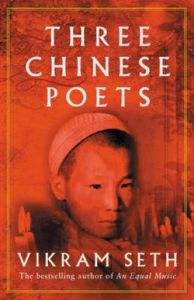
The three poets are from the Tang period - Wang Wei, Li Bai, and Du Fu, an age of great cultural leaps interrupted by a disastrous civil war. The Tang dynasty (618-907 AD) was founded by Tai Zong, with its capital at Changan; after his death, an erstwhile concubine became empress as the Empress Wu.
One of her innovations was the inclusion of poetry composition as a compulsory subject in the imperial civil examinations, which until then had dealt mainly with Confucian texts. This measure was to have a profound influence in contributing to the remarkable reflowering of peotry in the next generation. - intro, p.xiv
The Tang era is considered the golden period of Chinese poetry, and particularly well-known is the collection 300 Tang Dynasty poems, a text often prescribed in Chinese syllabi. (fulltext: U.Virginia etext)
The three poets lived under the emperor Ming Huang, and lived through the period of the rebellion by the general An Lushan (of central Asian Tujue-Turkish ancestry), who occupied the capital for some time, splintering many other rebellions across China. Eventually the rebellion was crushed, but at the cost of 10 million lives. The Tang dynasty limped on for another 150 years.
The three poets are stereotyped as Wang Wei: Buddhist recluse; Li Bai: Taoist
immortal; and Du Fu as Confucian sage.  While such a characterization is
perhaps "unsuitable and artificial, but it can act as a a clarifying
approximation for those approaching Chinese poetry for the first time."

Seth is attempting to faithful to the originals:

 	There is a school of translation that believes that one can safely
	ignore many of the actual words of a poem once one has drunk deeply
	of its spirit.  An approximate rendering invigorated by a sense of
	poetic inspiration becomes the aim.  THe idea is that if the final
	product reads well as a poem, all is well: a good poem existed where
	none existed before.

	I should mention that the poems in this book are not intended as
	transcreations or free translations, in this sense, attempts to use
	the originals as trampolines from which to bounce off on to poems of
	my own.  The famous translations of Ezra Pound, compounded as they
	are of ignorance of Chinese and valiant self-indulgence, have
	remained before me as a warning of what to shun. -intro: xxv

but the originals are extremely nuanced by the conventions of middle
Northern Chinese, a language that is lost today.  The stylized world of
these poems are a far cry from attempts to recover their meanings from
single-word articulations of the chinese radicals.

These poems are however, among Vikram Seth's finest work. (see excerpts
from his Collected poems).
Excerpts
Living in the hills: Impromptu Verses : Wang Wei
I close my brushwood door in solitude
and face the vast sky as late sunlight falls.
The pine trees: cranes are nesting all around.
My wicker gate: a visitor seldom calls
The tender bamboo's dusted with fresh powder.
Red lotuses strip off their former bloom.
Lamps shine out at the ford, and everywhere
The water-chestnut pickers wander home.

Literal analysis (from intro, p. xxiv):
	lonely, close, brushwood, door
	vast, face, falling, light
	cranes, nest, pine, tree, everywhere
	men, visit, wicker, gate, few
	tender, bamboo, hold, new, powder
	red, lotus, shed, old, clothes
	at the ford, lantern, fire, rise
	everywhere, water-chestnut, picker, return home.

This is a traditional octet form, more "commonly used of all forms for
several centuries -- more standard even than the sonnet in Europe":
   - Fixed number of syllables per line - either five or seven
   - 2nd, 4th, 6th, and 8th lines rhyming.  Sometimes 1st as well, as in the
     example poem above by Wang Wei
   - a prescribed sequence of tones for successive syllables.  This last "set
     up expectations and provided musical satisfactions that are impossible
     to provide in a non-tonal lg like English.

Of course all this structure is lost in translation, though Seth tries some
rhyming here and there.
Deer Park by Weng Wei, p. 3
Empty hills, no man in sight
Just echoes of the voice of men.
In the deep wood reflected light
Shines on the blue-green moss again.

(alternate translation: Witter Bynner & Kiang Kang-hu (1929):

	There seems to be no one on the empty mountain...
	And yet I think I hear a voice,
	Where sunlight, entering a grove,
	Shines back to me from the green moss.

and Kenneth Rexroth:

Empty hills, no one in sight,
only the sound of someone talking;
late sunlight enters the deep wood,
shining over the green moss again.

(see 26 translations of this poem at zfrans.com)

[Note Seth's use of broken, cut-up sentences, clearly it's
 deliberate (contrast the fluid flow in his Golden Gate, say).
 Surely a stylistic attempt to capture the short cryptic nature of the
 originals?  see also the style in Florence Ayscough's translation (of
 another poem) below. ]
Moonlit Night by Du Fu, p.37
In Fuzhou, far away, my wife is watching
The moon alone tonight, and my thoughts fill
With sadness for my children, who can't think
Of me here in Changan; they're too young still.
Her cloud-soft hair is moist with fragrant mist.
In the clear light her white arms sense the chill.
When will we feel the moonlight dry our tears,
Leaning together on our window-sill?

(see 48 other translations)
Translation Comparisons
Consider the Du Fu poem, lǚ yè shū huái [旅夜書懷], one of his  rightly
famous, from the comparative survey by Ray Brownrigg.
Thoughts While Travelling at Night : Du Fu
Light breeze on the fine grass.
I stand alone at the mast.
Stars lean on the vast wild plain.
Moon bobs in the Great River's spate.
Letters have brought no fame.
Office? Too old to obtain.
Drifting, what am I like?
A gull between earth and sky.
			 p.35

We may consider some alternate translations; here's Kenneth Rexroth:

	A light breeze rustles the reeds
	Along the river banks. The
	Mast of my lonely boat soars
	Into the night. Stars blossom
	Over the vast desert of
	Waters. Moonlight flows on the
	Surging river. My poems have
	Made me famous but I grow
	Old, ill and tired, blown hither
	And yon; I am like a gull
	Lost between heaven and earth.
A Traveller at Night Writes His Thoughts
	tr. Florence Ayscough, from _Tu Fu: The Autobiography of a Chinese
	Poet_, A.D. 712-770 (2 Volumes) (London: Cape, 1929, 1934)

Fine grass; slight breeze from bank;
High mast; alone at night in boat.
Over level widening waste stars droop-flowers;
Moon flows as water on vast surging stream.
Fame! is it manifest by essays, poems?
An official, old, sick, should rest.
What do I resemble, blown by wind blown by wind?
A gull on the sand between Heaven and Earth.
A Sojourner's Even Song
		tr. Tao, Tommy W. K. (www.taosl.net/tao/yq00712.htm)

Frail grass, soft wind, at the shore;
Tall mast, lone boat, in the eventide.
Stars dangle o'er the plain so vast;
Moon surging on the river wide.
Will I be known for my writings alone?
One should serve until one dies!
Drifting, drifting, what's it like?
A single sand gull 'twixt the earth and skies.

(original rhyme scheme: ABCBDBEB; here ABCBDEBE]
Thoughts while night traveling
	tr. Tony Barnstone & Chou Ping
	(www.7beats.com/200612017beatsarchive.html)

Slender wind shifts the shore's fine grass.
Lonely night below the boat's tall mast.
Stars hang low as the vast plain splays;
the swaying moon makes the great river race.
How can poems make me known?
I'm old and sick, my career done.
Drifting, just drifting. What kind of man am I?
A lone gull floating between earth and sky.
Thoughts while mooring at night
	unknown (dictionary.jongo.com/lesson/detail/318.html)

Riverside grass caressed by wind so light,
A tall lonely mast seems to pierce the night.
The boundless plain is fringed with stars hanging low;
The moon upsurges with the river on the flow.
Will fame e'er come to men of letters mere?
Old, ill, retired from office, I feel drear.
Drifting along, what do I look to be?
A wild gull seeking shelter on the sea.
literal translation
	 ([www.bopsecrets.org/gateway/passages/tu-fu.htm|Alexander, Mark]):
旅夜書懷    lǚ yè shū huái            Nocturnal Reflections While Traveling

細草微風岸  xì cǎo wēi fēng àn,       Gently grass soft wind shore
危檣獨夜舟  wēi qiáng dú yè zhōu.     Tall mast alone night boat
星垂平野闊  xīng chuí píng yě kuò,    Stars fall flat fields broad
月湧大江流  yuè yǒng dà jiāng liú.    Moon rises great river flows
名豈文章著  míng qǐ wén zhāng zhù,    Name not literary works mark
官應老病休  guān yīng lǎo bìng xiū.   Official should old sick stop
飄飄何所似  piāo piāo hé suǒ sì,      Flutter flutter what place seem
天地一沙鷗  tiān dì yī shā ōu.        Heaven earth one sand gull

links: review by E.A. Lombardi
	 wikipedia

---blurb:
The three Chinese poets translated here are among the greatest literary
figures of China, or indeed the world. Wang Wei with his quiet love of nature
and Buddhist philosophy; Li Bai, the Taoist spirit, with his wild, flamboyant
paeans to wine and the moon; and Du Fu, with his Confucian sense of sympathy
with the suffering of others in a time of civil war and collapse.These three
poets of a single generation, responding differently to their common times,
crystallise the immense variety of China and the Chinese poetic tradition
and, across a distance of twelve hundred years, move the reader as it is rare
for even poetry to do.
Send your jottings to Book Excerptise
to contribute some excerpts from your favourite book to
book
excerptise. send us a plain text file with
page-numbered extracts from your favourite book. You can preface your
extracts with a short review.
email to (bookexcerptise [at] gmail [dot] com).
bookexcerptise is maintained by a small group of editors. comments are always welcome at bookexcerptise [at] gmail. This article last updated on : 2014 Jan 15