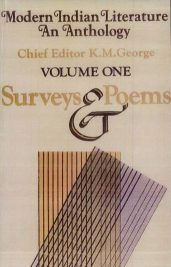
Modern Indian Literature, an Anthology: v1: Surveys and poems
K. M. George (ed)
George, K. M. (ed);
Modern Indian Literature, an Anthology: v1: Surveys and poems
Sahitya Akademi, 1992, 1148 pages
ISBN 8172013248, 9788172013240
topics: | poetry | india | anthology
Book Review
This politically constrained volume is a very poor reflection of poetry in India. If you come to this book unfamiliar with Indian literature - you'll end up with a thoroughly negative impression of the modern literatures of India!!
Sadly, the intention of the book was precisely the opposite. But this volume is the product of that accountability-less indian government body called sAhitya Akademi, and the selections are banal, bland, and constrained to reflect the literatures in the many official languages of india, whatever be the quality of the translations.
However, if you don't speak all 20 languages of India :) -- 18 in the Eighth Schedule, plus Hindi and English - and are really keen to get a flavour of the literatures of India and are not going to be stopped by having to step through some execrable translations along the way, and if you're ok with a definition of "modern" that stretches to the mid-1800s --
so long as at least some voices are post 1950 - well, then this book may still do something to reveal the flavour of some Indian language literatures. Surely no other book comes anywhere close in terms of range.
For me personally, I was able to wade through about half of the poetry pages, since I came with low expectations, and soon reduced them dramatically lower. For example, the Gujarati and Malayalam sections I found to be quite a revelation, though every poem was marred by the sudden dissonance of a phrase or so... Nonetheless, if it wasn't for this book, names like Suresh Dalal (Gujarati) or B.B. Agarwal (Hindi), would have remained completely outside my sphere.
How to read this book: Keep expectations very very low
To begin with, the poetry is far from "modern".  compiled in the 1990s, I
see little need to include poets from the 1870s.  Secondly, the Surveys
part of the book is completely useless.  I read the Assamese, Bengali and
English sections, and found little of interest.  Go straight to where the
meat is, though it may be a bit rancid.

So, the the poetry section disappoints completely, both in terms of
selection and translation.  The translations chosen (or executed for this
project) are uniformly poor and unpoetic.  Instead of showcasing Indian
literature for the world, these translations serve the neo-colonialist
position, that the best Indian literature is getting written in English,
which is definitely the best section (though I wish it had omitted all those
cobwebbed pre-independence authors).  The English section has the merit that
here we can hear the poets voice directly, without interlocutors...

Recently, the position that Indian regional writing is inferior to Indian
writing in English was controversially made by Salman Rushdie in his
introduction to Rushdie and West's Mirrorwork: 50 Years of Indian Writing
which includes only one piece in translation (a story by Minto).  In the
introduction, Rushdie justifies the title "Indian writing" despite this
exclusion:

	Prose writing — both fiction and non-fiction — created in this period by
	Indian writers working in English, is proving to be a stronger and
	more important body of work than most of what has been produced in
	the '16 official languages' of India, the so-called 'vernacular
	languages', during the same time; and, indeed, this new, and still
	burgeoning 'Indo-Anglian' literature represents perhaps the most
	valuable contribution India has yet made to the world of books.

Indeed, the naive reader, reading this selection from Sahitya Akademi,
India's official literature-promotion agency, could surely reach the same
conclusion.  In fact, it seems that the book bends over backwards to render
such a claim believable.

However, approaching the poems with a forgiving eye towards the workmanship
in the translations, one may well get a sense of a poetic spirit lurking
somewhere far below the words, and a murky poetic intentionality can be
sensed.  Another point is that unlike in some other translations, at least
the original titles of the poems are always included.  The headnotes for
each poem, introducing the poet, and finally the poem, are actually quite
good, and would have been served very well by better translations.  The
editing on the whole is solid, especially given Sahitya Akademi standards.

Also, the very attempt to bring such a diverse set of poets under the same
cover is quite laudable.

But it remains a fact that the main content disappoints, and disappoints
badly.
Pathetic translations
To study the quality of translations, let's look at a poem from a
literature that i have no knowledge of - Gujarati.  consider the poem,
chhello kaToro by Zaverchand Meghani (1897-1947).  The translation by
Shirin Kudchekar opens:

	Drink up this last goblet of poison, father!
	Consumer of the ocean! Do not spill any as a libation!

reading this I immediately felt that the poem would have been served better
if the word goblet was simply cup, (or even omitted). the reference to the
ocean, and "spill as a libation" is unclear.  in fact, i am not very happy
with the word "libation" - there is something anachronistic about it, as in
an orientalist translating a vedic verse.  despite all its weaknesses of
English expression, one can still sense some power behind this poem.
In fact, I found this translation elsewhere:

	Even as you know the futility of your mission
	O Bapu
	Drink this last cup of poison
	You, who have drank oceans of poison served by the British,
	Do not throw away this spoonful
		(comment on news by hemen parekh)

by translating Bapu as "father", what a disservice is being done to the
poem!!  though the headnote records that this poem was written at the time
of Gandhi's departure to attend the Round Table at London in 1931, poetry
thrives on images, and the generic "father" decimates the power of Bapu,
the affectionate name for Gandhi, which literally means "father", but is
clearly much more than merely father here.

the rest of the translation is quite unreadable.  but as noted, one can
sense some of the original's power, e.g. in the last
lines (I have replaced father with Bapu, and put some excesses of the
original in square brackets):

	Go Bapu, tame the maddened bull
	Go, sprinkle water-drops on a world bent on slaughter,   	[the]
	Go, build a bridge over the seven seas.

	Lighting a path through the pitch-dark forest,
	Stroking the mane of the fierce lion,
	Go ahead, it is God who is your guide,
	Bapu, drink up this last poison.  			[goblet of]
Poor selection
In addition to the poor translations, the selections themselves are rather
mediocre.  in other cases, even strong voices are emasculated by
inept translations.

The poor quality arises at least in part because the Akademi operates under
severe political constraints - it has to produce translations from all the
official languages of India,  the 22 languages listed in the eighth schedule.
Some languages such as Bodo and Santhali were added to the Schedule after
this book, and are not listed here.

All the major languages of India - say languages with more than 30 million
speakers - have flourishing literary histories.  Also, several smaller
languages - e.g. Manipuri (1.5mn), Kashmiri (5.5) or Maithili (12mn), have
had a long literary tradition, especially in poetry, though some of these
traditions, e.g. Maithili, is more in the past than in the present.

Today, these smaller languages are increasingly challenged.  For example,
in Kashmiri, the main cultural group that carried the literary tradition
were the Kashmiri Pandits - a Brahmin cultural elite in a largely Muslim
valley.  Since the violent expulsion of the Pandits from the valley in the
1970s, the new generation of Pandits does not learn Kashmiri in school, and
literary output has weakened.  Similarly, Maithili, spoken in Eastern
Bihar, was a major literary language many centuries back, and though widely
spoken, it is today increasingly under the sway of Standard Hindi which is
what is taught in schools.  Languages such as Manipuri are increasingly
fragile with the elite population using more and more English, while other
cultures such as Dogri (2.5mn) is increasingly under the sway of Hindi.

However, stable literary traditions continue in the major languages:
Hindi (400mn), Bengali (83mn), Telugu (74mn), Marathi (72), Tamil (61), Urdu
(52) Gujarati (46), Kannada (38), Malayalam (33), Oriya (33mn*), Punjabi
(29mn*).  Assamese (13m) is also a strong literary tradition.
   [* = these populations are those within India, not including
    	  others who speak these languages in Pakistan, Bangladesh, Nepal, etc. ]

This volume, with its charter of devoting an equal number of pages to
every language, has to deal with this inequality of output.  However, even
within these constraints, the best of any particular literature could have
been highlighted through proper translations, but this has not happened.
It is also quite plausible that local bosses of the various state literary
organizations - who are often identified based on political patronage -
were the ones whose work is disproportionately represented.

Another point I observed is the lack of women poets, they constitute
perhaps 5% of the poets listed.
Selections in this volume
As a case in point, we may consider the assamese section; the only poet
with two poems is Devakanta Barooah, who was the president of the Indian
National Congress during the emergency, and his largest claim to fame
(?notoriety) is his resolute sycophancy - he is the one who said "India is
Indira, Indira is India".  Not that he is a bad poet; he produced a single
book of 35 poems, sAgar dekhisa, which is quite well regarded.  But
perhaps others like Nilmani Phukan have a far stronger reputation.  see Dev
Kant Barua bio at facebook

I laboured through the assamese sections - assamese has a strong poetry
tradition.  the only poet i had heard of though, nilamani phukan, was
poorly translated by D.N. Bezboruah, who seems to have done most of the
assamese section.  For another poem by Navakanta Barua I found a somewhat
more readable translation by Pradip Acharya on the web , see below) which
is tighter and in places clearer than that of Bezboruah - but neither
manages to convey any power.

As a random test, I tried searching for poems by most of the names that have
more than one poem.   Two poets have four poems each - Tagore and the
completely unheard Madhav Borcar.  Either there are too few Konkani readers,
or Borcar is simply not in that class.  Or is this someone who had political
connections, in the late 80s Goa?

Someone like faiz has only one poem.  Indeed, the Urdu section deserves
better treatment.  The editors (presumably those who wrote the surveys) are
generally academics and not noted poets themselves.

Flipping through the Telugu section, I ran into this translation in rhyme:
	If men be weak all along
	How can the country be prosperous?
	Learning fast all the arts,
	Produce goods indigenous.

This poem, deshabhakti, by Gurajada Apparao, may have stirred its readers
in 1910, but the sentiments are surely no longer "modern" in 1992?  And as
for the English rendering it seems more like a schoolboy effort.

It is sad when you think of political connections while reading an anthology
of poetry.  Sahitya Akademi - do something!!
Excerpts
Devakanta Barua b.1914 : Manorama p.449
	                [assamese manoramA 1945, tr. Pradip Acharya ]

In your eyes the haze of dreams
The immaculate shade of the moon in your face
In your breath the whiff
Of a tender blade of grass

Who is it that put
The dark moonless nightsand
In your flowing black hair?
In your voice the dove coos
Haunting and distant

The breath of early summer
In your smile
Makes the river surge over   	[?Kolong]
And the hyacinths bloom.

Your fingers like champak buds
Your arms two lotus stems
Thrilling to the loom-batten
Heaving, restive like the shuttle.

Bonny breasts, ruby lips
Teeth like pomegranate seeds
In the desert of my life, love,
You are the lone stream of poesy.

		This otherwise competent translation is marred by the cliched
		"bonny breasts, ruby lips"; a web version at
		http://www.bipuljyoti.in/poetry/devakanta.html
		has "soft, supple breasts"
Navakanta Barua b.1926 : Silt p.453
	                [assamese palas 1954, tr. Ajit Barua]

The fire of the palAsh is now out
In the forests of sAl and satiyAn
How many dreams of past storm and invasion
have fallen --
Of them who keeps count?

The bones of my grandfather lie
On the banks of the Kolong, Kopili, Diju     		[no "the"]
The wild lily grows out of my grandmother's heart.

What has the cloud said?
Give, give a little more
Give till all is given
Plant a sapling by the road, start a school,
My beloved is a wayfarer forever on the road,
Heave a sigh for him.
Let water speeding from the roof
Wash away the shells of dead spiders
Let our silt make fertile the banks of the Kolong.

In the furrows
Of our grandsons' new settlements
We shall wake,
In our fossils they will read
The comic tales of those
Who remember their past births.
In the gutters of dream-blind alleys
where we live
is their future.
             [ Translated by Ajit Barua ]

link: seven poems translated by Pradip Acharya at
	http://www.bipuljyoti.in/poetry/navakanta.html
Sudhindranath Datta 1901-1960: Ostrich p. 503
	[bAnglA uTpAkhI (camel-bird), 1937, tr. poet]

You hear me well : and yet you try
To hide within the desert's fold.
Here shadows shrink until they die,
While dead horizons cannot hold,
The quick mirage, and never near,
The cruel sky is mute and blue.
The hunter stalks no phantom deer;
He loses all by losing you.
The sands are heedless. Why run on,
When tell-tale footprints point the way?
Your pre-historic friends are gone,
And, all alone, you stand at bay.

By brooding on a broken egg
You cannot hatch or make it whole:
The self-consuming hunger's peg,
You play in void a dual role.
Become, instead, my wilful ark
Upon the chartless seas of sand;
For danger you may refuse to mark,
Although you know the lie of land.
Come let us seek a new retreat,
Enclosed in thorn and scorched all through,
Where water trickles, though not sweet;
The earth brings forth a date or two.

No wishful creeper shall I grow
To keep your iron cage concealed,
Nor call hucksters who would know
What price your useless wings should yield.
With moulted feathers I shall make
A fan to suit the anchorite,
But out of fibrils never rake
The dust once raised by stars in flight.
My apprehensions shall prevail:
Your runic cry will not suborn:
For you are not the nightingale
Who lulls to feed on mortgaged corn.

This ruin is our inheritance:
A line of spendthrifts went before;
They picked the pounds, and left no pence:
Now both of us must pay their score.
And so your self-absorption seems
Inept: can blindness cheat a curse?
The present is no time for dreams:
By shunning me you make bad worse.
Let each of us then seal a bond
To serve the other's interest:
You speed me to the world beyond,
While I propose the human test.

	Sudhindranath Datta was born to an elite family (raja subodh basu
  	mallik was his mAmA).  though he did not finish his MA in English, he
  	was for some time professor of comparative literature at Jadavpur
  	University.  His language is somewhat obscure because of the use of
  	uncommon and obsolete words.

	the line from the last stanza is often quoted:
		অন্ধ হলে কি প্রলয় বন্ধ থাকে? "can blindness cheat a curse?"
  	more literally, "will apocalypse wait because of blindness?"

Sudhindranath Datta and Rajeshwari Datta archive at Jadavpur U
http://www.jaduniv.edu.in/view_department.php?deptid=135
	All manuscripts and papers of the poet Sudhindranath Datta and the
	singer and musicologist Rajeshwari Datta were bequeathed to Jadavpur
	University, and are now in the custody of the School. This
	treasure-house of unpublished, and often unknown, material has been
	sorted, identified, conserved and digitised, and a handlist
	prepared. Two volumes of material have been published, of
	Sudhindranath’s Bengali short stories, and his English writings.
Samar Sen : Farewell From Heaven 504
	[bAnglA swarga hote bidAy 1937, tr. Subhas Sarkar]

Even now in the desert of the sky
Night appears like a companionless beast,
When the tramtracks end, also ends the city.

The fragrance of Evening-in-Paris
Faded out on the handkerchief --
O my city, my grey city
Do you ever hear on the Kalighat Bridge
The sound of the libertine's footsteps
Do you hear the sound of time on the move?
O my city, my grey city
When you dance in the crowd of leering people
O Urvashi for a couple of hours, purchased at ten rupees         [rupees ten]
then in the tumult of sarees and country wine
In the heart of the son of Amrita, the soul-bewildered,
Dances the bloodstream
And on the horizon rises the burning moon
O my city, my grey city
Subhas Mukhopadhyay : For a Poem 511
		(bAnglA, ekTi kobitAr janya, 1967, tr. Subhas Sarkar)

A poem will be written. For that
The sky like the blue flame of fire
Rages in anger. The wild tempest
Flaps its wings in the sea, the cloud's smoky mane
Loosens itself; to the call of thunder
The forest stirs, the fear of a fall,
To the spread of roots, endlessly propitiates,
As the lightning looks back
In that light, throughout the region
Bhasmalochan
Sees his own face on the red mirror of blood.

A poem is being written. For him.
A poem will be written. For that
Who are those who fasten on the walls
The manifesto of an unborn day?
Leaving the fear of death on the hangman's nose,
He marches forward,
The air and the sky resound
In his booming voice,
On his fingertips is drawn
The face of the new earth, its endless happiness and love
A poem is being written for him.
In Love: Kamala Das b.1934 : p. 547
Of what does the burning mouth
Of sun, burning in today's
Sky remind me... oh, yes, his
Mouth, and... his limbs like pale and
Carnivorous plants reaching
Out for me, and the sad lie
Of my unending lust.  Where
Is room, excuse or even
Need for love, for, isn't each
Embrace a complete thing, a
Finished jigsaw, when mouth on
Mouth, I lie, ignoring my poor
Moody mind, while pleasure
With deliberate gaiety
Trumpets harshly into the
Silence of the room... At noon
I watch the sleek crows flying
Like poison on wings -- and at
Night, from behind the Burdwan
Road, the corpse-bearer's cry '_Bol
Hari Bol_', a strange lacing
For moonless nights, while I walk
The verandah sleepless, a
Million questions awake in
Me, and all about him, and
This skin-communicated
Thing that I dare not yet in
His presence call our love.
Fragmented : Umashankar Joshi (1911-88) p.572
		Gujarati chhinnabhinna chum 1956, tr. Umashankar Joshi]

I am fragmented -- falling apart --
Like rhythm striving to throb in a poem without metre,
Like a pattern trying to emerge upon a man's life-canvas.
Like bread crumbs in several homes, not yet placed in a beggar's bowl.

Who spoke?  The cuckoo?
This babbling of the nightingales in the groves,
Nature's cultural program on the radio --
What have I to do with it?
I feel like switching it off.

The first days of spring came, then went.
I never even knew.

[...]

Amid the burning scorch of May
A bus rushes on the bridge.
My eyes, behind dark glasses, were closed, as if in meditation.
And yet the slender Sabarmati --
an innocent deer chasing the mirage of eternity --
Sends up from below its cold sharp blade
Which, piercing the solid bridge,
Renews me for a second with coolness
Before the bus, reaching the bridge-end
Falls a fresh prey to the flames of summer heat.

If only this frail pulse, my heart,
Could do so much.  Perhaps it can;
Maybe it cannot --

Day and night I am torn with pain;
Struggling to reach and hold the centre, I am worn out.
Wasting every breath, fragmented;
I am fragmented.
Suresh Dalal : An Age-old Mountain p.576
		[Gujarati, tyare paNa 1975, tr. Suresh Dalal)
In my soul
There is an age-old mountain
Even I have not seen it.
But it is there . . . and there for centuries.

In my eyes
There is an age-old river
Even I have not seen it.
But it is there . . . and there for centuries.

In my feet
There is an age-old tree
Even I have not seen it.
But it is there . . . and there for centuries.

One day the mountain will collapse
One night the river will be on fire
In one season the tree will blossom ...

Even then I may not be there to see it.
Sitanshu Yashasohandra: Drought p.579
	tr. Saleep Peeradina, Jayanta Parekh, Rasik Shah and
	Gulam Mohammed Sheikh

... And yet --

What is thirst?
As if dragged from the throat at night,
it lay crumpled, a late-morning bedsheet,
on dust-coated brows; thirst pushed
itself into nostrils; raw thirst sat on parched
lips, passed through, forcing itself
deep into the gullet, then gushed from the
navel...

[...]
A million ants from the foundations of this house
will cover rooms and yawning terraces like
tongues...

dukAla, 1974
B.B. Agarwal : Without a Body 627
		Hindi; tr. R.O. Swan and C.S. Jossan

This evening when I got home
a very strange thing happened
nobody payed the slightest attention to me.
My wife did not come and ask if I wanted tea,
the children, too, stayed in the other room;
the servant, with great impudence,
went on sweeping the floor
as if I wasn't there.

Well, am I here or am I not?

And then, all of a sudden, awareness
mixed with astonishment.
Where is my body today?
I started to turn on the radio --
my hands were gone.
I began to speak --
no mouth!
As I tried to look --
O God! I had no eyes!
I was thinking - but it seemed that my head was missing.

Well then ...
How did I get home?

Little by little I began to understand:
By mistake I had left my head in the office when I started home.
My hands are still hanging from the bus-strap.
My eyes -- of course, they are back in the office peering into files;
my mouth is stuck to the telephone.
And my feet ... there is no doubt . . . they are still standing in a queue.
So that is how I got home today, without a body.

The concept of a bodiless life, after all,
is the essence of Indian tradition.
But is the weariness
which weighs down this limbless me
also a part of it?
Vallathol Narayana Menon : Father and Daughter p.777
Source: Journal of South Asian Literature, Vol. 15, No. 2, MALAYALAM ANTHOLOGY:  (Summer, Fall 1980), pp. 83-86

Stable URL: http://www.jstor.org/stable/40861163 .

Malayalam; tr.  Kainkkara M. Kumara Pillai

I.

'Go, my son, Sunassepha, and find out the time
    when I could see my venerable guru
    and offer my obeisance;
I will wait in the shade of this ashoka tree,'
    said he in words sweet and sonorous
    as the boom of the big battle drums,
which rose once upon a time, breaking
    the afternoon stillness  of the sylvan hermitage
    of Kashyapa on the slope of Mount Hemakoota.

Hardly had the visiting rishi sought the shade
    of the ashoka, having dispatched his dutiful
    disciple,  when a little  boy ran up to him
    lisping in honey-sweet words,
    'I will take you to my grandpa!'

Who is  this winsome child that could refer
    to Lord Kashyapa as his grandfather?
    Could it be Jayanta? But Indra 's  son should
    be older;  besides, it  is  human majesty
    that is manifest in this boy.

The great sage was more inclined to fold him
    instantly to his chest than to inquire
    as to who he was!

Lo!  The impetuous child has in a moment  dragged
    that liberated soul  down to the earth again!
The hallowed sage bent down and gathered the child
    in his powerful arms and held him close to
    his heart;

On his chest with its deer-skin cross-belt,
    the child beamed like a bright star in a black sky!
Softly drawing aside with one hand the thick
    curly hair rippling down on his shoulders,
    and still  moist with the sweat of playful exertion,
    the holy one pressed his long-bearded face
    against the flower-soft cheek of the child!
The tender shoot of martial glory
    and the hard core of spiritual glory blended
    augmenting  each other to make a fascinating sight!
The boy unhesitatingly rested his head on the
    stranger's shoulder, as  if moved by some
    mysterious kinship!

Did the happy child feel as  if he were being
    fondled by another grandfather?
Or, maybe little  children know not
    the difference between grandfathers;
    any gentle hand can fondle these blossoms.

May I  ask in all  humility, 0 great rishi
    which did you find more delectable:
    the heavenly bliss  inherent in meditation,
    or the bliss you experienced in fondling
    the flower-soft body of this tender child?

The ascetic closed his eyes in the happiness
    of holding the child close to his heart.
As for the boy, his eyes scoring the distance,
    he suddenly started laughing and shouted,
    'Mother, here I  am!'
And hearing that voice sweet as a bell,
    a young woman  suddenly appeared there;
    soiled clothes, a wealth of plaited hair,
    body emaciated but graceful, with no ornaments
    except its  own native grace,
    she looked the very embodiment  of sorrow!

The moment the sage set his eyes on her,
    they started moistening fast;
Perhaps his lips were shaping to say,
    'What change has come over you, Menaka?'
But it was thus that he presently spoke:
    'Who are you, my daughter, who is  the mother
    of this child with the distinct birthmarks
    of an emperor?'
Meanwhile, that son, shouting,
    'Ah! There in the hands of Markandeya		[a playmate, friend]
    is  a painted clay peacock,'
    leaped down from the chest of the rishi,
    wriggled out of his mother's attempted hold,
    and ran away in a desperate hurry!

Watching  the sprint of her son, she heaved
    a deep sigh and repressed her tears with
    great effort, with folded hands, full
    of veneration even surpassing it with love,
    the good lady told the rishi her own story:

'0 liberated soul, I was abandoned in the forest
    by my mother and father on the yery day I was born,
    picked up and fostered by sage Kanva,
    married in secrecy by King Dushyanta;
as for my father, he is  the far-famed Viswamitra!'

'Me!'  The maharishi was astounded!
    0 rishi's daughter, it  is your father
    that is  now speaking to you!
'Ah, yes!  I  remember; Menaka is your mother!

'Why do your eyes well with tears,  you who have
    crossed all  worldly sufferings?'

'I  am blessed by the sight of my father!'
    The sage instantly raised his daughter from the ground,
    as overwhelmed  with happiness,
    she prostrated at his feet:
    he fervently kissed her forehead a hundred times,
    brushed away her tears with his right hand,
    while gently patting her back with the other;
    and also  inquired about the welfare of his son-in-law.

Ah, parental affection, even the ascetic who has
    conquered all  emotions is  swayed by you!

'Darling, what is your name? Tell me, and the name of
    your son?
Wherefore  did you, consort of a great king
    come into this forest?'

A voice sweet as the note of the vina
    quivered out of the handsome woman:
'Father Kanva named me Shakuntala,
    and thy grandson bears the name Sarvadamanan;
    by my mother's blessing, this holy hermitage became
    my lying-in chamber  in the hour of my great sorrow!
When  I was with child, I was sent from the ashram
    by father Kanva, with his love and blessings;
    and when I  reached the palace--'
Unable to bear her grief, she wept. bitterly
    for a while:
'I was disowned by my gentle husband!'
The aspect of that incarnate power of destruction
    suddenly changed; sparks of burning fire
    shot out of his eyes;  his eyebrows arched,
    the brow wrinkled; even the leaves stood still;
    the wind ceased to stir anywhere!

'Who is  this Dushyanta who dares to remain alive
    after having flung my daughter into unbearable shame?
This one hand is  enough to raise men to the heavens
    in the fraction of a second and fling them
    into hell!
Hasn't the king ever heard of the dire
    experiences of Trisanku and Harischandra,
    brought about by Kausika's prowess?
Lo!  Let the world unmistakably  behold once again
    the dread spiritual might of Vishwamitra
    achieved by dint of fierce penance:
Wicked soul, who, having espoused an innocent
    woman  on his  own initiative,  has now
    heartlessly, causelessly abandoned her--'

The mighty Vishwamitra  had started uttering
    these words, placing his right arm clenched
    in anger, on his breast--
    that arm with which, after having forced Brahma
    by the might of his penance to appear before him
    in person, he had extorted from him the highest
    honor--the order of Brahmarishi-
    if only he were to fling it  forward,
    it would spell  the end!
It will become the thunderbolt that would
    annihilate her husband with his entire race!
Fully aware of that dread consequence, she instantly
    clutched that dread missile of destruction
    with both her hands and cried:
'Father, for my sake, forbear! Let not your
    daughter become the destroyer of her husband!
    Let her not be consumed by the fire of dire
    widowhood!
    Abandoned  earlier by her parents once,
    she has now been abandoned freely
    by her husband too;  that is  all!
    Let my life be completely destitute-
    but let not my son too become an outcast
    on account of my sin.'

The fire of his anger having been quenched
    by the tears of his daughter,
    the father, now feeling extremely happy,
    commanded  her:
'Fare thee well!  Your goodness has pulled me
    out of moral ruin;
May you, along with your son, soon join your lord!'


--Edappally Raghavan Pillai : The Bell Tolls, p. 789
			Malayalam; tr. K. Ayyappa Paniker

The tolling bell!  It  is  the sweet knell
Of the day of death!  I am coming!
Let me say my farewell words
To friends who come to see me off.

0 comrades who beat drums
In their minds, hiding themselves in oblivion!
0 world that has no sympathy!
0 autumnal sky that joins me in everything!
0 golden quill,  0 sylvan scenes!
Close partners of mine in the game of verse,
0 cluster of trees thrilled to ecstasy
At my silent song, never so sweet.
1 take my leave now, one lowborn,
A lover born to lament.
Let this earthen lamp, love-bereft,
Lie down lifeless,  cast in the sand!

The graceful garden ground of life,
The camp of repose on the way,
The scaffold that keeps this body for the hawk-
Ah, I was drawn into it  for a while!
In this mansion whose beauty is  enhanced
By plastering grief with a touch of joy.
If you raise your foot a bit,
You are sure to slip  and fall.

Drenched  in the song of simple joy
That comes from a myriad pleasant dreams,
Drunk with the honey of love
That fills  and spills  over every moment,
Drawn to the flower-soft smile
Put forth by those in friendship's garb:
So long like a raincloud
That keeps creeping up the hill
Have I  soared high, swept off the ground
To fathom the depths of the billowy sea!
I have grown callous  seeing bars of iron
Whenever  I opened my eyes!
I am one who became a prisoner
Struck by the dearth of unbroken  love!
The tenement rises to become a palace; -113-
The sea rages to reach the canal ;
If you try to unite the lovers,
Darkness will come to create a split!
The bell tolls!  It  is  the sweet knell
Of the day of death- I  am comingl

From this scene where in every laugh
There scatter the sparks from the pyre,
Good-bye, it  is  enough; let us leave,
Me, my dance and my mute song.
Difficult it  is  for me to sing
In myriad ways in one moment.
It has to reflect the nine moods,
It has to please each and all!
No, no;  this is  quite impossible for me;
Even if my life has to remain incomplete,
After the make-up was completed, for a while
I  stayed in the green room in privacy;
I  tried ever-new styles on many days,
But it was all  to no purpose.
My mind crumbling to pieces for grief
Has to smile and dance in glee there!
My master smacked me on the head
Many a time to make me smile.
How surprising, alas,  0 world,
These lessons in dance are yery strange!
I  shall now take the course in a different school;
I shall change the performing  stage.
The drama of love cannot but end
Without  leading to this splash of blood.

The bell  tolls!  It  is  the sweet knell
Of the day of death!  I am coming!
If there is  a dawn again,
It will come to perform my obsequies.
Why should I,  never separated, go on crying
For grief in this capricious world?
When thoughts of joy have disappeared,
It  is  death to go on living now.

How long can I go on crying at night
From my broken heart with none to care.
0 world without a heart, why should you
Keep asking for a reason for it?
A hundred thousand secrets have I
To sob like this from behind me,
To come flying every day as memories,
To deck my deathbed with tender mango  leaves.
It  is  time for me, the lengthening shadows
Measuring patience, watch all  along. -114-
Over the endless horizon circled by a coral line
All around, in the fullness of love,
Is the golden constellation of the Pleiades
Twinkling  in glory to witness what I do.
Immaculate  she is and so far away,
Yet is she always close by for company.
May the hard times to come never bring
Even a little pain to the glow of her cheeks.

Will every drop of blood
Dripping from my heart's broken walls,
Exhausted  by the repeated batterings
Of the rough and rude rubble of insults,
Inspire the pen that writes love songs?
And if it does, will it bear fruit?
Dilip Chitre : Change
				marathi: Palat 1996; p. 869
   	        all trace of trees
		removed
		the road goes
		terribly straight
		no sign of green
		anywhere

		2

		i love
		both of us love.
		the bed has now
		become strictly white.
		we love
		in a sort of void.
		a hushed
		silence in our bones.
		the blood flows
		freer this way
		and we don't
		measure its temperature.

		the body is born austere,
		and its only excess
		is the soul.
		you love.
		i love.
		both of us love.
		in a light
		that is neither kind
		nor austere.
		we love
		just barely moving
		in a difficult bare awareness.

		3

		let the light
		have the blandness
		of a teenage mother's milk.
		let the room
		be lean
		as at the touch of a lover
		grown old. ...

		two loners embraced
		in the loneliest conjugation.

		4

		not touching the other
		we keep
		each to ourselves.
		what do i know
		what you feelo
		walking barefoot
		on the cold floor
		out of my arms.

		but surely there are
		stars in the sky?

		i don't know, and
		i don't care now.

		out of fear we built
		a ceiling of gestures and symbols
		which now one by one
		i remove.
				[tr. Dilip Chitre]
Sri Sri: National Histories
		telugu: desha charitrAlu 1938
		[some lines tightened in this excerpt]

What is there to be proud of
in any nation's history?
the history of the human race is
exploitation of man by man

the history of human race is
an attempt at collective gobbling up:
the history of human race is
soaked in the bloody streams of battlefields

fraught with gruesome events
a weird dance of sprites:
the history of human race is
persecution of paupers.

the mighty mesmerised
the meek:
homicides hailed in
history as monarchs.

there is no corner of the world today
that isn't a battlefield:
all our past is drenched in blood
or in tears.

families extinct
multitudes of dead,
cries of the helpless
groan on the pages of history

hatred, selfishness,
crokedness, jealousy, rivalries,
assuming deceptive forms and names
define history's drift.

Chenghiz, Tamerlane
Nadir Shah, Ghazni, Ghori,
Sikander, whoever he be,
each one's a champion killer,
...

a bridge of swords across time. [...]
crumbled like a house of cards
with a new history born of forces
converging collectively.

the trickery of the great
the violence of the mighty
the wiles of the rich
how long can they rule the roost?

exploitation of man by man
race by race,
this social milieu
how long can it last?

the rickshawallah in China,
the miner in Czechoslovakia,
the rating in Ireland,
Hottentot, Zulu, Negro

so many races
in every continent
proclaim in one voice
historical forces at work

the queen's legends of love
the expenditire of that siege
of goals, accounts,
these aren't the essence of history.

the irrepressible truth
secreted
in the dark womb of history
now defines its nature

which labourers shouldered
the stones of Taj mahal?
in histories dawns and dusks
which men bear the royal palanquin?

who created what sculpture? what literature?
what science?  which harmony?
what splendour in this great journey?
for what glorious dream? for what victory?

	(tr. Sri M.V.Chalapati Rao)
ghalib (1797-1867): (gham khAne me boda dil-e nakam)
			ghazal 3, urdu; p. 1126

ग़म खाने में बोदा दिल-ए ना-काम बहुत है
यह रनज कि कम है मै-ए गुलफ़ाम बहुत है
gham khane men boda dil-e-nakaam bahut hai
ye ranj ki kam hai mai-e-gulfam bahut hai

[this first stanza is skipped in the version here, roughly]

	this ineffective heart is too feeble to endure the sorrow;
	for that overflowing grief this red wine is also too little
]

कहते हुए साक़ी से हया आती है वरनह
है यूं कि मुझे दुरद-ए तह-ए जाम बहुत है
kahte hue saqi se haya aati hai warna
hai yun ki mujhe durd-e-tah-e-jam bahut hai

	i'm ashamed to
	beg
	the cupbearer --
		but even the dregs
		would be enough
		for me.


ने तीर कमां में है न सैयाद कमीं में
गोशे में क़फ़स के मुझे आराम बहुत है
nai tir kaman men hai, na sayyaad kamin men
goshe men qafas ke mujhe aaram bahut hai

	no arrows aimed at me
	no hunters lurking --
		in the corner of my cage
		i'm at peace

कया ज़ुहद को मानूं कि न हो गरचिह रियाई
पादाश-ए `अमल की तम`-ए ख़ाम बहुत है
kya zohd ko manun ki na ho garche riyai
padash-e-amal ki tama-e-KHam bahut hai

	i can't respect piety,
		even if it's not false
	the half-baked desire
	to win
	rewards
		goes so deep.
		;

हैं अहल-ए ख़िरद किस रविश-ए ख़ास पह नाज़ां
पा-बसतगी-ए रसम-ओ-रह-ए `आम बहुत है
hain ahl-e-KHirad kis rawish-e-KHas pe nazan
pabastagi-e-rasm-o-rah-e-am bahut hai

	why are the learned
	proud --
	and of what?
		all they do is follow
		well established paths.


ज़मज़म ही पह छोड़ो मुझे कया तौफ़-ए हरम से
आलूदह ब मै जामह-ए अहराम बहुत है
zamzam hi pe chhoDo mujhe kya tauf-e-haram se
aaluda-ba-mai jama-e-ehram bahut hai

	leave me here by zamzam
	why should i
	take the trouble
		to walk around
		the kabah?
	my pilgrimage robe
		is too deeply stained with wine.


है क़हर गर अब भी न बने बात कि उन को
इनकार नहीं और मुझे इबराम बहुत है
hai qahr gar ab bhi na bane baat ki un ko
inkar nahin aur mujhe ibram bahut hai

[translation of this verse is skipped]


ख़ूं हो के जिगर आंख से टपका नहीं अय मरग
रहने दे मुझे यां कि अभी काम बहुत है
khun ho ke jigar aankh se Tapka nahin ai marg
rahne de mujhe yan ki abhi kaam bahut hai

	my heart hasn't turned to blood
	or dripped away in tears,
		oh death.
	leave me here --
		i have a lot to do yet


होगा कोई ऐसा भी कि ग़ालिब को न जाने
शा`इर तो वह अचछा है पह बद-नाम बहुत है

hoga koi aisa bhi ki ghaalib ko na jaane
shaer to wo achchha hai pe badnam bahut hai

	can there possibly be anyone
	who doesn't know ghalib?
	he's a good poet no doubt
	but he has
		a bad reputation.

			[tr. Frances W. Pritchett]

also see:
	* FWP's amazingly detailed website
	* beautifully rendered word by word translation rekhta.org
Balraj Komal (1927-2013): The paper boat
			Urdu kAgaz ki nAo, 1959; p.1143

Sleepy in bed, my little son asked
Difficult questtions
About the moon and the distant stars
His two balloons and the black cat
Prescribed a glass of water for his ailing elephant.
I wove a tale for his rambling mind
In the middle of it he fell asleep.

At midnight
Some feeble words
Like raindrops from floating clouds
Descended on a scrap of paper
In front of me
And formed the elusive impression of a poem
I thought I might create;
Towards morning, the light drizzle
Turned into a heavy downpour
The patter of rain
Like a weird lullaby
Soothed me to sleep.

In the morning
bright flowers
Of gay laughter and shouts of boisterous children
Blossomed everywhere --
The overnight rain had formed a lake:
Small paper boats floated across its rippling waves;
The scrap of paper, the familiar words, the elusive lines,
I knew them at a glance --

The little one shouted:
"He who doesn't clap his hands today
Is a fool."
		[tr. Balraj Komal]
Alternate translation : Leslie Lavigne and Baidar Bakht
		http://www.oocities.org/kavitayan/balraj.html

Last night, drifting off to sleep,
My little son asked me :
Why is the moon so far away ?
Why do the stars shine ?
Two balloons ...
What happened to the black cat ?
Give my elephant some warm water.
Tell me that story. I'm so sleepy ...

Through midnight's floating clouds,
Some frail words fell in the shape of drops
On the piece of paper in front of me,
The tale of my eyes and heart,
Stretching over countless years,
Slept in the lap of night,
Perhaps to the lullaby of the pouring rain

In the morning,
Bright flowers of children's cheerful shouts and laughter
Blossomed everywhere
Floating in the lake of last night's rain,
Among the fleet of tiny, wobbly ships
I saw my son's dear little boat.
The elusive form of the poem,
Familiar piece of paper,
Familiar words.
My little boy was calling out :
Anyone who doesn't clap his hands today
Is nothing but a fool.


Carlo Coppola: Echoes and Exuberances: Baidar Bakht’s
	Recent Translations of Urdu Poetry

describes this poem:
	  Here the small son of the speaker, also a poet, asks his father the
	  same litany of answerless questions with which every parent is
	  inflicted by a child wishing to avoid going to bed: “Why is the
	  moon so far away?,” etc. Finally, the child falls asleep and the
	  speaker writes a poem. The next morning children are happily
	  shouting, sailing “the fleet of tiny, wobbly ships” “in the lake of
	  last night’s rain.” His son’s boat is made of “The elusive form of
	  the poem, / Familiar piece of paper, / Familiar words.” If that
	  isn’t enough, the child calls out, perhaps to add insult to injury,
	  perhaps to put everything, including the ruined poem, into proper
	  perspective: “Anyone who doesn’t clap his hands today / Is nothing
	  but a fool.”


links
   * critique by Shamsur Rahman Faruqui : pdf
   * poems at kavitayan
Contents
Foreword :  B.K. BHATTACHARYYA v
Publishers Note :  INDRA NATH CHOUDHURI vii
Selection Committee ix
Preface : K.M. GEORGE	 xi
Guide to users: pronunciation and transliteration :  xxvii
General Introduction :  K.M. GEORGE	 1
I. Surveys
Assamese : SAILEN BHARALI   					        55
Bengali : AJIT KUMAR GHOSH         				        71
Dogri : SHIVANATH       					        95
English : L.S. SESHAGIRI RAO       				       107
Gujarati : DEEPAK B. MEHTA  					       120
Hindi : R.C. PRASAD     					       144
Kannada : K. NARASIMHA MURTHY     				       167
Kashmiri : P.N. PUSHP       					       191
Konkani : MANOHARRAI SARDESSAI    				       205
Maithili : JAYAKANTA MISHRA        				       219
Malayalam : AWAPPA PANIKER   					       231
Manipuri : IROM BABU SINGH  					       256
Marathi : SUDHEER RASAL    					       264
Nepali : KUMAR PRADHAN   					       285
Oriya : JATINDRA MOHAN MOHANTY 				       297
Punjabi : S.S. KOHLI       					       320
Rajasthani : RAWAT SARASWAT   				       342
Sanskrit : K. KRISHNAMOORTHY       				       355
Sindhi : MOTILAL JOTWANI         				       364
Tamil : NEELA PADMANABHAN      				       378
Telugu : C.R. SARMA      					       401
Urdu : SHAMSUR RAHMAN FARUQI 					       420
II. Poems
Assamese
  A Letter from My Sweetheart : HEMACHANDRA GOSWAMI 		       445
  The Unconquerable : CHANDRA KUMAR AGARWALA 			       446
  The Supreme Thirst : NALINIBALA DEVI 			       447
  Two Poems: : DEVAKANTA BAROOAH [Barua]
      Manoroma 						       449
      And We Open the Gates 					       450
  The Boatman Rows Downstream : JATINDRA NATH DUWARA 		       451
  Silt : NAVAKANT BARUA 					       453
  The Sea Scare : HAREKRISHNA DEKA 				       454
  Jengrai 1963 : AJIT BARUA 					       456
  The Setting Horizon : HIRENDRANATH DUTTA 			       457
  The Laments of Darkness : AMULYA BARUA 			       459
  Poignant : NIRMAL PRABHA BARDOLOI 				       462
  Sound of the Flute : HIREN BHATTACHARYA 			       463
  Lily's Afternoon : BIRESWAR BARUA 				       463
  She Pursued Me. . . : NILAMANI PHOOKAN 			       464
      (see bio at poetryinternational.org)
  The Transparent Voice : BHABEN BARUA 			       465

Bengali
  The Slaying of Meghanada : MICHAEL MADHUSUDAN DUTT 		       466
  Hymn of the Auspicious Sarda : BIHARILAL CHAKRAVARTI 	       475
  Four Poems: : RABINDRANATH TAGORE
      The Golden Boat 					       480
      Urvashi 						       481
      Holy India 						       484
      A Flight of Swans 					       486
  The Rebel : NAZRUL ISLAM 					       487

  	I am ever-uncontrollable, rude and ruthless,
  	I am the dancing deity causing the world's doom
  	I am a cyclone, I am destruction
  	I am the Great Terror,
  	I am the curse of the world
  	       I am irresistible,
  	I crush everything into pieces...

  The Pessimist : JATINDRANATH SENGUPTA 			       493
  A Prisoner's Adoration : BUDDHADEVA BASU 			       495
  The Wayfarer : MOHITLAL MAJUMDAR 				       498
  Camel-Bird : SUDHINDRANATH DATTA 				       503
  Farewell From Heaven : SAMAR SEN 				       504
  Invocation : SUKANTA BHATTACHARYA 				       506
		(bodhan, tr. Subhas Sarkar)
  Banalata Sen : JIBANANANDA DAS 				       509
  On This Shore : AMIYA CHAKRAVARTI 				       510
  For a Poem : SUBHAS MUKHOPADHYAY 				       511

Dogri
  Milkmaid : DINU BHAl PANT 					       513
  This Little Life : SUDARSHAN KAUSHAL 'NOORPURI' 		       516
  Daybreak : R.N. SHASTRI 					       517
  The Oil-Press : K.S. MADHUKAR 				       519
  A Song : YASH SHARMA 					       521
  The Raja's Palaces : PADMA SACHDEV 				       522
  An Evening in Akhnoor : DHIAN SINGH 			       524
  Two Peaks : CHARAN SINGH 					       525
  The Black Man : VED PAL DEEP 				       527
  Kindling the Latent Love : MOHAN LAL SAPOLIA 		       529
  A Playing Card : NARSINGH DEV JAMWAL 			       531
  I Too Am Not Apart : SARATHI O.P. SHARMA 			       532

English
  Our Casuarina Tree : TORU DUTT (1856-77)529
  Indian Weavers : SAROJINI NAIDU (1879-1949) 		       531
  Savitri Challenges Death : SRI AUROBINDO (1872-1950) 	       532
  Autobiography : DOM MORAES (b.1938) 			       543
  The Exile: Poem No. 1 : R. PARTHASARATHY (b.1934) 		       544
  Night of the Scorpion : NISSIM EZEKIEL (b.1924) 		       546
  In Love : KAMALA DAS (b.1934) 				       547
  The Old Man : P. LAL (b.1929) 				       548
  Small-scale Reflections on a Great House : A.K.  RAMANUJAN (b.1929) 549
  Indian Women : SHIV K. KUMAR 				       552
  Hunger : JAYANTA MAHAPATRA 					       553
  An Old Woman : ARUN KOLATKAR      				       554

Gujarati
  The Message at Death : NARMAD 				       556
  Remembrance : KALAPI 					       557
  Throw Open Your Temple of Bliss : NARSINGHRAO BHOLANATH DEVATIA    558
  Taj Mahal : NHANALAL (Nanalal Dalpatram Kavi) 		       559
  Conquest of Spring : KANT 					       561
  The Last Goblet : ZAVERCHAND MEGHANI 			       566
  As a Flower I Come : SUNDARAM 				       568
  Humming : BALWANTRAI THAKORE 				       569
  Jungle Solitude : RAJENDRA SHAH 				       570
  This Leaning Sky Is Krishna : PRIYAKANT MANIYAR 		       572
  Fragmented : UMASHANKAR JOSHI 				       572
  Bombay City : NIRANJAN BHAGAT 				       575
  An Age-old Mountain : SURESH DALAL 				       576
  Sound Can't Be Dug : LABHSHANKAR THAKER 			       577
  Mira Would Leave Your Mevar : RAMESH PAREKH 		       578
  The Saffron Suns : RAVJI PATEL 				       579
  Drought : SITANSHU YASHASOHANDRA 				       579
  And I Remembered You : HARINDRA DAVE 			       582

Hindi
  A Flower's Wishes : MAKHANLAL CHATURVEDI 			       583
  Silent Solicitations : SUMITRANANDAN PANT 			       583
  Saket : MAITHIU SHARAN GUPTA 				       585
  Kamayani : JAISHANKAR PRASAD 				       597
  Saroj: An Elegy : SURYAKANT TRIPATHI 'NIRALA' 		       601
  Himalaya : RAMDHARI SINGH 'DINKAR' 				       610
  This Is the Lamp of the Temple : MAHADEVI VERMA 		       612
  Building of Nests Again and Again : HARIVANSH RAI BACHCHAN 	       613
  The Facts Will Speak : SHAMSHER BAHADUR SINGH 		       614
  The Night of Ravenous Hair : G.K. MATHUR 			       616
  Freedom of the Writer : KEDAR NATH AGARWAL 			       617
  Pets : PRABHAKAR MACHWE 					       619
  Hiroshima : SACHCHIDANAND HIRANAND  VATSYAYAN 'AGYEYA' 	       619
  Brahmarakshasa : MUKTIBODH 					       621
  Without a Body : B.B. AGARWAL 			       627
  Aquarium : VIJAY DEV NARAIN SAHI 				       628
  Expression : BHAVANI PRASAD MISHRA 				       629
  The Last Testament : SHRIKANT VERMA 			       630
  The Soldier's Letter : SHIV MANGAL SINGH 'SUMAN' 		       630

Kannada
  Madalinga's Valley : MASTI VENKATESHA IYENGAR 		       635
  Gods No More : V. SITARAMAIAH 				       640
  Rangavalli : P.T. NARASIMHACHAR 				       642
  Fog Over Madikeri : G.P. RAJARATHNAM 			       645
  Golgotha : M. GOVINDA PAI 					       647
  Reflections : D.V. GUNDAPPA 				       650
  Dasanana's Vision Fulfilled : K.V. PUTTAPPA 		       651
  The Jogi : D.R. BENDRE 					       656
  The Festival of Dance : PEJAVAR SADASHIVA RAO 		       659
  The Seven-Walled Fort : RAMACHANDRA SHARMA 			       661
  Seat Me Not on Your Throne : K.S. NARASIMHASWAMY 		       665
  Earth Song : GOPALAKRISHNA ADIGA 				       667
  A Leafless Tree : V.K. GOKAK 				       672
  The Transmigration of an Inchworm : A.K. RAMANUJAN 		       674
  A Horoscope of Bombay : G.S. SinYARUDRAPPA 			       677
  The Snake-Charmer Boy : S.R. EKKUNDI 			       678
  The Two Banks : CHENNAVIRA KANAVI 				       680
  Mother : GANGADHAR CHITTALA 				       681
  The Three Faces of Mother : SHANKAR MOKASHI PUNEKAR 	       683

Kashmiri
  The River : ABDUL AHAD AZAD 				       685
  Freedom : GHULAM AHMED MAHJOOR 				       687
  Six Rubaiyaats : MIRZA ARIF 				       689
  To the Bulbul : GHULAM NABI FIRAQ 				       690
  Helplessness : ZINDA KAUL 					       692
  Six Quatrains : G.R. NAZKI 					       694
  Naked Thoughts : AMIN KAMIL 				       695
  Creation : RAHMAN RAHI 					       696
  Night Watchman : VASUDEV REH 				       698
  Daybreak : MOTI IAL SAQI 					       699
  Candy and Artemesia : DINA NATH NADIM 			       700
  Craving : G.R. SANTOSH 					       702
  Dreams : MUZZAFFAR AAZIM 					       703
bookexcerptise is maintained by a small group of editors. get in touch with us! bookexcerptise [at] gmail [dot] .com. This review by Amit Mukerjee was last updated on : 2015 Sep 11